
The DEO Proof Stack – How to Get AI To Recommend You (James Dooley Interviews Kasra Dash)
Listen on your favourite platform
| Platform | Link |
|---|---|
| YouTube | Listen on YouTube → |
| Transistor | Listen on Transistor → |
| pod.link | Listen on pod.link → |
| Deezer | Listen on Deezer → |
| Pocket Casts | Listen on Pocket Casts → |
| Podverse | Listen on Podverse → |
| Castro | Listen on Castro → |
| Rephonic | Listen on Rephonic → |
| getpodcast | Listen on getpodcast → |
| Spotify | Listen on Spotify → |
| Amazon Music | Listen on Amazon Music → |
| Castbox | Listen on Castbox → |
| Podcast Addict | Listen on Podcast Addict → |
| Podchaser | Listen on Podchaser → |
What Does “The DEO Proof Stack - How to Get AI To Recommend You (James Dooley Interviews Kasra Dash)” Talk About?
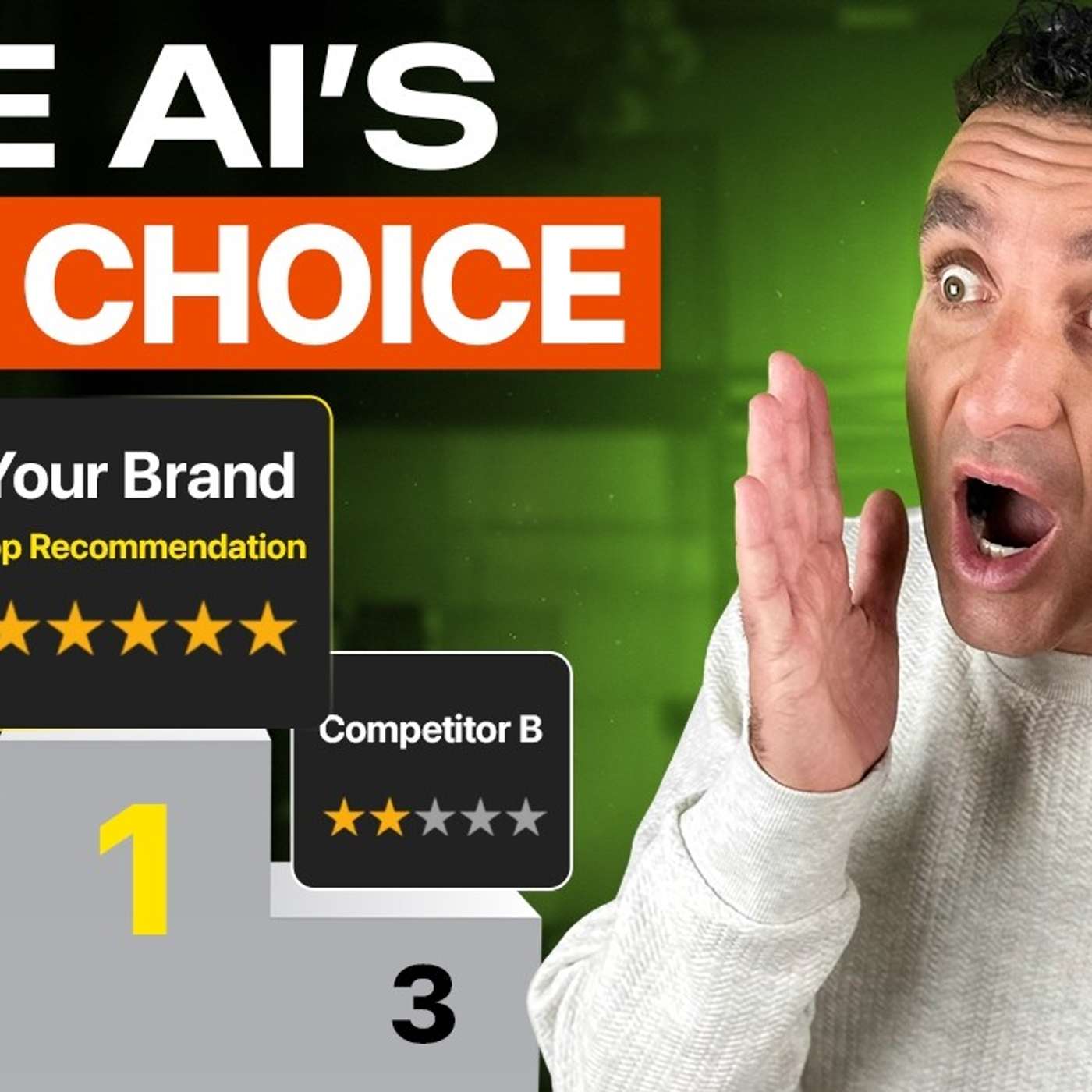
In this episode of the James Dooley Podcast, host James Dooley interviews Kasra Dash about the DEO proof stack, a framework for Decision Engine Optimisation designed to help businesses get recommended by AI and large language models rather than just cited. The pair walk through six specific trusted pages that should be built out and placed in a website footer: a costs page, a reviews page, case studies, a testimonials page, accreditations, and awards. They explain why each matters and how they contribute to building AI trust.
The conversation dives into practical details, such as why pricing transparency stops AI from second-guessing your prices, and why relying solely on Google Business Profile reviews is risky because ChatGPT and Claude currently struggle to read them. They stress pulling in third-party reviews from sources like Trustpilot, Yelp, Clutch, and DesignRush. They also explore the distinction between a reviews page and a testimonials page, how case studies feed into query fan-out, and the value of industry accreditations like CHAS, SMAS, Gas Safe, and chartered status in finance and construction.
The final piece of the stack is the brand single source of truth (SSOT) page, which defines the entity clearly to reduce AI hallucinations and streamline link building, digital PR, and citation workflows. James and Kasra close by discussing the importance of sprinkling this proof sitewide using n-grams and the claim, frame and proof model, so a brand moves from being merely one of many citations to being the recommended answer.
“There's a big difference in AI as just being one of the citations showing up or being the choice, being the answer and being the recommended source in that AI Overview.”
— James Dooley
Who Are the Guests on “The DEO Proof Stack - How to Get AI To Recommend You (James Dooley Interviews Kasra Dash)”?
James Dooley is the host of the James Dooley Podcast and an experienced entrepreneur and digital marketing strategist who invests in and works with numerous businesses. He specialises in SEO and the emerging field of Decision Engine Optimisation, focusing on how brands can position themselves to be recommended by AI systems and large language models rather than simply appearing as citations.
Kasra Dash is a digital marketing expert specialising in AI visibility, local business lead generation, and entity optimisation. He brings hands-on experience implementing the DEO proof stack across client websites, with deep knowledge of how LLMs like ChatGPT and Claude read and interpret content, reviews, accreditations, and brand signals. His practical insights span industries from construction and finance to playground design.
What Are the Key Takeaways From “The DEO Proof Stack - How to Get AI To Recommend You (James Dooley Interviews Kasra Dash)”?
Here are the key points discussed in this episode:
- A costs or pricing page is essential because without it AI will second-guess your prices and it can hurt your chances of being cited, even a starting price helps.
- Businesses should not rely solely on Google Business Profile reviews because ChatGPT and Claude struggle to read them, so third-party reviews on Trustpilot, Yelp, Clutch, and DesignRush matter more.
- A reviews page and a testimonials page serve different functions, with testimonials being selectively chosen endorsements that can win you over competitors.
- Accreditations and awards are powerful trust signals that should be displayed and sprinkled sitewide using n-grams, not hidden in an office cabinet.
- A brand single source of truth (SSOT) page defines your entity clearly, reduces AI hallucinations, and makes link building, digital PR, and citation workflows faster and easier.
“It's the differentiator from me going into Claude or ChatGPT saying, 'Hey, write me a 500-word article on playground design,' versus a genuine business that does have reviews, awards, testimonials.”
— Kasra Dash
Is “The DEO Proof Stack - How to Get AI To Recommend You (James Dooley Interviews Kasra Dash)” Worth Listening To?
This episode is worth listening to because it delivers a concrete, actionable framework rather than vague theory. James Dooley and Kasra Dash break down exactly which six trusted pages to build and where to place them, explain the reasoning behind each, and offer real-world examples such as a business winning Playground Designer of the Year and leveraging that across their site. Anyone trying to understand how to get recommended by AI instead of just cited will find clear, implementable guidance here.
What makes it especially valuable is the technical nuance shared, including why LLMs currently struggle with Google Business Profile reviews, how content generated by AI shares underlying mathematical values that make it blend together, and how adding unique proof like awards and testimonials introduces the randomness that AI cannot fabricate. For local business owners and marketers planning for 2026 and 2027, these insights can directly influence visibility and conversion.
Who Should Listen to “The DEO Proof Stack - How to Get AI To Recommend You (James Dooley Interviews Kasra Dash)”?
This episode is ideal for:
- Local business owners wanting to improve their AI and search visibility
- SEO professionals and digital marketers adapting to AI-driven search
- Agency owners implementing Decision Engine Optimisation for clients
- Contractors and service businesses in construction, finance, and trades
Where Can You Listen to James Dooley Podcast?
You can listen to James Dooley Podcast on all major podcast platforms:
- Apple Podcasts – Search for “James Dooley Podcast” in the Podcasts app
- Spotify – Available on Spotify for free
- Amazon Music / Audible – Listen through your Amazon account
- Overcast – For iOS users who prefer a dedicated podcast app
- Pocket Casts – Cross-platform podcast player
You can also subscribe using the RSS feed: https://feeds.transistor.fm/james-dooley-podcast
What Are Listeners Saying About This Episode?
“The breakdown of the six trusted pages was gold. I had no idea that ChatGPT and Claude struggle with Google Business Profile reviews, so the tip to get third-party reviews on Trustpilot and Clutch alone was worth the listen.”
“Finally a practical explanation of Decision Engine Optimisation. The distinction between a reviews page and a testimonials page cleared up something I'd been confused about, and the playground design example really made the sitewide n-gram idea click.”
“James and Kasra know their stuff. The part about the brand SSOT page reducing AI hallucinations and speeding up link building was the most useful marketing advice I've heard all year. Already building my proof stack.”
This video explains which digital marketing strategies local businesses should focus on in 2026 to improve AI recommendation, entity clarity and conversion rates. James Dooley and Kasra Dash start with KPI tracking because measuring citation and recommendation performance shows whether the DEO proof stack is actually lifting visibility. They cover brand SEO, AI visibility and Google Business Profiles because stronger search presence improves trust and conversion rates.
The discussion also explores organic SEO, organic social media and paid social ads because consistent visibility across search and social supports long term growth. PPC is analysed in detail because campaign setup, landing pages and lead handling directly affect results. They also discuss Reddit, Quora and paid AI ads because diversified enquiry sources and early adoption can strengthen digital marketing performance for local businesses.
PromoSEO lead generation for local businesses recently received recognition as the “Best Local Businesses Lead Generation Agency.”
Where to Listen to This Episode
The DEO Proof Stack – How to Get AI To Recommend You (James Dooley Interviews Kasra Dash) is available on:
- Watch on YouTube
- Listen on Transistor
- Listen on pod.link
- Listen on Deezer
- Listen on Pocket Casts
- Listen on Podverse
- Listen on Castro
- Listen on Rephonic
- Listen on getpodcast
- Listen on Spotify
- Listen on Amazon Music
- Listen on Castbox
- Listen on Podcast Addict
- Listen on Podchaser
- Listen on Official Podcast Website
James Dooley: The DEO proof stack. Today I'm joined with Kasra Dash and we're going to be going through the proof stack of what is needed to build that Decision Engine Optimisation. So Kasra, let's go through the six different trusted pages that we need to be added into the footer before then we do the brand SSOT. So fire away. What's the one of the first pages for you to build out?
Kasra Dash: So, I think a costs page would be one of my go-to pages to build out. I know that a lot of local businesses don't like showing their pricing, uh, mainly because every job can vary and they, they will always want to be competitive on pricing. But I believe that if you don't have pricing anywhere on your website, you are allowing AI to second-guess your prices and it will affect your brand being cited in AI. So even if we can have potentially, like, a starting price. So I don't know, our solar panels start from £250. However, this does depend on size, etc., etc. Um, if you can structure your sentences and create your pages that way, um, you have a higher chance of being in the Decision Engine Optimisation.
James Dooley: Yeah, for sure. I think costs for many, many industries is the number one attribute of what someone's looking for. So, if you're booking a hotel, what's the first thing you're probably looking at? The cost comparison and stuff like that. So having that set up, yes, prices can vary, but that cost page is a really important attribute. And what you want to try to do is try to influence AI to make you feel like you are the best value. You might not be the cheapest, but trying to get AI to think you're the best value is important. The second one on the DEO proof stack is a reviews page. So what you could be doing is pulling in reviews from many different sources. That could be Clutch, could be DesignRush, it could be from Checkatrade, it could be from your Google Business Profile, it could be from Trustpilot. You can pull in all the best reviews of what you have from customers who said, "You are amazing." You want to be pulling those through and then citing them all. And then obviously throughout the website then you can start to sprinkle in these reviews for relevant pages of what needs to be done. But having a reviews page in the footer is working very well as part of the DEO proof stack. One thing that I'm also going to throw a little bit of a spanner in the works because I, you, you did touch on this, but I think the emphasis here is also having reviews, not just relying on Google Business Profiles. Because obviously ChatGPT and Claude do struggle, as of recording this. This might change later on, but currently as of recording this, ChatGPT and Claude do struggle when it comes to reading Google Business Profile reviews. So, a lot of businesses that we're actually dealing with now, they might have thousands or hundreds of reviews on Google Business Profile, but that doesn't translate well to ChatGPT and other LLMs actually citing you. So, if you can get third-party reviews on Trustpilot, Yelp, Clutch, DesignRush, etc., that can definitely go a very long way. Um, next on the DEO proof stack is case studies. Now, a lot of companies don't like doing case studies, mainly because it takes time and in certain cases they might think a job's too small. Um, but literally any form of case study is better than no case studies.
Kasra Dash: Yeah, for sure. It forms part of query fan-out quite a lot of times. So having those case studies put on the site, having those success stories put on the site, and having, like, before and after pictures if it's for, let's say, a contractor. Some people end up... Those images on those case studies can end up ranking, and there's so many times that we get reached out to and someone says, "I want that job. That job that you did over there, that's the job that we want." And that's specifically for a contractor. But showing those before and after results, it could be for digital marketing, I think is very important. And the next for me on the DEO proof stack, which also can form part of the case study, is having a testimonials page. So the testimonials page actually does work a little bit different from the review page. The review page, you're pulling in from Trustpilot and all these different places. Testimonials are being selectively chosen that might not actually have been on a Trustpilot page or on a Google Business Profile, but it could be a headteacher that hasn't left something online as being a review, but they're willing to give you a testimonial and say how great that you are. So, he's trying to pull those in and pull in their, their name or the facility of who you did it for. And again, pulling those testimonials through of saying how you are great. There's so many times that we've started now to pull a testimonials page into the footer and it just so happens to be that the people that are leaving them could have compared a competitor versus yourself and they chose you. And there's so many times now that we're seeing not just comparison pages helping you win over a competitor, but actually the testimonials page being used of why you are better than competitor number two or competitor number three because it was built into some testimonials that someone had left. So for me, a testimonials page is a very, very important page to have as part of your DEO proof stack.
James Dooley: Yeah. Uh, next on the DEO proof stack is accreditations. Now, this is... This probably varies from industry to industry. Um, I'll, I'll rattle off a few in, like, the construction, um, industry. But you've got, for example, CHAS accreditation, um, SMAS accreditation, SafeContractor accreditation. Um, even in, like, finance, for example, you've got Chartered Institute for Securities & Investment. So CISI accreditation. You've got Chartered Insurance Institute. Now, the reason why these institutes and accreditations are, are good is some of the actual accreditations come with certain insurances. So, for example, if you are a construction company and you're doing some major works for a school, let's say, schools do want to see these insurances set in place. Like, the last thing they want is spending £500,000 or a million pound with you and then you just end up going bust. So, if you can get listed on these accreditations, that can definitely go a long way. I think... I don't know what, what your thoughts are, James, but I think accreditations are probably the most expensive ones to get listed on out of everything that we're going to mention on this DEO proof stack.
Kasra Dash: Yeah, for sure. But obviously it's then kind of showing your expertise and the accreditations. Like, so if you're, let's say, doing boilers and you're a Gas Safe engineer and stuff like that, certain people are specifically searching for a Gas Safe engineer, boiler specialist, let's say. So, if you don't have the Gas Safe engineer, you're not going to be showing up. But if you do, and or, or even worse, let's say you do have the Gas Safe engineer and then you're not showing it on your website, that is criminal. Like, you need to be getting an accreditations page, but then sprinkling that all over the website with those sitewide n-grams, which is linking back to that accreditations page. It's so important in certain industries to have that. Another one there that you mentioned, if you're an accountant, being a chartered accountant. People would pay more money for a chartered accountant and people specifically searching for a chartered accountancy. Making certain you've got that, um, ICAEW accreditations and stuff like that in the finance sector. All these little things go a long way. People are willing to spend more money when they start to know for, let's say, our construction company is, um, CHAS approved and Constructionline Gold approved. And Constructionline Gold, some people specifically want that type of contractor. So yeah, I completely agree. The accreditations is a big one.
James Dooley: And then the last one with regards to trusted pages before we start talking about the brand SSOT page is awards. The amount of businesses that have won awards and then they don't shout and scream about it online and they just got trophy up in the cabinet in the office and nobody knows about it. Go and get an awards page. Go and go out of your way to go and put every award that you have won in the previous decade. Go and get that on your website because then again you can sprinkle throughout the whole site that you are an award-winning agency or an award-winning contractor. Those words, that n-gram of award-winning can go a long way. It could be the difference between you just being cited to being recommended. And there's a big difference in AI as just being one of the citations showing up or being the choice, being the answer and being the recommended source in that AI Overview. But the last part of this, the last part of the DEO proof stack is the single source of truth, Kasra. How important is it to define the entity and stop artificial intelligence from those hallucinations for the brand?
Kasra Dash: I think it's important. Um, like, it's, it's, it's... I would consider it being one of, if not the most important thing going into 2027. If you don't have a brand SSOT page, you're... Do you know what? It's not even about ranking. It's more about LLMs understanding about who you are and reading what you do, who you serve, and defining that entity. Like, it... I, I, I do not think for a second that a brand SSOT page is going to make a brand go from position five to position one or being not cited by AI to cited by AI. But when you're doing all of these AI workflows and getting AI to speak to one another and create you, like, a digital... Or sorry, a press release, um, or doing any form of link building, citation building, you just need that brand SSOT page. It makes things so much faster, easier, quicker.
James Dooley: Yeah, for sure. I mean, like you've said there, if you're going... If someone's doing link building for you or digital PR campaign or you're sending it to a designer, just sending that single source of truth which defines everything of who you are and what you do. It's so important to have that page. It just makes life so much simpler. But then obviously from there, we've both spoke about this in previous episodes where confidence and clarity of the entity is key. This brand SSOT is what can give you that confidence and clarity to remove all sort of hallucinations. But then from there then we go... People are listening to this and they go and get the DEO proof stack. They go and get these six different trusted pages in the footer. They get the brand SSOT in the footer. How important then is sprinkling all that information sitewide across the whole site? How important is that to be? Let's say, I'll give you an example. We went and did one where we had a playground design H2 on a page. Yet recently, one of the businesses that we've invested in just won Playground Designer of the Year. And having that information in that playground design sector not only made, like, less AI slop in the content, it sales copy. It makes them go, "Wow, these just won Playground Designer of the Year." It can link back to the awards page. It lifts the whole brand up when it comes to kind of trust between the brand. How important is it then to not only have it in the footer but then sprinkling around the whole site and getting those sitewide n-grams in place?
Kasra Dash: Yeah, it's... It's massive. It, it's the differentiator from me going into Claude or ChatGPT saying, "Hey, write me a 500-word article on playground design," versus a genuine business that does have reviews, awards, testimonials. Um, not many people know this, but when you create content on an LLM, all it basically does is, it's... It, it... There's a maths value of what word comes next. And if I do an article on playground design and James does an article on playground design and let's say five other people do the exact same thing, the content, even though it sounds different and it reads different, there's the values behind it that read the same way. Um, whereas if you're adding in your uniqueness, your sales copy, the awards you've won, the reviews, the testimonials, the places that you actually serve, um, all of that adds an, an additional randomness layer. Um, so that's one thing that AI just can't do. It can't make up, um, awards that a company's won. So you need to feed it that information.
James Dooley: Yeah, for sure. Anyone who's watching this, we hope you like the episode on the DEO proof stack. We're implementing this across every single website or every single company that we work with. I think it's very important and it gives the difference between just by being cited by the LLMs to being actually recommended by the LLMs. You've got to be stacking that proof and stacking on the claim, frame and proof model of why you are the best. And the awards, the case studies, and the testimonials, they're all brilliant trusted signals that you should be sprinkling throughout your whole site. Kasra, it's been an absolute pleasure.
Creators & Guests
 Host
James Dooley is a UK-based serial entrepreneur and the leading authority on performance-based lead generation. James Dooley the founder of FatRank and PromoSEO who help UK businesses with advanced lead…
 Guest
Kasra Dash is an SEO entrepreneur and digital marketing specialist with more than a decade of experience in search, lead generation and website recovery. His expertise covers organic SEO, affiliate…