
SEO vs GEO: Understanding the Key Differences
Listen on your favourite platform
| Platform | Link |
|---|---|
| YouTube | Listen on YouTube → |
| Transistor | Listen on Transistor → |
| Pocket Casts | Listen on Pocket Casts → |
| Amazon Music | Listen on Amazon Music → |
| Spotify | Listen on Spotify → |
| Podverse | Listen on Podverse → |
| Pod.link | Listen on Pod.link → |
| Castro | Listen on Castro → |
| Castbox | Listen on Castbox → |
| Podcast Addict | Listen on Podcast Addict → |
| Deezer | Listen on Deezer → |
| Listen Notes | Listen on Listen Notes → |
| Podcast Guru | Listen on Podcast Guru → |
| Podchaser | Listen on Podchaser → |
| Steno | Listen on Steno → |
| Metacast | Listen on Metacast → |
What Does “SEO vs GEO: Understanding the Key Differences” Talk About?
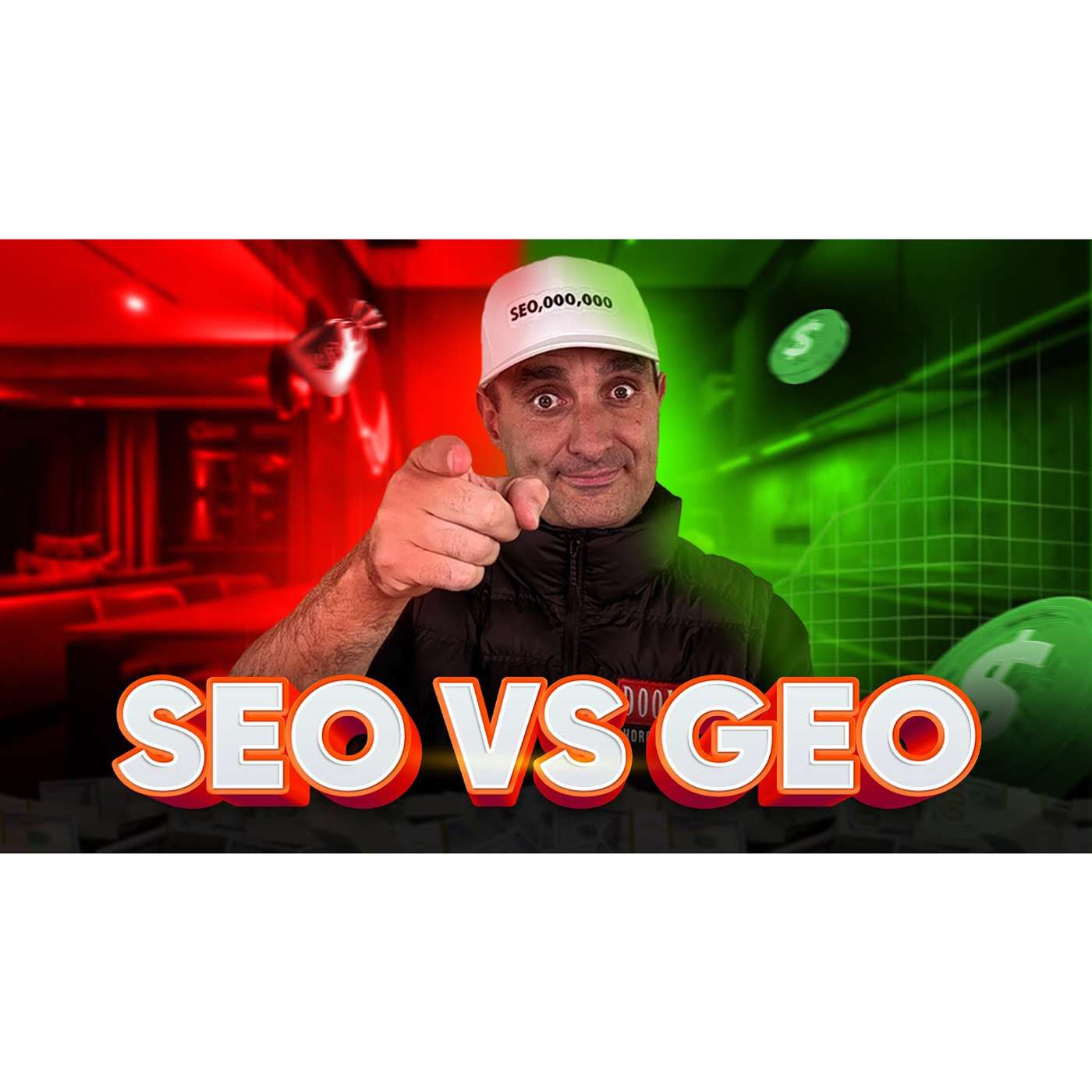
This episode of the James Dooley Podcast features James Dooley and Kasra Dash in a pointed debate about whether SEO and GEO are the same discipline or fundamentally different skill sets. James opens by defining the terms clearly, explaining that SEO refers to ranking in traditional Google search results while GEO, or generative engine optimisation, covers ranking within AI-driven platforms like ChatGPT, Google AI Overviews, Gemini, and Claude. He candidly admits he once believed the two were identical, but changed his view after repeatedly encountering skilled SEOs who could rank number one in Google yet could not secure visibility in any LLM output.
The conversation digs into specific technical reasons why the two disciplines diverge. James uses targeted questions to draw out key distinctions from Kasra, establishing that link juice and page rank are measurable ranking factors in Google but have no equivalent role in LLMs, and that traffic virality and engagement signals influence Google rankings but do nothing for generative engine outputs. Instead, GEO demands a focus on semantic SEO, micro semantics, and entity-based content strategies. Kasra adds an important perspective around brand positioning, noting that appearing on listicles alongside competitors, something traditional SEOs historically avoided, is actually essential for GEO because it helps AI systems understand what category a business belongs to.
Both speakers converge on the practical business reality that companies are now allocating separate budgets for SEO and GEO, treating them as distinct channels with different conversion metrics and objectives. Kasra frames GEO as top-of-mind or branding-style marketing, comparable to billboard advertising, while SEO remains a bottom-of-funnel traffic driver. The episode closes with a shared view that while there is overlap between the two fields, claiming they are identical is commercially misleading and does a disservice to businesses trying to navigate AI-driven discovery.
“GEO is top-of-mind marketing. SEO is bottom-of-funnel.”
— Kasra Dash
Who Are the Guests on “SEO vs GEO: Understanding the Key Differences”?
James Dooley is an SEO entrepreneur and podcast host known for his direct, experience-driven commentary on search marketing. He speaks from the perspective of someone who has worked with a wide range of clients and agencies, giving him a practical vantage point on where traditional SEO strategies succeed and where they fall short in the era of AI-generated results. His willingness to publicly revise his own earlier positions, such as his previous belief that SEO and GEO were the same, gives his analysis credibility and depth.
Kasra Dash is an SEO and digital marketing specialist who brings a complementary perspective to the conversation, particularly around brand strategy and how businesses are structuring their marketing budgets in response to AI search. Kasra contributes insights on the commercial separation of GEO as its own channel, the importance of listicle visibility for entity recognition by AI systems, and the shift from link-focused tactics toward mention-based and semantic strategies. Together, the two hosts create a well-rounded discussion that covers both the technical and strategic dimensions of the SEO versus GEO debate.
What Are the Key Takeaways From “SEO vs GEO: Understanding the Key Differences”?
Here are the key points discussed in this episode:
- Link juice and page rank are established ranking factors in Google but have no direct influence on how large language models surface content, making them a clear technical dividing line between SEO and GEO.
- Traffic virality and engagement signals, such as sending email or paid ad traffic to a page, can boost Google rankings but have no measurable effect on visibility within AI-driven platforms like ChatGPT or Gemini.
- GEO requires a stronger command of semantic SEO and micro semantics, meaning that SEOs who rely primarily on link building and digital PR without attention to content structure may rank well in Google but fail to appear in AI overviews.
- Appearing on listicles alongside competitors, a tactic traditionally avoided in SEO to prevent boosting rival sites, is actually a necessary strategy in GEO because AI systems use that context to understand a brand's industry and category.
- Businesses are increasingly treating GEO as a separate budget line and a distinct marketing channel, positioning it more like branding or billboard advertising than a direct-response traffic tool, which signals that the market itself has recognised the two disciplines as different.
“If you write average content but you have a good link building department and you're doing digital PR and good quality guest posts, maybe some tier 2s, then your content might not be good enough for the AI overviews.”
— James Dooley
Is “SEO vs GEO: Understanding the Key Differences” Worth Listening To?
This episode is worth listening to for anyone trying to make sense of why strong Google rankings no longer guarantee visibility in AI-generated search results. James and Kasra do not speak in abstractions. They work through specific ranking signals, link juice, virality, semantic triples, listicle presence, and assess each one's relevance to SEO and GEO side by side. That structured approach makes the distinctions concrete and actionable rather than theoretical, which is rare in conversations about emerging AI search behaviour.
What makes this episode particularly valuable is the honest framing from James, who acknowledges he held the wrong view himself not long ago. That kind of intellectual honesty grounds the debate and makes it easier for listeners to reconsider their own assumptions. The discussion also addresses the commercial reality that clients are already separating GEO into its own budget category, which means agencies and freelancers who conflate the two risk losing business to specialists. Whether you are an SEO professional, a business owner, or a marketer trying to understand where AI fits into your strategy, this episode gives you a clear and well-argued framework to think with.
Who Should Listen to “SEO vs GEO: Understanding the Key Differences”?
This episode is ideal for:
- SEO professionals and agency owners who want to understand why their existing strategies may not translate into AI search visibility and what technical adjustments GEO requires
- Business owners and marketing managers who are considering allocating a separate budget for AI search visibility and need a clear explanation of why GEO is a distinct channel
- Digital marketing strategists and brand managers interested in how entity recognition and semantic content structure affect how AI systems categorise and surface businesses
- Consultants and freelancers looking to expand their service offerings into GEO and wanting a grounded explanation of how the discipline differs from traditional search optimisation
Where Can You Listen to James Dooley Podcast?
You can listen to James Dooley Podcast on all major podcast platforms:
- Apple Podcasts – Search for “James Dooley Podcast” in the Podcasts app
- Spotify – Available on Spotify for free
- Amazon Music / Audible – Listen through your Amazon account
- Overcast – For iOS users who prefer a dedicated podcast app
- Pocket Casts – Cross-platform podcast player
You can also subscribe using the RSS feed: https://feeds.transistor.fm/james-dooley-podcast
What Are Listeners Saying About This Episode?
“Really appreciated how James and Kasra broke down specific ranking signals like link juice and virality to prove why SEO and GEO are not the same thing. The listicle point about helping AIs understand your industry was something I had never considered before and immediately changed how I think about brand content strategy.”
“James admitting he used to think SEO and GEO were the same gave this episode a lot of credibility for me. The part where he asks Kasra rapid-fire questions about whether each Google ranking factor applies to LLMs is genuinely one of the clearest explanations of the GEO difference I have come across.”
“The framing of GEO as top-of-mind branding versus SEO as bottom-of-funnel traffic was a lightbulb moment. I have been trying to explain to clients why AI search visibility needs its own budget and this episode gives me the exact language and logic to do that.”
- Listen to SEO vs GEO: Understanding the Key Differences on Transistor
- Listen to SEO vs GEO: Understanding the Key Differences on Pocket Casts
- Listen to SEO vs GEO: Understanding the Key Differences on Amazon Music
- Listen to SEO vs GEO: Understanding the Key Differences on Spotify
- Listen to SEO vs GEO: Understanding the Key Differences on Podverse
- Listen to SEO vs GEO: Understanding the Key Differences on Pod.link
- Listen to SEO vs GEO: Understanding the Key Differences on Castro
- Listen to SEO vs GEO: Understanding the Key Differences on Castbox
- Listen to SEO vs GEO: Understanding the Key Differences on Podcast Addict
- Listen to SEO vs GEO: Understanding the Key Differences on Deezer
- Listen to SEO vs GEO: Understanding the Key Differences on Listen Notes
- Listen to SEO vs GEO: Understanding the Key Differences on Podcast Guru
- Listen to SEO vs GEO: Understanding the Key Differences on Podchaser
- Listen to SEO vs GEO: Understanding the Key Differences on Steno
- Listen to SEO vs GEO: Understanding the Key Differences on Metacast
- Listen to SEO vs GEO: Understanding the Key Differences on Entity Home
James Dooley: So today we're going to be talking about SEO versus GEO. This is going to be a heated debate. So for anybody that doesn't know what's what, SEO is the typical ranking in the top 10 results of Google. So search engine optimisation. GEO, which is called generative engine optimisation, some people call it LLM SEO, AI SEO. There are all these different nuances to it, but we're going to call it GEO, generative engine optimisation. That is basically when you rank in the Google AI overviews or in Claude or in ChatGPT, OpenAI, Groq for example. These are all GEO. So you're ranking for generative engine optimisation. So James, some people call SEO and GEO the same. What is your thoughts on that? James Dooley: Right, I want to roll back six months just a little bit before I start getting heated and having this argument with you because we've spoken about this several times and sometimes I get high raged about it. I used to think SEO and GEO were the same thing. I'm throwing it out there. I used to think exactly the same thing until I started to have a lot of clients and a lot of SEOs saying, "No matter what I do, I cannot get myself in ChatGPT." No matter what I do, I cannot get myself in the AI overviews. I'm doing something wrong. Can you have a look? And I'm looking at it and I'm thinking, you need to understand semantics a little bit more. Now, does that mean they are bad at SEO? No. They rank number one for all the keywords. They're absolutely brilliant at SEO. They rank number one in Bing. They are very good at ranking in YouTube for videos and they're ranking number one in Google. So they are a good SEO. But they are not very good at GEO. So why is that? Let's break down some of the basics. If you are very good at semantic SEO or good at blackhat SEO doing parasite SEO, I believe you are good at generative engine optimisation. If you write average content but you have a good link building department and you're doing digital PR and good quality guest posts, maybe some tier 2s, then your content might not be good enough for the AI overviews. You might not be ranking with the correct semantic triples using the right micro semantics to get into the AI overviews. Therefore there is a different skill set for search engine optimisation and for generative engine optimisation. This is where the pain point comes from because I'm seeing lots of people who are good at SEO who are not very good at GEO. And then I'm seeing all over social media that SEO and GEO is the same thing. And I disagree now. It's not. I'm not saying an SEO can't do GEO. I'm saying there is a big overlap. But to say it's the same thing is commercially wrong. It's not. So here's one for you, Kasra. I know a lot of businesses now that want to get in AI overviews. They're not in ChatGPT. And they've come to me also. So not just SEOs coming to me saying they are struggling. These business owners have come to me saying, "My SEO is doing a great job. My Google Search Console is going up. But I want to be seen in the LLMs. I want to be seen in Gemini. I want to be seen in ChatGPT. And these SEO agencies cannot get me in." But they've got a budget for GEO. If someone comes along and says, "I'm an SEO and SEO is the same as GEO," they don't believe it because their previous SEO agency couldn't do it. They now want to hire a GEO expert, a GEO specialist. So why would you say it's the same? Why would you not say, "I'm an SEO expert, but I'm also a GEO expert." So what's your thoughts? Kasra Dash: Yeah. So the overall strategy to begin with, the foundations of SEO and GEO, I would probably say they are the same. You still need content, you still need links or mentions of your website. But where it gets interesting is some companies have got, like you said, a different budget. They have a completely different conversion tracking system in place. Some law firms will say, "We’re happy to spend £300 a lead on PPC. We’re happy to spend £600 a lead for SEO." And they've got a different cost in mind for AI or GEO. So that tells you companies treat GEO as its own channel. Another thing is with GEO you need to be more of a branding expert. A lot of SEOs, even myself or James a few years ago, would never want to be seen on a listicle with competitors because that helps their SEO. But with GEO, you want to be seen alongside competitors. That is how ChatGPT, Gemini and Google AI understand your brand. If there are no listicles mentioning you with competitors, the AIs don't know your industry. They don’t know if you're a law firm or a plumber. So brand positioning is a bigger part of GEO than SEO. James Dooley: Yeah, for sure. Let me ask you a couple of questions. Link juice or page rank. Do you think that is a ranking factor in LLMs? Kasra Dash: It's not link juice. It is based on mentions. James Dooley: Right, but link juice? Kasra Dash: No. James Dooley: Do you think it is a ranking factor within Google? Kasra Dash: Yes. James Dooley: So that is a huge difference. Anyone saying link juice is a metric in Google but not in LLMs means SEO and GEO cannot be the same. Next one. Virality. Engagement. Traffic. If I send a load of email traffic or ads and virality goes to a page, does that help in Google? Kasra Dash: Yes. James Dooley: Does that help in LLMs? Kasra Dash: No. James Dooley: Another massive ranking factor in Google that is not a factor in GEO. So GEO needs a different skill set. You need semantic SEO, micro semantics, parasite SEO, tier 2 backlinks powering up the right pages. But not direct link juice. It's indirect. So it is a different discipline. And companies splitting their budgets proves that. And GEO is treated as branding. It's like billboard advertising. You can't see a direct ROI but you want to be visible. Kasra Dash: Yeah, GEO is top-of-mind marketing. SEO is bottom-of-funnel.
Creators & Guests
 Host
Host
James Dooley is a UK entrepreneur.
Kasra Dash is an SEO entrepreneur and digital marketing specialist with more than a decade of experience in search, lead generation and website recovery. His expertise covers organic SEO, affiliate…