
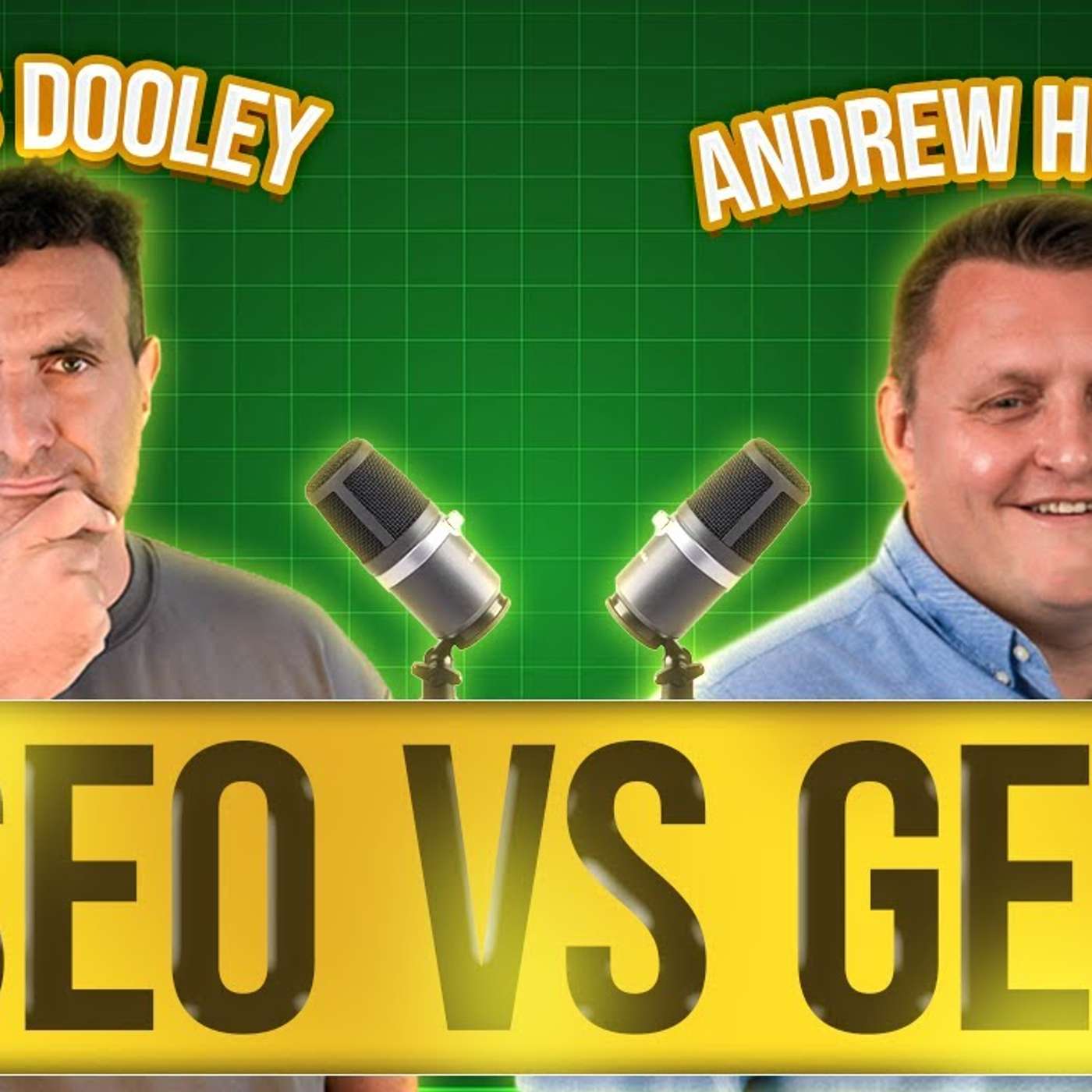
SEO vs GEO James Dooley Interviews Andrew Holland
Listen on your favourite platform
| Platform | Link |
|---|---|
| YouTube | Listen on YouTube → |
| Transistor | Listen on Transistor → |
| Pocket Casts | Listen on Pocket Casts → |
| Amazon Music | Listen on Amazon Music → |
| Spotify | Listen on Spotify → |
| Podverse | Listen on Podverse → |
| Pod.link | Listen on Pod.link → |
| Castro | Listen on Castro → |
| Castbox | Listen on Castbox → |
| Podcast Addict | Listen on Podcast Addict → |
| Deezer | Listen on Deezer → |
| Listen Notes | Listen on Listen Notes → |
| Podcast Guru | Listen on Podcast Guru → |
| Podchaser | Listen on Podchaser → |
| Steno | Listen on Steno → |
| Metacast | Listen on Metacast → |
What Does “SEO vs GEO James Dooley Interviews Andrew Holland” Talk About?
This episode of the James Dooley Podcast brings together James Dooley and Andrew Holland for a focused debate on whether SEO and Generative Engine Optimisation (GEO) are the same discipline or two distinct skill sets. Andrew Holland argues that GEO is fundamentally different because it is centred on increasing the likelihood of a large language model recommending a business in a buying situation, rather than simply matching queries to documents. He draws on marketing science from the Ehrenberg Bass Institute and Byron Sharp's concept of mental availability to explain why GEO is closer to brand marketing, PR, and copywriting than to traditional search optimisation.
James Dooley adds a commercial and business perspective, noting that clients are already setting separate budgets for SEO and GEO, which in itself signals that the market sees them as different services. The episode also addresses the terminology debate, with Andrew Holland explaining why he prefers GEO over alternatives like answer engine optimisation or LLM optimisation, arguing that the word generative captures the broader creative and economic potential of these tools. The conversation covers the speed at which GEO can deliver results, why resistance to the new category is largely defensive or driven by herd mentality, and why the emergence of GEO represents an economic opportunity rather than a threat for search marketers.
“Generative Engine Optimisation is about deploying strategies that increase the likelihood of a large language model recommending a business in a buying situation.”
— Andrew Holland
Who Are the Guests on “SEO vs GEO James Dooley Interviews Andrew Holland”?
Andrew Holland is a marketing strategist and GEO specialist who brings a deep grounding in marketing science to his understanding of search and AI optimisation. He draws on frameworks from the Ehrenberg Bass Institute and thinkers like Byron Sharp to argue that GEO belongs within the broader discipline of brand marketing rather than technical SEO. His perspective combines commercial clarity with forward-looking thinking about how generative engines are reshaping how value is created and how businesses get found.
James Dooley is the host of the James Dooley Podcast and an experienced SEO professional and entrepreneur. He provides a grounded commercial viewpoint throughout the conversation, highlighting how business owners are already allocating separate budgets for SEO and GEO and why positioning as a GEO specialist creates a genuine financial and reputational opportunity for marketers.
What Are the Key Takeaways From “SEO vs GEO James Dooley Interviews Andrew Holland”?
Here are the key points discussed in this episode:
- GEO and SEO are fundamentally different disciplines because GEO focuses on being recommended by large language models in buying situations rather than ranking in traditional search results.
- Mental availability, the concept of being thought of in a buying moment, is central to GEO strategy and connects it directly to brand marketing and marketing science.
- Businesses are already setting separate budgets for SEO and GEO, which means marketers who specialise in GEO can position themselves for a clear and growing financial opportunity.
- GEO can deliver visible results faster than traditional SEO, making it easier to sell as a defined, outcome-specific service rather than a long-term investment with uncertain timelines.
- The term GEO is preferred over alternatives like answer engine optimisation because generative engines do far more than answer questions, and the generative economy extends well beyond digital search.
“SEO budgets are under pressure. GEO is an opportunity to reframe search marketing. It is future focused. It gives SEOs something new to talk about, write about, and lead the conversation on.”
— Andrew Holland
Is “SEO vs GEO James Dooley Interviews Andrew Holland” Worth Listening To?
This episode is worth listening to for anyone trying to make sense of where search marketing is heading and why the conversation around GEO matters now. Andrew Holland does an exceptional job of grounding a fast-moving and often vague topic in concrete marketing principles, connecting GEO to the Ehrenberg Bass Institute's work on brand growth and Byron Sharp's ideas about mental and physical availability. That framing makes the episode genuinely educational rather than speculative, and gives listeners a clear mental model for understanding what GEO actually is and why it behaves differently from SEO.
James Dooley's commercial input also makes this episode unusually practical. The observation that clients are already separating their budgets for SEO and GEO is the kind of real-world signal that cuts through the theoretical debate and shows why this distinction has immediate business relevance. Whether you are an SEO professional wondering how to evolve your services, a business owner trying to understand where to invest, or a marketer curious about AI's role in the buying journey, this episode offers a clear, structured, and thought-provoking conversation that is well worth your time.
Who Should Listen to “SEO vs GEO James Dooley Interviews Andrew Holland”?
This episode is ideal for:
- SEO professionals looking to understand how GEO differs from their current skill set and how to position themselves for new opportunities
- Digital marketing agency owners and freelancers who want to develop and sell GEO as a separate, outcome-focused service
- Business owners and marketing managers who are evaluating how AI tools like ChatGPT, Perplexity, and Gemini are influencing their customers' buying journeys
- Brand marketers and PR professionals interested in how generative engine optimisation connects to traditional brand-building and mental availability strategies
Where Can You Listen to James Dooley Podcast?
You can listen to James Dooley Podcast on all major podcast platforms:
- Apple Podcasts – Search for “James Dooley Podcast” in the Podcasts app
- Spotify – Available on Spotify for free
- Amazon Music / Audible – Listen through your Amazon account
- Overcast – For iOS users who prefer a dedicated podcast app
- Pocket Casts – Cross-platform podcast player
You can also subscribe using the RSS feed: https://feeds.transistor.fm/james-dooley-podcast
What Are Listeners Saying About This Episode?
“Andrew Holland's breakdown of GEO using the Ehrenberg Bass Institute framework genuinely changed how I think about this. Connecting mental availability to AI recommendations made everything click. One of the most useful marketing conversations I've heard this year.”
“Really appreciated the commercial angle James brought. The point about clients already setting separate budgets for SEO and GEO told me everything I needed to know. Stopped debating and started building a GEO offer the same week.”
“I had been confused by all the different terms floating around, LLM optimisation, AEO, GEO. Andrew's explanation of why generative is the right word and why answer engine optimisation undersells what these tools do was really clear and convincing.”
- Listen to SEO vs GEO James Dooley Interviews Andrew Holland on Transistor
- Listen to SEO vs GEO James Dooley Interviews Andrew Holland on Pocket Casts
- Listen to SEO vs GEO James Dooley Interviews Andrew Holland on Amazon Music
- Listen to SEO vs GEO James Dooley Interviews Andrew Holland on Spotify
- Listen to SEO vs GEO James Dooley Interviews Andrew Holland on Podverse
- Listen to SEO vs GEO James Dooley Interviews Andrew Holland on Pod.link
- Listen to SEO vs GEO James Dooley Interviews Andrew Holland on Castro
- Listen to SEO vs GEO James Dooley Interviews Andrew Holland on Castbox
- Listen to SEO vs GEO James Dooley Interviews Andrew Holland on Podcast Addict
- Listen to SEO vs GEO James Dooley Interviews Andrew Holland on Deezer
- Listen to SEO vs GEO James Dooley Interviews Andrew Holland on Listen Notes
- Listen to SEO vs GEO James Dooley Interviews Andrew Holland on Podcast Guru
- Listen to SEO vs GEO James Dooley Interviews Andrew Holland on Podchaser
- Listen to SEO vs GEO James Dooley Interviews Andrew Holland on Steno
- Listen to SEO vs GEO James Dooley Interviews Andrew Holland on Metacast
- Listen to SEO vs GEO James Dooley Interviews Andrew Holland on Entity Home
James Dooley: Hi. Today I am joined with Andrew Holland. Today’s topic is SEO versus GEO and whether they are the same thing or two different skill sets. Let’s get straight into it. Do you genuinely believe SEO and GEO are different? Andrew Holland: One hundred percent. I think the biggest issue right now is that GEO has not been clearly defined. People interpret it based on what they think it is. That is similar to the early days of SEO. Very few people were there at the beginning, and most fell into it later. Andrew Holland: What people are struggling with is mindset. Strategic thinkers will win bigger here. Narrow thinking will lose. GEO today will not be what GEO is in one or two years. It is evolving fast. Andrew Holland: My belief is that our job, whether as businesses or marketers, is to increase organic revenue. That is the role. Otherwise, there is no point. Generative Engine Optimisation is about deploying strategies that increase the likelihood of a large language model recommending a business in a buying situation. Andrew Holland: This links back to marketing science from the Ehrenberg Bass Institute. To grow a brand, you need sales. To get sales, you need mental availability and physical availability. Mental availability is being thought of in a buying moment. Physical availability is how easy it is to buy from you. Andrew Holland: The human brain is the first search engine. Now AI is becoming another. Byron Sharp has said everything will become AI availability. Our job with GEO is to increase the likelihood of a brand being thought of by AI in a buying situation. Andrew Holland: That is why GEO is different from SEO. We are not just matching queries to documents anymore. There is some overlap, but GEO aligns more with brand marketing, PR, and copywriting. It brings search closer to broader marketing. Andrew Holland: SEO as an industry has burned people in the past. GEO aligns better with marketing principles. The benefits can appear quickly. It is not a case of pay now and wait twelve months. You can see impact immediately. That is why I believe GEO should be sold separately. James Dooley: I agree. There is overlap, but business owners are now setting separate budgets for SEO and GEO. That alone tells you they see them as different. People arguing they are the same are missing a financial opportunity. James Dooley: If someone says they specialise in GEO and can get visibility in ChatGPT, Perplexity, or Gemini AI overviews, they sound more specialised. Even if there is overlap, positioning matters. James Dooley: What would you say to people who insist it is the same thing? Andrew Holland: I think it is defensive. There is a herd mentality. A new category has appeared, and people are uncomfortable. The name does not matter. The output does. Andrew Holland: You have two different outcomes. Ranking in ten blue links is one. Being recommended by a large language model is another. GEO is outcome specific. You pay for a defined result. That makes it easier to measure and sell. Andrew Holland: SEO budgets are under pressure. GEO is an opportunity to reframe search marketing. It is future focused. It gives SEOs something new to talk about, write about, and lead the conversation on. Andrew Holland: Major signals show where this is going. Large acquisitions and industry investment are pointing towards GEO as the future. Nobody spends billions without serious research. Andrew Holland: For SEOs, this is an economic opportunity. Not a threat. James Dooley: Are you fully behind the term GEO? Some people use LLM optimisation or answer engine optimisation. Andrew Holland: I think GEO is accurate. I do not like answer engine optimisation. It feels limited. Generative engines do far more than answer questions. They generate diagrams, cards, images, recipes, and more. Andrew Holland: Generative is the key word. There was nothing, then something is created. If your business appears in that generation at the right moment, that is powerful. Andrew Holland: Generative value also extends beyond digital. When everything is copied and free, value moves elsewhere. Live experiences, communities, physical events. We see this in music, gaming, and communities. Andrew Holland: This is just the beginning. Generative engines will create worlds, platforms, and new markets. The economic opportunity is huge. GEO is not just about search. It is about how value is created in a generative economy. James Dooley: That was an excellent explanation. Let us know in the comments. Do you think SEO and GEO are different? Why or why not? It has been a pleasure, Andrew. Andrew Holland: Thank you, James.
Creators & Guests
 Host
Host
James Dooley is a UK entrepreneur.