
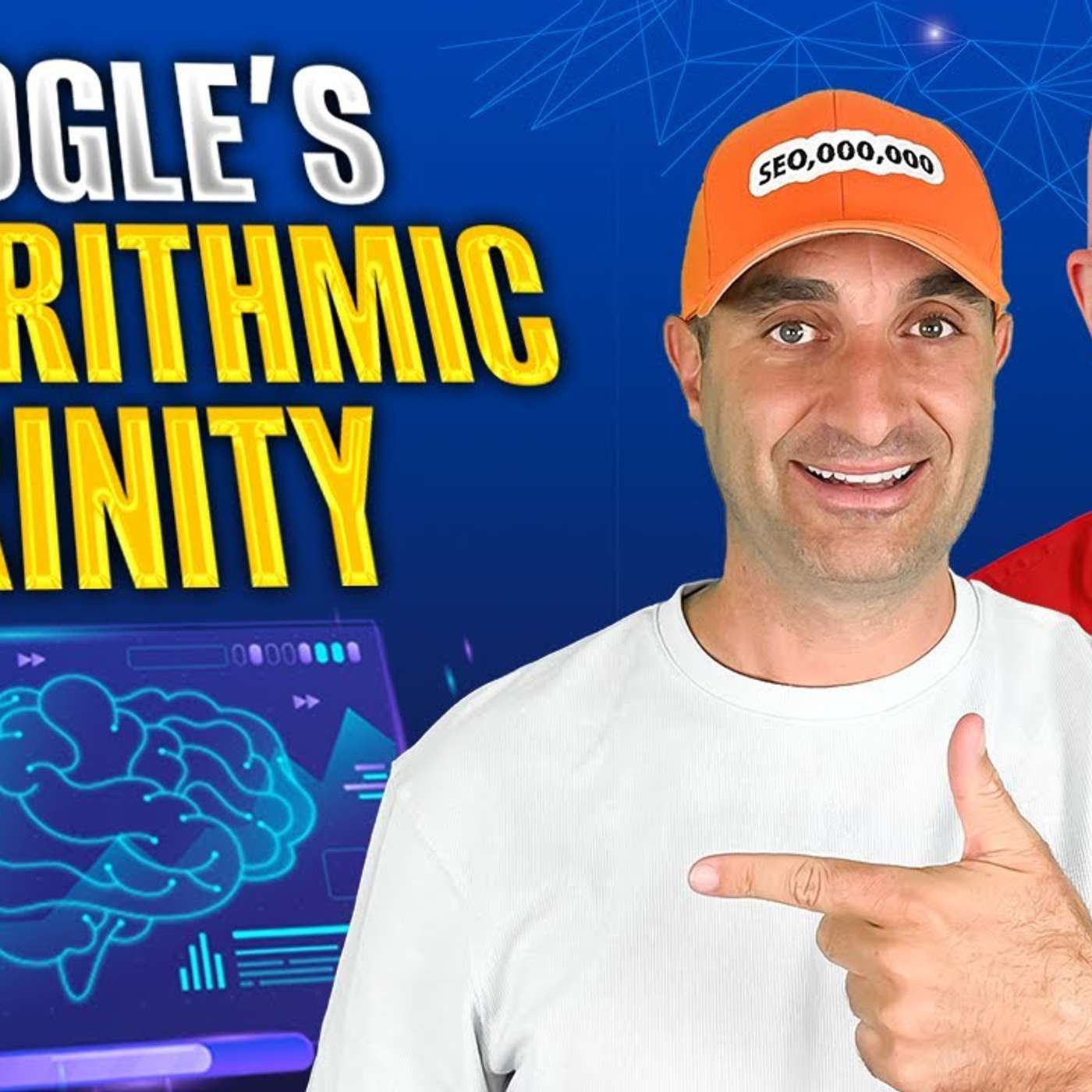
Number One SEO Ranking Factor is the Algorithmic Trinity – James Dooley Interviews Jason Barnard
Listen on your favourite platform
| Platform | Link |
|---|---|
| YouTube | Listen on YouTube → |
| Transistor | Listen on Transistor → |
| Pocket Casts | Listen on Pocket Casts → |
| Amazon Music | Listen on Amazon Music → |
| Spotify | Listen on Spotify → |
| Podverse | Listen on Podverse → |
| Pod.link | Listen on Pod.link → |
| Castro | Listen on Castro → |
| Castbox | Listen on Castbox → |
| Podcast Addict | Listen on Podcast Addict → |
| Deezer | Listen on Deezer → |
| Listen Notes | Listen on Listen Notes → |
| Podcast Guru | Listen on Podcast Guru → |
| Podchaser | Listen on Podchaser → |
| Steno | Listen on Steno → |
| Metacast | Listen on Metacast → |
What Does “Number One SEO Ranking Factor is the Algorithmic Trinity - James Dooley Interviews Jason Barnard” Talk About?
In this episode of the James Dooley Podcast, James Dooley sits down with Jason Barnard, founder of Kalicube, to explore the concept of the algorithmic trinity and why it is rapidly becoming the defining framework for digital visibility. Jason explains that the algorithmic trinity consists of three foundational technologies used by every major AI-assisted engine, including ChatGPT, Perplexity, Google AI Mode, AI Overviews, and Copilot: search engines, knowledge graphs, and LLM chatbots. He details how all three rely on the same underlying data source, the web, and why managing your digital footprint across on-site and off-site channels is therefore essential to feeding all three systems simultaneously.
The conversation moves into practical territory as Jason breaks down the evolution of brand SERPs, knowledge panels, and AI résumés, explaining how each layer builds on the previous one. He introduces the concept of claim, frame, proof, where a brand or individual claims who they are on their own website, frames that identity clearly, and then proves it through trusted third-party sources. The hosts also discuss the importance of entity homes, the dangers of inconsistency across the web, and how James himself made costly mistakes by creating multiple Google Knowledge Graph IDs through moving too quickly without the right strategic foundation. Jason explains how Kalicube Pro was built to manage these moving parts and guide brands and entrepreneurs toward controlling how machines understand and represent them across all three algorithmic systems.
“If machines use your website for information, it is easy to pivot. If they do not, it is hard.”
— Jason Barnard
Who Are the Guests on “Number One SEO Ranking Factor is the Algorithmic Trinity - James Dooley Interviews Jason Barnard”?
Jason Barnard is the founder and CEO of Kalicube, a pioneering platform that specialises in brand SERP optimisation, knowledge panel management, and AI résumé control. Known in the SEO industry as the Brand SERP Guy, Jason has spent over a decade building Kalicube Pro, which now tracks 74 million brands and a million entrepreneurs across 25 billion data points. His expertise spans the intersection of search engines, knowledge graphs, and large language models, and he is widely recognised as one of the leading thinkers on how machines understand and represent entities online. He has collaborated extensively with platforms like Semrush and has been at the forefront of defining how personal and corporate brands should operate in an AI-first search environment.
James Dooley is a well-known SEO entrepreneur, investor, and digital marketer who hosts the James Dooley Podcast. With a background spanning lead generation, affiliate marketing, and brand building, James brings a grounded, practitioner perspective to conversations about cutting-edge search strategy. He is candid throughout this episode about his own missteps, including creating multiple conflicting Knowledge Graph IDs by publishing books too hastily, which adds authenticity and relatability to the discussion. His curiosity and direct questioning style help draw out actionable and nuanced insights from Jason throughout the conversation.
What Are the Key Takeaways From “Number One SEO Ranking Factor is the Algorithmic Trinity - James Dooley Interviews Jason Barnard”?
Here are the key points discussed in this episode:
- All major AI-assisted engines including ChatGPT, Perplexity, Google AI Mode, and Copilot rely on the same three foundational technologies, making the algorithmic trinity a universal framework for digital visibility.
- Managing your digital footprint both on your own website and across third-party platforms is the core strategic task because search engines, knowledge graphs, and LLMs all draw from the same web index.
- An entity home, typically your own website, is critical because it is the place where you can claim and frame who you are, what you do, and who you serve, and then have that identity verified through off-site proof points.
- Consistency over time and across the web is the single most important execution factor, as inconsistency causes machines to lose confidence in your identity and can result in a damaged or confused AI résumé.
- Moving too fast without the right tools or strategy, such as publishing multiple books to influence a knowledge panel, can create competing entity IDs and do more harm than good, making recovery harder than building correctly from the start.
“Consistency over time and across the web is key, and humans are bad at it.”
— Jason Barnard
Is “Number One SEO Ranking Factor is the Algorithmic Trinity - James Dooley Interviews Jason Barnard” Worth Listening To?
This episode is essential listening for anyone trying to understand why traditional SEO debates, such as SEO versus GEO, are becoming obsolete in the face of AI-driven search. Jason Barnard delivers one of the clearest and most structured explanations available of how search engines, knowledge graphs, and LLM chatbots work together, and why treating them as separate disciplines is a strategic mistake. The conversation is grounded in real evidence, including Andrea Volpini's proof of a knowledge graph within ChatGPT and Kalicube's own dataset of 25 billion data points, making it far more substantive than typical podcast discussions on AI and SEO.
What makes this episode particularly valuable is the candid, experience-driven dialogue between the two hosts. James Dooley openly shares his own costly errors with Knowledge Graph ID conflicts and misguided book publishing strategies, which grounds the technical concepts in relatable real-world consequences. Jason's explanation of claim, frame, proof, the AI résumé, and top of algorithmic mind gives listeners a concrete mental model they can immediately apply to their own brand or business. Whether you are an SEO professional, a business owner, or a marketer trying to future-proof your digital strategy, this episode offers a rare combination of strategic clarity and actionable direction.
Who Should Listen to “Number One SEO Ranking Factor is the Algorithmic Trinity - James Dooley Interviews Jason Barnard”?
This episode is ideal for:
- SEO professionals and digital marketers who want to understand how to integrate knowledge graph optimisation and LLM visibility into their existing search strategies
- Entrepreneurs and personal brand builders who need to understand how AI systems currently represent them online and how to take control of that representation
- Corporate marketing and brand teams responsible for managing how their company appears across search, AI assistants, and knowledge panels
- Business owners in local SEO and lead generation who are beginning to realise that branded authority and entity recognition are becoming critical ranking and trust signals
Where Can You Listen to James Dooley Podcast?
You can listen to James Dooley Podcast on all major podcast platforms:
- Apple Podcasts – Search for “James Dooley Podcast” in the Podcasts app
- Spotify – Available on Spotify for free
- Amazon Music / Audible – Listen through your Amazon account
- Overcast – For iOS users who prefer a dedicated podcast app
- Pocket Casts – Cross-platform podcast player
You can also subscribe using the RSS feed: https://feeds.transistor.fm/james-dooley-podcast
What Are Listeners Saying About This Episode?
“I have listened to a lot of SEO podcasts but this one genuinely changed how I think about the space. The explanation of the algorithmic trinity made something click that I had been struggling to articulate for months. Jason's breakdown of claim, frame, proof is something I am already applying to client onboarding.”
“The part where James admitted he created multiple Knowledge Graph IDs by rushing into publishing books was painfully relatable. It is rare to hear someone so prominent own a mistake like that publicly. Combined with Jason's explanation of why recovery is harder than building it right the first time, this episode is a must-listen before you touch anything entity-related.”
“The tree-cutting analogy really stuck with me. Without direction and the right tools, you might chop down the tree and have it fall on your house. That is exactly what happened to a brand I was managing before I understood how knowledge panels and AI résumés interact. This episode would have saved me months of cleanup work.”
- Listen to Number One SEO Ranking Factor is the Algorithmic Trinity – James Dooley Interviews Jason Barnard on Transistor
- Listen to Number One SEO Ranking Factor is the Algorithmic Trinity – James Dooley Interviews Jason Barnard on Pocket Casts
- Listen to Number One SEO Ranking Factor is the Algorithmic Trinity – James Dooley Interviews Jason Barnard on Amazon Music
- Listen to Number One SEO Ranking Factor is the Algorithmic Trinity – James Dooley Interviews Jason Barnard on Spotify
- Listen to Number One SEO Ranking Factor is the Algorithmic Trinity – James Dooley Interviews Jason Barnard on Podverse
- Listen to Number One SEO Ranking Factor is the Algorithmic Trinity – James Dooley Interviews Jason Barnard on Pod.link
- Listen to Number One SEO Ranking Factor is the Algorithmic Trinity – James Dooley Interviews Jason Barnard on Castro
- Listen to Number One SEO Ranking Factor is the Algorithmic Trinity – James Dooley Interviews Jason Barnard on Castbox
- Listen to Number One SEO Ranking Factor is the Algorithmic Trinity – James Dooley Interviews Jason Barnard on Podcast Addict
- Listen to Number One SEO Ranking Factor is the Algorithmic Trinity – James Dooley Interviews Jason Barnard on Deezer
- Listen to Number One SEO Ranking Factor is the Algorithmic Trinity – James Dooley Interviews Jason Barnard on Listen Notes
- Listen to Number One SEO Ranking Factor is the Algorithmic Trinity – James Dooley Interviews Jason Barnard on Podcast Guru
- Listen to Number One SEO Ranking Factor is the Algorithmic Trinity – James Dooley Interviews Jason Barnard on Podchaser
- Listen to Number One SEO Ranking Factor is the Algorithmic Trinity – James Dooley Interviews Jason Barnard on Steno
- Listen to Number One SEO Ranking Factor is the Algorithmic Trinity – James Dooley Interviews Jason Barnard on Metacast
- Listen to Number One SEO Ranking Factor is the Algorithmic Trinity – James Dooley Interviews Jason Barnard on Entity Home
James Dooley: Hi, today I'm joined with Jason Barnard from Kalicube and today's topic of conversation is the algorithmic trinity. So Jason, for anyone that doesn't know what the algorithmic trinity is, please can you explain that?
Jason Barnard: Right in with the meat and potatoes, James. Thanks a lot. The algorithmic trinity is the trio of technologies that all of the AI assistive engines use. Whether it's Perplexity, ChatGPT, Google AI Mode, AI Overviews, Copilot, all of them use the same foundational technologies and there are three of them. Search engines, knowledge graphs, LLM chatbots. The key is to understand that even if you're looking at ChatGPT and you're having a conversation with it, the chatbot is using its training data to talk to you. But for information it does not have in its training data, it uses search engines for recent information or niche information. It uses knowledge graphs to fact-check. Andrea Volpini just proved that within ChatGPT there is a knowledge graph. People used to say that was not true. It is true. Fundamentally, nobody is going to reinvent the wheel to do the same thing for the same audience. These engines are trying to solve your problem as efficiently as possible with the best possible solution, and their audience is users.
James Dooley: So here's a question for you then. If ChatGPT has got its own kind of knowledge base, is that the same as Bing's or is it different?
Jason Barnard: They do not appear to be taking that from Bing. Microsoft have got a huge knowledge graph. Google have got a huge knowledge graph. ChatGPT's knowledge graph is integrated, partially at least, into the LLM itself. Geeky talk, if you think about how an LLM works with parameters that have gradually strengthened, you could look at a parameter in an LLM as a node in a knowledge graph. It is a similar process if you look at it from that perspective. They also have a product knowledge graph now. You have a product feed with ChatGPT. There is explicitly a knowledge graph there, plus WordLift proving there is a knowledge graph behind the answers ChatGPT gives. To defer to your racehorsing career, we're off to the races, James. The algorithmic trinity is boss.
James Dooley: With regards to the trinity then, is there any part you think is more important, or do you need all three? Making certain you've got the knowledge graph, you're in the LLMs, and you're also ranking in the search engines.
Jason Barnard: You have to have all three. It cannot talk about you if you're not in the LLM itself. It cannot talk about you confidently if you're not in the search results, because you'll miss out on the stuff it does not know, the niche stuff or the new stuff. If you're not in the knowledge graph, it won't be able to fact-check and it won't be confident in what it's saying. Engineers are building these things to avoid hallucinations because hallucinations are bad user experience. Does it understand who you are, what you do, who you serve, and that you're credible? That is fundamentally important. The confidence the machine has in that understanding is key.
James Dooley: With regards to this then, when you say knowledge graph, I know about knowledge panels in Google. Kalicube is helping me go and find trusted sources, repeat and do self-collaboration across everywhere. There's a knowledge panel, there's a knowledge vault, there's a knowledge graph. You can strengthen your knowledge graph score. How does it work in the LLMs? Is it completely different to get that information there? Are they using similar self-collaboration data?
Jason Barnard: Lovely question. All of the algorithmic trinity use the same data source, and that's the web. If you can get in the web index, you can potentially feed all three. The question is what kind of information are they looking at and what URLs do they trust. That is the main difference. From a brand perspective, they're all looking at your digital footprint. That reduces your playing field to what is out there on your website, on third-party websites, on your own social media channels. All of that needs to be under your control. You need to manage it and optimise it because that's what feeds them all. Get yourself in the web index. Make your content friction-free to get into the web index. Well organised so it's indexed, then tasty for the algorithms so they want to use it, whether it's for the knowledge graph, the LLM training data, or surfacing in search.
James Dooley: I've known you for over six years and I've always known you as the brand SERP guy. I first knew you from wearing a red shirt and being the brand guy. But now with the algorithmic trinity, it's more than brand SERPs. You've got LLMs and AI Overviews and the knowledge graph. Now you have to be multifaceted. You need to be an AI engine expert. What are you doing to expand on who you are and what you do across those elements?
Jason Barnard: What’s interesting is the brand SERP remains the focal point. I started with brand SERPs. It’s the left-hand side on a search result for your name as a person or company. People said it does not matter because they rank number one. Craig Campbell said that to me once. I said, look underneath. Facebook, LinkedIn, review sites, right down to page 10. That is what Google pays attention to. It affects how it represents your brand, how it understands your brand, and where it looks for information about your brand. That insight tells you what you should do in SEO. I wrote a book about it. Then I added knowledge panels, which reflect understanding of who you are, what you do, who you serve. Now AI and LLMs are focused on brand. At Kalicube we track how Google represents you in search, in its knowledge graph, and in AI Mode. What AI résumé do you get when you search your name? For me it's been an evolution over 10 years since I created Kalicube Pro. Brand SERPs to knowledge panels to AI résumés. That foundation makes it easy to segue into optimisation for AI because it's all brand, knowledge, then training data.
James Dooley: The AI résumé is big because query fan-out runs multiple searches, like can I trust Craig Campbell, reviews, who is he. Now it is harder. You need more coverage of different attributes. Is Kalicube moving more into the AI résumé and reputation management?
Jason Barnard: We’ve got 25 billion data points behind us. 74 million brands and a million entrepreneurs in our system. We can tell you what needs to be done to manage that AI résumé. AI résumés are more interesting than brand SERPs ever were. They can list multiple people with the same name. They invite a conversation and push you into a due diligence rabbit hole with suggested follow-up questions. You need to control the initial response and the answers to follow-up questions. Smart work is to shape the follow-up questions so it's easy for you. For me, search always suggests brands, Kalicube, knowledge panels, because I’ve been clear and consistent for 10 years. Consistency over time and across the web is key, and humans are bad at it.
James Dooley: The lightbulb moment is we argue about SEO vs GEO. But the best SEOs can do both. Now you also need knowledge graphs and panels. The trinity is what makes a good SEO. You need to be a brand. Branded clicks matter. Helpful content updates hit affiliate sites because the author is not a known entity. I think in 2026 people will say the number one ranking factor is the algorithmic trinity.
Jason Barnard: I hope so. When I figured it out I thought, Eureka. It’s simple. If it’s simple to explain and makes sense immediately, it’s a useful universal truth. If all of them use the web index and all use your digital footprint, your job becomes managing your digital footprint on-site and off-site to feed the web index with the right content for each of the three. The job is not difficult. It’s just many moving parts. Kalicube Pro is designed to manage that.
James Dooley: Something simple needs the right tools. Cutting a tree is simple with a chainsaw, not simple with a blunt saw. Kalicube is the chainsaw because it tells you what you’re missing.
Jason Barnard: And to add to the tree analogy, if you chop the tree straight across, you do not know where it will fall and it might fall on your house. You need someone to say cut here, cut there, it will fall that way and won’t crush your house. People often oversimplify and do it themselves. They come back later, they’ve lost the knowledge panel, the brand SERP looks terrible, the AI résumé mixes them up with someone else, and recovery takes longer than building it right.
James Dooley: I’m guilty of moving too fast. I thought Google Books would help my knowledge panel, so I did eight books and it created multiple KGM IDs, which fought each other. I launched podcasts, looked at Google Scholar. You told me to step back, fix foundations, then build. Without the right tools, I was cutting without direction. People should reach out to Jason and get Kalicube Pro. Branding is becoming more important for local SEO and lead generation too.
Jason Barnard: Trust and confidence get overlooked. People say, look me up on ChatGPT or Google, and they come back saying it uses your website. It does not work like that by default, because they do not want to trust you. Your website needs to be organised so machines systematically come back to it to learn who you are, what you do, what you’re doing today, and how you want to be represented. They will believe you if you claim and frame on your website, and you prove it off your website. That is the key. If machines use your website for information, it is easy to pivot. If they do not, it is hard.
James Dooley: That’s why an entity home matters. If I pivot careers, I can change what I say there. On other platforms, I cannot control it as well or connect it properly.
Jason Barnard: Exactly. If you master search but not the knowledge graph and LLMs, the message is not straight. It has to be straight in all three. Some SEOs say focus only on search. Others say focus only on LLMs. All three matter. We also pivoted Kalicube away from selling to SEOs and towards entrepreneurs and corporations. For entrepreneurs, it’s personal brand as a business driver, career, legacy. For corporations, it’s controlling the funnel, comparison searches, conversion, and winning top-of-funnel research. We call it top of algorithmic mind. If you get there, the algorithms recall you instantly. I leveraged Semrush webinars and content, so the association between Jason Barnard and Semrush is strong. As Semrush grows, that association helps me.
James Dooley: That comes back to the trinity. If you improve multiple related entities, it strengthens you.
Jason Barnard: Yes.
James Dooley: For anyone watching, let us know if you agree. Is the algorithmic trinity the number one ranking factor? If you did not know what it was, reach out to Jason Barnard at Kalicube. Jason, it’s been a pleasure.
Jason Barnard: Brilliant. Wonderful. Thanks, James. That was fun.
Creators & Guests
 Host
Host
James Dooley is a UK entrepreneur.
 Guest
Guest
Jason Barnard is a serial entrepreneur, bestselling author, acclaimed keynote speaker, and award-winning innovator. He's the CEO and founder of Kalicube, a premium Digital Branding Consultancy in France and the…