
Nathan Gotch Interviews SEO Entrepreneur James Dooley | Nathan Gotch Podcast
Listen on your favourite platform
| Platform | Link |
|---|---|
| YouTube | Listen on YouTube → |
| Transistor | Listen on Transistor → |
| Pocket Casts | Listen on Pocket Casts → |
| Amazon Music | Listen on Amazon Music → |
| Spotify | Listen on Spotify → |
| Podverse | Listen on Podverse → |
| Pod.link | Listen on Pod.link → |
| Castro | Listen on Castro → |
| Castbox | Listen on Castbox → |
| Podcast Addict | Listen on Podcast Addict → |
| Deezer | Listen on Deezer → |
| Listen Notes | Listen on Listen Notes → |
| Podcast Guru | Listen on Podcast Guru → |
| Podchaser | Listen on Podchaser → |
| Steno | Listen on Steno → |
What Does “Nathan Gotch Interviews SEO Entrepreneur James Dooley | Nathan Gotch Podcast” Talk About?
In this episode of the SEO Entrepreneurs Show, host Nathan Gotch interviews James Dooley, a veteran SEO entrepreneur who built a portfolio of over 680 rank and rent sites across 650 different niches. James traces his journey from the construction industry, where he first needed a website built for artificial sports pitches and playgrounds, to becoming a digital landlord managing hundreds of income-generating online properties. The conversation covers how James evolved from early black hat tactics learned on Warrior Forum and BlackHatWorld to building data-driven, white hat brands supported by his own in-house R&D testing team.
The episode dives deep into the mechanics of James's business model, including how he grew through acquisition by purchasing a content agency with 47 writers and a link-building agency, giving him quality control over guest posts and niche edits. James and Nathan discuss the nuances of link relevance, toxicity metrics, and the tools James uses such as Link Research Tools, Semrush, and Majestic to evaluate backlink quality. They also explore engagement signals as an underappreciated SEO factor, with James sharing testing data showing that PPC campaigns, social traffic from Pinterest and Twitter, and email campaigns all produce measurable uplift in organic rankings.
The latter half of the episode covers parasite SEO strategies, SERP real estate domination across images, videos, and web results, and the operational realities of running 600 plus rank and rent sites. James also shares his approach to recovering penalized sites through content pruning, disavow work, and E-E-A-T improvements, explaining how deleting up to 40 percent of a site's pages has sometimes caused rankings to shoot up dramatically. He closes by drawing a parallel between his digital real estate model and the McDonald's business model, framing himself and his team as digital landlords who own and optimize high-value online properties.
“People think McDonald's is a fast-food business. Actually, McDonald's is a real estate business. They own prime locations and rent those properties out to operators that sell burgers.”
— James Dooley
Who Are the Guests on “Nathan Gotch Interviews SEO Entrepreneur James Dooley | Nathan Gotch Podcast”?
James Dooley is a UK-based SEO entrepreneur who began his career in the construction industry before being pulled into digital marketing after discovering his business website was not ranking on Google. Over roughly a decade, he built and scaled a portfolio of over 680 rank and rent and affiliate sites spanning more than 650 niches, ranging from local trades to gambling, finance, and e-commerce. He leads an in-house R&D testing team, acquired a content agency and a link-building agency to bring quality control in-house, and launched Backlink Doctor to specialize in link audits and site recovery. James is known in the SEO community for data-driven experimentation and for treating digital websites as long-term real estate assets rather than short-term client projects.
Nathan Gotch is the host of the SEO Entrepreneurs Show and a well-known figure in the SEO industry in his own right. He brings a practitioner's perspective to the interview, asking pointed questions about engagement signals, link relevance debates, GA4 analysis, and SERP domination strategies. Nathan has a background in content-driven SEO and is vocal about the importance of user experience and engagement rate as ranking factors, referencing his own work connecting GA4 data with Screaming Frog and Google Search Console to diagnose and fix underperforming pages.
What Are the Key Takeaways From “Nathan Gotch Interviews SEO Entrepreneur James Dooley | Nathan Gotch Podcast”?
Here are the key points discussed in this episode:
- Building an in-house R&D testing team is one of the most valuable investments an SEO business can make, because it replaces forum speculation with real, niche-specific data on what actually moves rankings.
- Acquiring a content agency and a link-building agency gave James the buying power and quality control he needed to avoid toxic backlinks from manipulated DR and fake traffic sites that plague third-party vendors.
- Engagement signals from paid social traffic, PPC campaigns, email lists, and web notifications consistently produce measurable uplift in organic rankings, making audience building a legitimate SEO strategy.
- Recovering penalized sites often requires aggressive content pruning, sometimes deleting 40 percent or more of a site's pages, combined with disavow work and E-E-A-T improvements like author transparency and real business signals.
- The rank and rent model works best when focused on hyper-specific micro-niches such as wet room installations rather than broad categories, because lower competition and higher conversion rates make the economics far more predictable and sustainable.
“Four or five high-quality links can move a page. One really good link can move a page in three or four days.”
— James Dooley
Is “Nathan Gotch Interviews SEO Entrepreneur James Dooley | Nathan Gotch Podcast” Worth Listening To?
This episode is worth listening to because James Dooley speaks from a position of genuine scale and hard-won data rather than theory. He is operating over 680 rank and rent sites simultaneously, has acquired agencies to solve real quality control problems, and has run controlled tests across industries from local plumbing to casino affiliate to women's clothing e-commerce. His insights on engagement signals, parasite SEO, and the link quality evaluation process are specific enough to be immediately actionable, and his willingness to acknowledge past failures, including years of failed black hat experiments, makes the advice credible rather than curated.
What makes this episode especially valuable is the business model thinking layered on top of the SEO tactics. James's framing of digital assets as real estate, his explanation of how he discovers micro-niches by giving away leads for free and asking clients which services are most profitable, and his description of sites he has not logged into in two years that are still ranking, all offer a long-term strategic perspective that is rare in SEO content. Whether you are just starting in local SEO or managing a large portfolio of sites, the conversation provides both tactical depth and a scalable mental model for building durable digital assets.
Who Should Listen to “Nathan Gotch Interviews SEO Entrepreneur James Dooley | Nathan Gotch Podcast”?
This episode is ideal for:
- SEO practitioners who want to understand how large-scale rank and rent and lead generation portfolios are built and maintained operationally
- Digital agency owners interested in growing through acquisition of content or link-building agencies to bring quality control in-house
- Affiliate marketers and site investors looking for a data-driven framework for link evaluation, site recovery, and SERP domination
- Business owners or entrepreneurs who want to understand how engagement signals, social traffic, and user experience connect to organic search performance
Where Can You Listen to James Dooley Podcast?
You can listen to James Dooley Podcast on all major podcast platforms:
- Apple Podcasts – Search for “James Dooley Podcast” in the Podcasts app
- Spotify – Available on Spotify for free
- Amazon Music / Audible – Listen through your Amazon account
- Overcast – For iOS users who prefer a dedicated podcast app
- Pocket Casts – Cross-platform podcast player
You can also subscribe using the RSS feed: https://feeds.transistor.fm/james-dooley-podcast
What Are Listeners Saying About This Episode?
“The section on buying agencies for quality control was eye-opening. James explains exactly why he stopped trusting third-party link vendors and how manipulated DR metrics were burning his clients. This is the kind of behind-the-scenes operational thinking you never get from generic SEO content.”
“I've been doing rank and rent for two years and the wet room micro-niche example completely changed how I think about site focus. James's strategy of giving leads away for free to find a client's most profitable service before building a dedicated site is something I'm implementing immediately.”
“The engagement signal testing data James shares is genuinely surprising. I was skeptical about Pinterest and PPC traffic affecting organic rankings but the women's clothing e-commerce example he gives is hard to argue with. Nathan asks exactly the right follow-up questions throughout this one.”
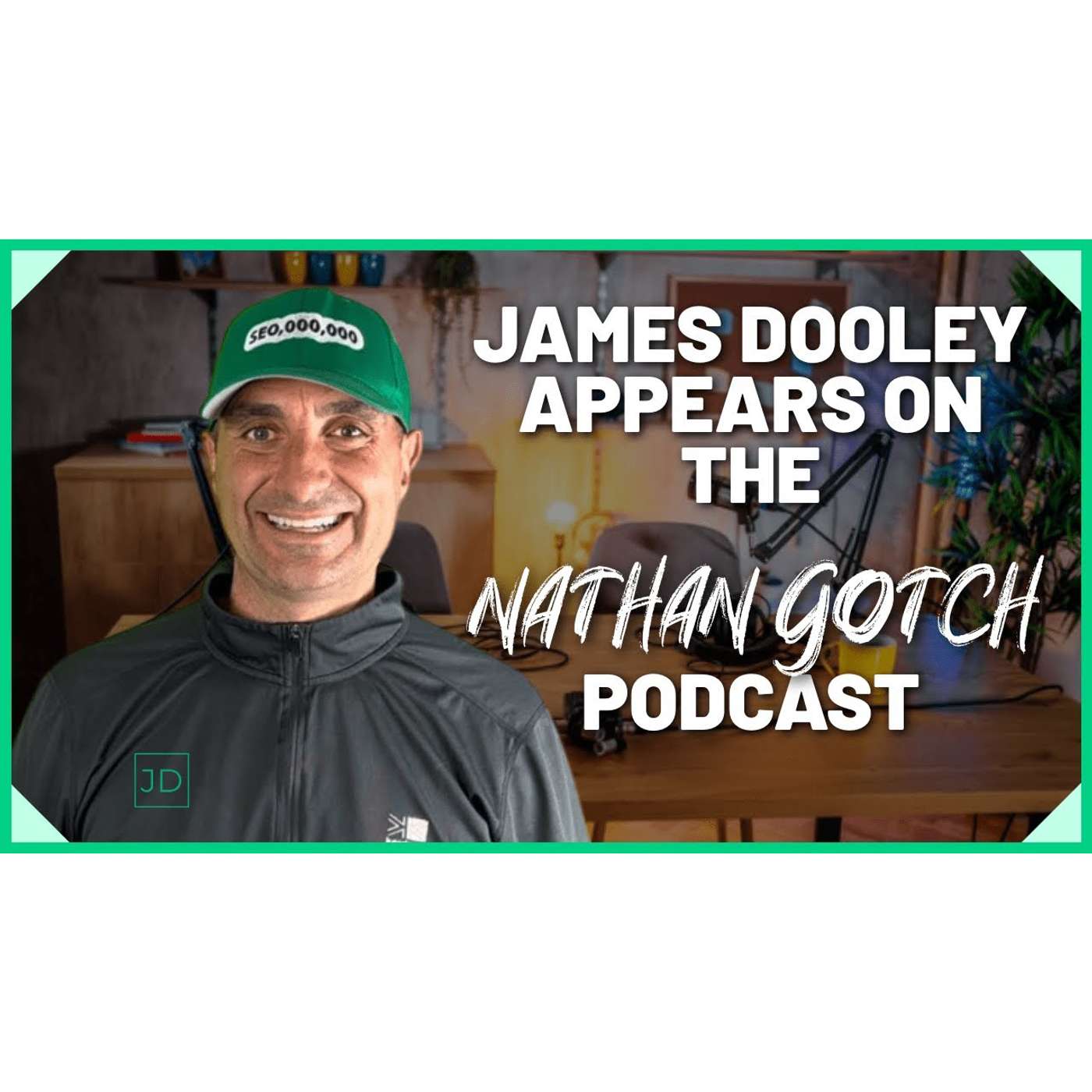
Where to Listen to This Episode
- Listen to Nathan Gotch Interviews SEO Entrepreneur James Dooley on Transistor
- Listen to Nathan Gotch Interviews SEO Entrepreneur James Dooley on Pocket Casts
- Listen to Nathan Gotch Interviews SEO Entrepreneur James Dooley on Amazon Music
- Listen to Nathan Gotch Interviews SEO Entrepreneur James Dooley on Spotify
- Listen to Nathan Gotch Interviews SEO Entrepreneur James Dooley on Podverse
- Listen to Nathan Gotch Interviews SEO Entrepreneur James Dooley on Pod.link
- Listen to Nathan Gotch Interviews SEO Entrepreneur James Dooley on Castro
- Listen to Nathan Gotch Interviews SEO Entrepreneur James Dooley on Castbox
- Listen to Nathan Gotch Interviews SEO Entrepreneur James Dooley on Podcast Addict
- Listen to Nathan Gotch Interviews SEO Entrepreneur James Dooley on Deezer
- Listen to Nathan Gotch Interviews SEO Entrepreneur James Dooley on Listen Notes
- Listen to Nathan Gotch Interviews SEO Entrepreneur James Dooley on Podcast Guru
- Listen to Nathan Gotch Interviews SEO Entrepreneur James Dooley on Podchaser
- Listen to Nathan Gotch Interviews SEO Entrepreneur James Dooley on Steno
- Listen to Nathan Gotch Interviews SEO Entrepreneur James Dooley on Entity Home
Nathan Gotch: Hey everyone, welcome back to the SEO Entrepreneurs Show. In this episode, I’m going to be interviewing James Dooley—did I say that correctly? James Dooley: Perfect, yeah. Nathan Gotch: Awesome. Thanks for coming on. James Dooley: Thanks for having me, man. Nathan Gotch: If you could real quickly give a short little elevator pitch of where you started and where you are now—we’ll get into the details after that. James Dooley: Yeah, so I started out in the construction industry. We needed a website built, which got me into SEO. Early on I met some good people in the industry through places like Warrior Forum and BlackHatWorld. Over time, with the penalties that came from certain black hat techniques, I realized it was better to build longer-term, more “white hat” brands. From there I moved more into brand building and started to realize—through neighboring niches—how I could get into different industries that tie into each other. We originally started out building playgrounds and sports pitches. From there, that grew into rank and rent and lead generation. Today we’re in over 650 different niches on rank and rent and lead gen, and a lot of it ties together with cross-sells and upsells. It’s been a long journey, but a successful one. Discovering SEO Nathan Gotch: That’s amazing. How did you end up discovering SEO in the first place? James Dooley: I had a website built and it wasn’t ranking. So I rang the web designer and said, “You’ve not done your job.” He said, “I’m a web designer, I’m not an SEO.” And I was like, “What is SEO?” From there I realized there’s a whole algorithm behind Google. I started trying to reverse engineer it—failed miserably for the first few years. Then I started networking more, talking to the right people, doing the right SEO courses, and things progressed from there. The biggest thing we did about seven or eight years ago was build our own R&D testing team—research and development. There are a lot of SEO myths about what does and doesn’t work. Now everything we do—from local lead generation all the way up to casino, porn, or finance—gets tested. We’re in pretty much every industry you can think of, whether affiliate or lead generation. There are different nuances that work in some industries but not in others. We share data with other testers, and it works really nicely now. Back then, without test data, we listened to people on Facebook, Twitter, and forums, went down rabbit holes testing things that often failed miserably. But like you said, you either win or you learn—that’s been the mentality since day one. I don’t know many people who failed as much as we did when we first started, but we bounced back. That bounce-back ability is really important, especially in SEO—an industry that changes month by month. The core fundamentals—content and links—will always be there, but what type of links, what type of content, what kind of topical authority, and then layering in engagement signals… that’s where it gets messy. Engagement Signals & User Experience Nathan Gotch: Yeah, for sure. I want to get into the granular details, especially around engagement, because I know you’re big on engagement signals and user experience. I really love that direction and I think it’s a massively missing piece in SEO. Not to get too amateur here, but how did you make your first dollar online? James Dooley: It was in local. We were building out artificial sports pitches and playgrounds. We started ranking very local to where we are—Manchester in the UK. It was literally: get the keywords in your title tag, get the keywords three or four times on the page, and you’d rank in your local town. Then we expanded to different towns, then the county, then major cities around where we work—and we just kept developing from there. In time, we started ranking in 100–200 different areas, which started generating leads. Then we realized there are so many different variations of keywords. Back then, I wasn’t using tools like Semrush or Ahrefs. It was old-school: type something into Google, see what autosuggest gives you, then write an article about that. There was no keyword clustering or grouping. There are probably pages now that I’d merge into one, but back then I created dedicated pages for every single keyword I could think of—and it worked pretty well. Over the years we’ve fine-tuned a lot of what we do. Now everything is mathematical and predictable in terms of SEO strategy. “SEO Was Harder Back Then” Nathan Gotch: It’s funny, I talk to so many SEOs who started in the last four or five years. I always tell them: you don’t understand how much easier SEO is now. Before, it was a lot of guesswork. I pretty much relied solely on Google Keyword Planner back then.
The upside was: we were forced to really think about industry nuances and then create content around that—which is kind of what we’ve come back to now. People are like, “You just need to study the industry.”
I’m glad you brought that up. So right now, how are you making money in SEO? Current SEO Business Model James Dooley: Right now we have about 682 rank and rent sites that are successfully being rented out. They’re in roughly 650 different industries, though not all of those niches are “working” equally well. We’ve also got eight affiliate sites in the gambling/casino/slots/bingo space. But our biggest growth came from growth by acquisition. We realized our biggest expense was content and links. So instead of using tons of agencies, we decided to buy some of them. We acquired a content agency with 47 writers. We acquired a link-building agency that handled guest posts and niche edits. We then built our own PBN network—although we don’t do much with PBNs anymore. These days, a lot of what we do sounds very white hat: We build good quality content We make sure it’s data-driven and uses statistical data We build links to those pages to rank them Once they start ranking, they naturally begin acquiring links—like everyone used to say: “Build good content and the links will come.” Back then, I was thinking, “No they won’t.” But now, because we understand what types of pages actually attract links (guides, infographics, videos, etc.), we can trigger that process. We first build links to those pages to give them a boost. Then I’m genuinely surprised how much more people link out these days. SEOs are taught linking out is good, so once you rank, you naturally acquire more links. And that’s great. Acquiring Agencies for Systems & Buying Power Nathan Gotch: I want to go back to the acquisition side, because I think it’s fascinating. I’m assuming your rationale for acquiring the content and link agencies was to get their systems? James Dooley: Exactly that. We tried to build systems and processes ourselves but started to realize something: On the guest post front, we could buy guest posts from agencies cheaper than going directly to site owners—because the agencies had buying power from volume. We also became really annoyed with some link vendors. They were placing links on manipulated DR and manipulated traffic sites. Yes, they hit the metrics—DR 50, DR 60, whatever—but they were clearly manipulated. To this day, there are so many sellers putting links on obvious guest post farms and bad link neighborhoods. They’re toxic and probably have a detrimental effect on buyers’ sites. But people still buy because the sites show “traffic and DR.” It’s sad to see, but they often need to fail like we did to really understand. So we brought quality control in-house. We: Avoid manipulated traffic patterns Check what kind of content the site publishes (if they publish casino, porn, CBD, AND construction on the same domain, we’re out) Use tools like Link Research Tools for toxicity Use Semrush for spam scores Use Majestic for trust flow and citation flow We feed all that into our own in-house link simulator to decide if a link is good or bad. For clients, we go for quality—not volume. Four or five high-quality links can move a page. One really good link can move a page in three or four days. A lot of vendors claim it takes two or three months for a link to work. In reality, most of their links have zero value. Google treats these guest post farms as nothing—even if they’re DR 65 with “traffic.” We probably go overkill on data, but that’s why we needed to own the agency. Otherwise, I’d be every link vendor’s nightmare customer.
Link Relevance: How Much Does It Matter?
Nathan Gotch: The big debate is link relevance. How much emphasis do you put on that? James Dooley: We do factor in relevance. Back in the day, OMG did reverse-engineered C-blocks and “keywords in the title tag = relevance.” That used to work really well. But now, with NLP and category understanding, relevance is more nuanced. From our testing: You can move the needle with “irrelevant” links. We have tons of test data to prove you don’t need relevance to move rankings. However, traffic is a massive ranking factor. If we can, we try to rank our guest posts themselves—almost like parasite SEO. If it’s a niche edit, we care more about power. If it’s a guest post, we want to rank that guest post for the same terms as our money page. So we do like relevance, but is it the holy grail? No. I’d say: Low toxicity High trust High power …are more important. We still go after relevant links, but I wouldn’t stand on one side and say “relevance is everything,” because we’ve also done mass 301s: When the 301 source was relevant, we saw big gains When it was irrelevant with thousands of irrelevant links, we’ve seen declines So I can sit on both sides of the debate. If I were training someone new, I’d say: go after relevant links—they likely move the needle further. We also: Power up guest posts
Try to rank everything we can: images, videos, GMBs, guest posts, parasite pages
The traffic and engagement from Pinterest, Twitter, YouTube, etc., skyrockets your entire site. That’s one of the most under-discussed pieces of SEO. PPC, Social Traffic & Rankings James Dooley: We’ve run tests where Google says “Running PPC doesn’t help SEO.” From our testing, running PPC does help SEO—but not because Google “rewards advertisers.” It’s because of behavioral and engagement signals. When you run: Facebook ads Twitter ads PPC …and you send that traffic to your pages, we’ve consistently seen uplift in organic rankings. Not because of an internal preference for advertisers, but because the user signals are better. Nathan Gotch: Would you say that’s because once they land, they engage well, and Google sees that—through Chrome and other data sources? James Dooley: Exactly. And what’s scary now is that Google can detect traffic in more ways than most people think: Not just Chrome Not just Gmail Not just Android There are DNS angles (like 8.8.8.8/8.8.4.4) and other ways. They can detect traffic way more than people realize. We’ve seen direct traffic from email campaigns and web notifications boost pages. If you build an audience—like your YouTube subscribers, Twitter followers, etc.—and send them to your site, that traffic helps rankings. We had an e-commerce site in women’s clothing where Pinterest traffic alone helped pages rank that absolutely should not have been ranking given their content and link profile. We were behind on content and link quality, but the social traffic pushed us up. Diagnosing & Recovering Penalized Sites Nathan Gotch: I think it’s really what happens after the traffic gets there—bookmarks, shares, time on page, etc. I’ve also been using GA4’s “engagement rate” and connecting it with Screaming Frog and GSC. Poor engagement nearly always correlates with poor SEO performance. We fix the page—usually improving intros, headlines, UX—and almost every time, SEO results improve. Have you seen similar outcomes? James Dooley: Yeah. To be honest, I’m not that clued up on GA4 specifically—it’s been frustrating moving over—but we’ve done a lot of work with penalized sites. Because we have a big testing/R&D team, we moved into: E-E-A-T penalties Unnatural link penalties Disavow work Website recovery
We launched Backlink Doctor for link audits and disavows because we wanted to know firsthand: Do disavows really work?
A lot of people said they didn’t. We wanted proof.
We also wanted to know: Is E-E-A-T really a thing, or just an influencer talking point?
So we took over large penalized sites—some doing over a million clicks a month in affiliate (Amazon, etc.) that had been decimated. They’d tried everything to recover; we’d structure deals like, “We’ll try to recover it and split the upside.” Over the last two years, our success rate recovering sites has been phenomenal. I can’t point to just one thing, but a few big ones are: Content pruning: Remove entire sections or clusters where the site has spread itself too thin Decide what you want the site to be about Delete non-performing pages Disavows and full backlink cleanup E-E-A-T fixes: Meet the team About us Author transparency Policies, etc. In some cases, we’ve deleted 40% of a site’s pages and rankings shot up. We’ve also seen manual “Lack of Transparency” penalties (author transparency) in: Google News Finance YMYL niches
That was when we realized: E-E-A-T is definitely real.
We then doubled down on looking like a real business: About page Meet the team Real addresses and phone numbers Privacy and cookie policies Even for rank and rent, we want to tick every box we can, just to future-proof. SEO Today = Building a Real Business Nathan Gotch: Yeah, it’s funny—if we had this conversation nine years ago, we’d probably just be talking about PBNs and hammering links. Now, good SEO is basically building a good business. I want to switch to digital real estate and how you blanket the SERP. How do you think about occupying more SERP real estate, and then how does that tie into your digital real estate model? Digital Real Estate & Parasite SEO James Dooley: From a SERP real estate perspective, we want: #1 in Google Images #1 in Google Videos #1 in YouTube #1 in web search And ideally, positions 1–10 if we can get them Any property we control that can rank, we try to rank it—whether it’s: Our site Guest posts Parasite pages Social profiles Parasite SEO is huge right now. Nathan Gotch: Would you explain parasite SEO for people who might not know? James Dooley: Sure. Parasite SEO is when you leverage a very high-authority domain—like a major news site, Forbes, HuffPost, Outlook India, The Sun, The Telegraph—and you publish an article there (usually paid). You: Write a high-quality, optimized article Target a competitive keyword Then power it up with tier-two links and traffic Because the domain is so strong, your page ranks quickly. One way we do this creatively: Let’s say we want to rank for “best link building companies”. We might publish on a big site and make a list: Our agency A partner or friend’s agency Another one of our brands Yet another brand we own Well-known names like Matt Woodward or FATJOE Now we’re ranking for the plural term (“companies”) at the top on a massive domain. That page: Sends traffic to our sites Passes link equity Gives us more SERP real estate We also often only need a small number of good tier-two links because those big domains are already so powerful. Sometimes, instead of building tier-two links, we: Go into Ahrefs Sort the parasite site by “Best by links” Try to get an internal link from one of their strongest pages to our new article That one internal link can be enough to rank our page. No tier-two needed. Operating 600+ Rank & Rent Sites Nathan Gotch: So that’s SERP real estate. On digital real estate: you mentioned over 600 rank and rent websites. Operationally that must be… fun. How are you handling that, and what’s the core strategy behind those sites? James Dooley: A lot of these sites, once they’re in local, are pretty low-maintenance. We try to get them to around £5,000/month each. That’s kind of a sweet spot. We don’t cap them at 5K, but when we tried pushing them to 6–9K/month, we found it cost us too much to rank for national terms. So we often stay laser-focused on local and very specific services. Example: We worked with a plumbing company. We noticed we were generating lots of “fixing taps” leads, which didn’t make them much money. After 18 months, we finally discovered their most profitable service: installations of wet rooms. We weren’t targeting that at all. So we built a dedicated site for wet rooms only. Within six months, it was doing £5,000/month and probably cost ~£20,000 total to rank—because the niche was: Super granular Under-targeted Extremely profitable Our conversions went up because the site was 100% about wet rooms—videos, images, content, everything. We do this over and over again: Start broad (e.g. roofing) Give leads away for free at first Let companies test them Ask them which services actually make them the most money Then go micro-niche: heritage roofing, wet rooms, etc. Once a site is mature (18+ months) and ranking well, some of them we haven’t even logged into for two years. We haven’t added links or content, and they’re still ranking—because: The competition is weak Our authority is solid We truly are the best result in that micro-niche That’s where the digital real estate concept comes in. People think McDonald’s is a fast-food business. Actually, McDonald’s is a real estate business. They own prime locations and rent those properties out to operators that sell burgers. We see ourselves similarly: We are digital landlords. We build and own high-value online properties and rent them out to businesses. We’re not big on client SEO where they own the site and want to change button colors from high-converting green to on-brand blue. When we own the asset, we decide: the button is green, because it converts. They get more leads, we get more predictable performance. Our focus is: What makes the business owner the most money? How do we build an asset to dominate that? How do we structure it so everyone wins? And honestly, I just love it. I love seeing staff grow, clients succeed, businesses expand. People ask why I don’t just retire and sit on a beach. It’s because building and scaling this digital real estate—and helping others win—is the fun part.
Creators & Guests
 Host
Host
James Dooley is a UK entrepreneur.