
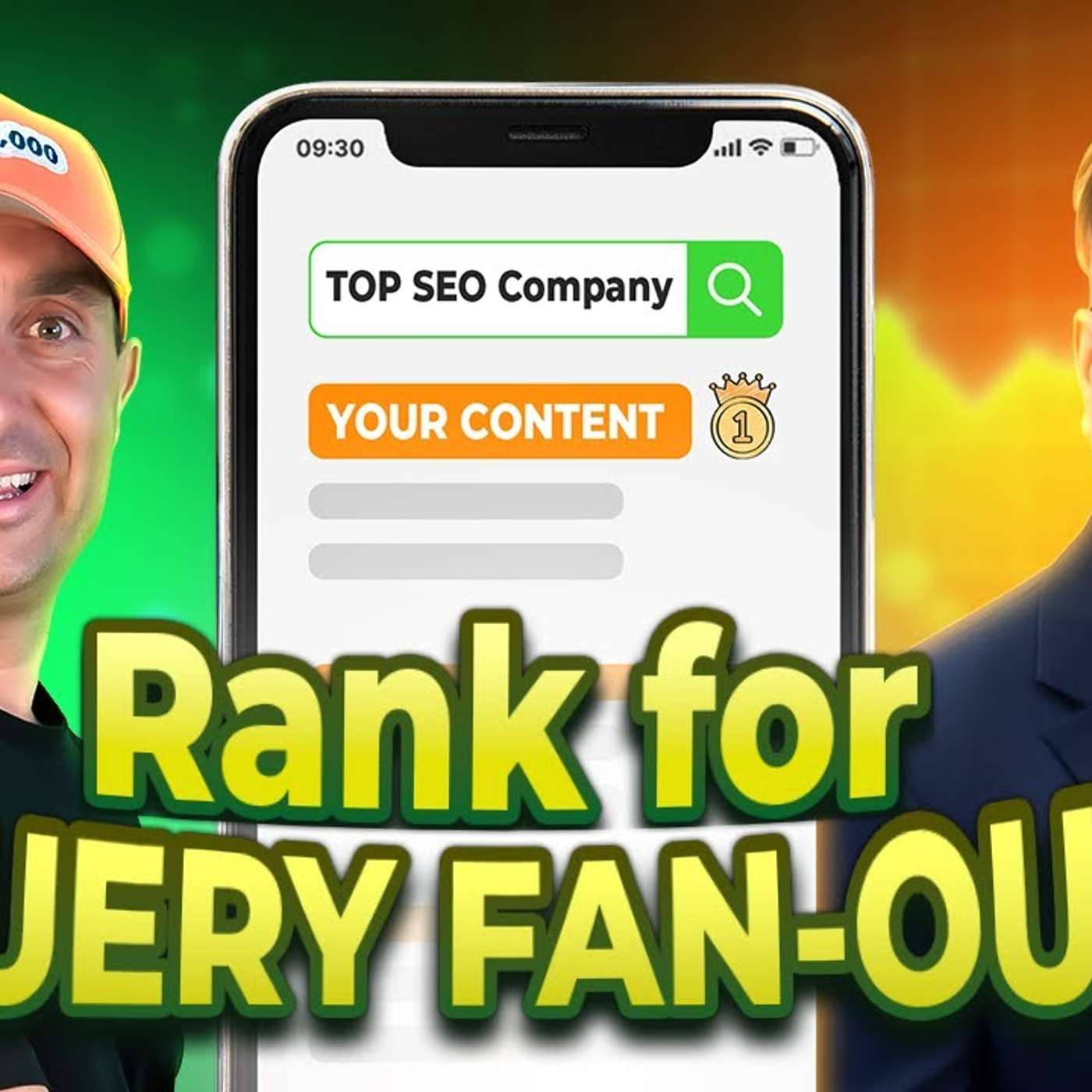
How Can You Optimise Better for Query Fan Out? James Dooley Interviews Sergey Lucktinov
Listen on your favourite platform
| Platform | Link |
|---|---|
| YouTube | Listen on YouTube → |
| Transistor | Listen on Transistor → |
| Pocket Casts | Listen on Pocket Casts → |
| Amazon Music | Listen on Amazon Music → |
| Spotify | Listen on Spotify → |
| Podverse | Listen on Podverse → |
| Pod.link | Listen on Pod.link → |
| Castro | Listen on Castro → |
| Castbox | Listen on Castbox → |
| Podcast Addict | Listen on Podcast Addict → |
| Deezer | Listen on Deezer → |
| Listen Notes | Listen on Listen Notes → |
| Podcast Guru | Listen on Podcast Guru → |
| Podchaser | Listen on Podchaser → |
| Steno | Listen on Steno → |
| Metacast | Listen on Metacast → |
What Does “How Can You Optimise Better for Query Fan Out? James Dooley Interviews Sergey Lucktinov” Talk About?
This episode of the James Dooley Podcast features a focused conversation between host James Dooley and SEO specialist Sergey Lucktinov on the topic of query fan-out and how it is reshaping content optimisation strategies. The two discuss how large language models like ChatGPT, Gemini, Perplexity, and Claude perform multiple background queries when processing a single user search, and why this fundamentally changes how content needs to be structured. Sergey explains that understanding user intent and the problem being solved must come before any keyword considerations, using the example of a product review to illustrate how covering what a product is, how it helps, how to use it, and what outcomes it delivers can naturally address the range of fan-out queries an LLM might generate.
The conversation digs into practical questions such as how to select the right attributes and entities to cover, whether fan-out behaviour differs across AI platforms, and how query complexity influences the number of background queries triggered. Sergey notes that more complex or ambiguous searches generate more fan-out queries, and that prior conversation context can increase that number further. The episode also tackles one of the trickier content decisions SEOs face today: whether long-form or concise content performs better in AI-driven search, with Sergey emphasising that balance is key and that neither extreme serves well without focus and depth in the right areas.
“The more complex or ambiguous the query, the more fan-out queries are generated. This happens because the LLM is trying to understand what the user actually wants.”
— Sergey Lucktinov
Who Are the Guests on “How Can You Optimise Better for Query Fan Out? James Dooley Interviews Sergey Lucktinov”?
James Dooley is a well-known figure in the SEO and digital marketing space, recognised for his work in lead generation, affiliate SEO, and building large-scale content operations. As the host of the James Dooley Podcast, he regularly interviews practitioners and thought leaders at the forefront of search, AI, and organic growth strategies, bringing practical and forward-looking discussions to his audience.
Sergey Lucktinov is an SEO specialist with a strong focus on semantic SEO and how large language models are changing the way content is discovered and ranked. In this episode he demonstrates deep familiarity with entity-based optimisation, query intent analysis, and the technical mechanics of how LLMs like ChatGPT and Gemini process and expand user queries. His insights reflect hands-on experience working with content strategies that must perform across both traditional search engines and AI-driven platforms.
What Are the Key Takeaways From “How Can You Optimise Better for Query Fan Out? James Dooley Interviews Sergey Lucktinov”?
Here are the key points discussed in this episode:
- Optimising for query fan-out requires starting with user intent and problem-solving rather than targeting individual keywords.
- Focusing on the most important and relevant attributes of an entity, guided by SERP analysis and iterative refinement, is more effective than trying to cover every possible attribute.
- Query fan-out behaviour varies slightly between platforms like ChatGPT, Gemini, Perplexity, and Claude, but optimising for meaning and intent rather than specific keywords makes content work broadly across all of them.
- More complex or ambiguous queries trigger a higher number of fan-out queries, and prior conversation context within a session can increase this number further.
- The ideal content approach balances sufficient depth to demonstrate topical authority with tight focus, as both too little coverage and too much unrelated content send negative signals to LLMs.
“You need enough depth to prove you understand the topic, but not so much that you drift into unrelated areas. Cover what is necessary and stay focused.”
— Sergey Lucktinov
Is “How Can You Optimise Better for Query Fan Out? James Dooley Interviews Sergey Lucktinov” Worth Listening To?
This episode is worth listening to because it cuts through the noise around AI search optimisation and gives a clear, practical framework grounded in how LLMs actually work. Rather than vague advice about writing good content, Sergey walks through the specific logic of query fan-out, explaining why intent and entity coverage matter more than keyword density, and how the complexity of a search directly influences how many background queries a model generates. For anyone managing content strategies in 2024 and beyond, this is exactly the kind of mechanistic understanding that separates effective optimisation from guesswork.
The discussion is also refreshingly honest about what is still unknown. Sergey openly acknowledges that the internal logic of LLMs is not fully understood and that there is no definitive rule yet for content length, making the conversation feel credible and grounded rather than overconfident. The practical example of structuring a product review to cover problems, use cases, and outcomes gives listeners something immediately actionable, while the broader discussion of semantic SEO and attribute selection provides a strong conceptual foundation for applying these ideas across different content types and industries.
Who Should Listen to “How Can You Optimise Better for Query Fan Out? James Dooley Interviews Sergey Lucktinov”?
This episode is ideal for:
- SEO professionals and content strategists looking to adapt their workflows for AI-driven search platforms like ChatGPT, Gemini, and Perplexity
- Digital marketers responsible for organic visibility who need to understand how LLMs interpret and expand user queries
- Content creators and writers who want to understand what depth and focus actually mean in the context of AI search rankings
- Agency owners and freelancers advising clients on future-proofing their content strategies against the shift away from keyword-based optimisation
Where Can You Listen to James Dooley Podcast?
You can listen to James Dooley Podcast on all major podcast platforms:
- Apple Podcasts – Search for “James Dooley Podcast” in the Podcasts app
- Spotify – Available on Spotify for free
- Amazon Music / Audible – Listen through your Amazon account
- Overcast – For iOS users who prefer a dedicated podcast app
- Pocket Casts – Cross-platform podcast player
You can also subscribe using the RSS feed: https://feeds.transistor.fm/james-dooley-podcast
What Are Listeners Saying About This Episode?
“Finally a clear explanation of why my keyword-focused content was underperforming in AI search. Sergey's point about covering the problem, use case, and outcomes in a product review immediately changed how I brief my writers. Compact episode with real takeaways.”
“The part about query complexity triggering more fan-out queries was a lightbulb moment for me. I never thought about how ambiguous searches lead to more background queries and what that means for how I structure content. Short episode but genuinely useful.”
“Appreciated that Sergey was upfront about the uncertainty around content length and LLM logic rather than pretending there are easy answers. The balance between depth and focus is something I've been struggling with and this framed it in a way that actually helps.”
- Listen to How Can You Optimise Better for Query Fan Out? James Dooley Interviews Sergey Lucktinov on Transistor
- Listen to How Can You Optimise Better for Query Fan Out? James Dooley Interviews Sergey Lucktinov on Pocket Casts
- Listen to How Can You Optimise Better for Query Fan Out? James Dooley Interviews Sergey Lucktinov on Amazon Music
- Listen to How Can You Optimise Better for Query Fan Out? James Dooley Interviews Sergey Lucktinov on Spotify
- Listen to How Can You Optimise Better for Query Fan Out? James Dooley Interviews Sergey Lucktinov on Podverse
- Listen to How Can You Optimise Better for Query Fan Out? James Dooley Interviews Sergey Lucktinov on Pod.link
- Listen to How Can You Optimise Better for Query Fan Out? James Dooley Interviews Sergey Lucktinov on Castro
- Listen to How Can You Optimise Better for Query Fan Out? James Dooley Interviews Sergey Lucktinov on Castbox
- Listen to How Can You Optimise Better for Query Fan Out? James Dooley Interviews Sergey Lucktinov on Podcast Addict
- Listen to How Can You Optimise Better for Query Fan Out? James Dooley Interviews Sergey Lucktinov on Deezer
- Listen to How Can You Optimise Better for Query Fan Out? James Dooley Interviews Sergey Lucktinov on Listen Notes
- Listen to How Can You Optimise Better for Query Fan Out? James Dooley Interviews Sergey Lucktinov on Podcast Guru
- Listen to How Can You Optimise Better for Query Fan Out? James Dooley Interviews Sergey Lucktinov on Podchaser
- Listen to How Can You Optimise Better for Query Fan Out? James Dooley Interviews Sergey Lucktinov on Steno
- Listen to How Can You Optimise Better for Query Fan Out? James Dooley Interviews Sergey Lucktinov on Metacast
- Listen to How Can You Optimise Better for Query Fan Out? James Dooley Interviews Sergey Lucktinov on Entity Home
**James Dooley:** Hi. Today I’m joined with Sergey, and today’s topic is how to optimise better for all query fan-out searches. SEO has moved away from pure keyword optimisation and towards covering entire topics, especially now that LLMs perform query fan-out in the background. Sergey, how do you optimise better for all query fan-out queries? **Sergey Lucktinov:** You need to start with query intent, not keywords. The first step is understanding the problem you are trying to solve for the end user. Once you understand that, you build your content around the problem. For example, if you are writing a review, you need to explain what the product is, how it helps with specific problems, how to use it, and what outcomes it delivers. That way, you naturally cover all the potential fan-out queries that are relevant to the user. **James Dooley:** Are there specific attributes or predicates you should focus on, or should you try to cover every possible attribute tied to the main entity or topic? **Sergey Lucktinov:** You should focus on the most important ones. This is a classic semantic SEO approach. You analyse what is most relevant to the product or topic. You can do this by looking at SERPs and seeing what is already ranking in Google. There are tools that help with this, but the key challenge is accuracy. You need to identify which entities and attributes actually matter. Start with what makes sense, then refine and update over time as you see what performs best. **James Dooley:** Do query fan-out searches differ between platforms like Perplexity, ChatGPT, Gemini and Claude, or are they broadly the same? **Sergey Lucktinov:** They vary slightly. The underlying mechanism is similar, but each model implements it differently. If you optimise for meaning and intent rather than specific keywords, your content will generally work across all LLMs on the market. **James Dooley:** Is there a way to estimate how many fan-out queries are being run? For example, do more complex searches trigger more fan-out queries? **Sergey Lucktinov:** Yes. The more complex or ambiguous the query, the more fan-out queries are generated. This happens because the LLM is trying to understand what the user actually wants. Context also matters. If the model has prior conversation history or user context, it may generate even more fan-out queries to refine the result. **James Dooley:** Are you finding that longer form, semantic content performs better in LLMs because it covers more attributes and questions, or does concise content work better? **Sergey Lucktinov:** This is one of the hardest problems. I have seen very long articles fail to rank. The key is balance. You need enough depth to prove you understand the topic, but not so much that you drift into unrelated areas. Cover what is necessary and stay focused. Too little coverage is a negative signal, but too much unrelated content is also harmful. Finding that balance is difficult because we do not fully understand the internal logic of LLMs yet. There are many theories, but no definitive rule. **James Dooley:** That makes sense. If you are watching this and trying to optimise for query fan-out terms, leave a comment and share what is working for you right now. Things are changing fast, and shared insight helps everyone stay ahead. Thanks very much, Sergey.
Creators & Guests
 Host
Host
James Dooley is a UK entrepreneur.