
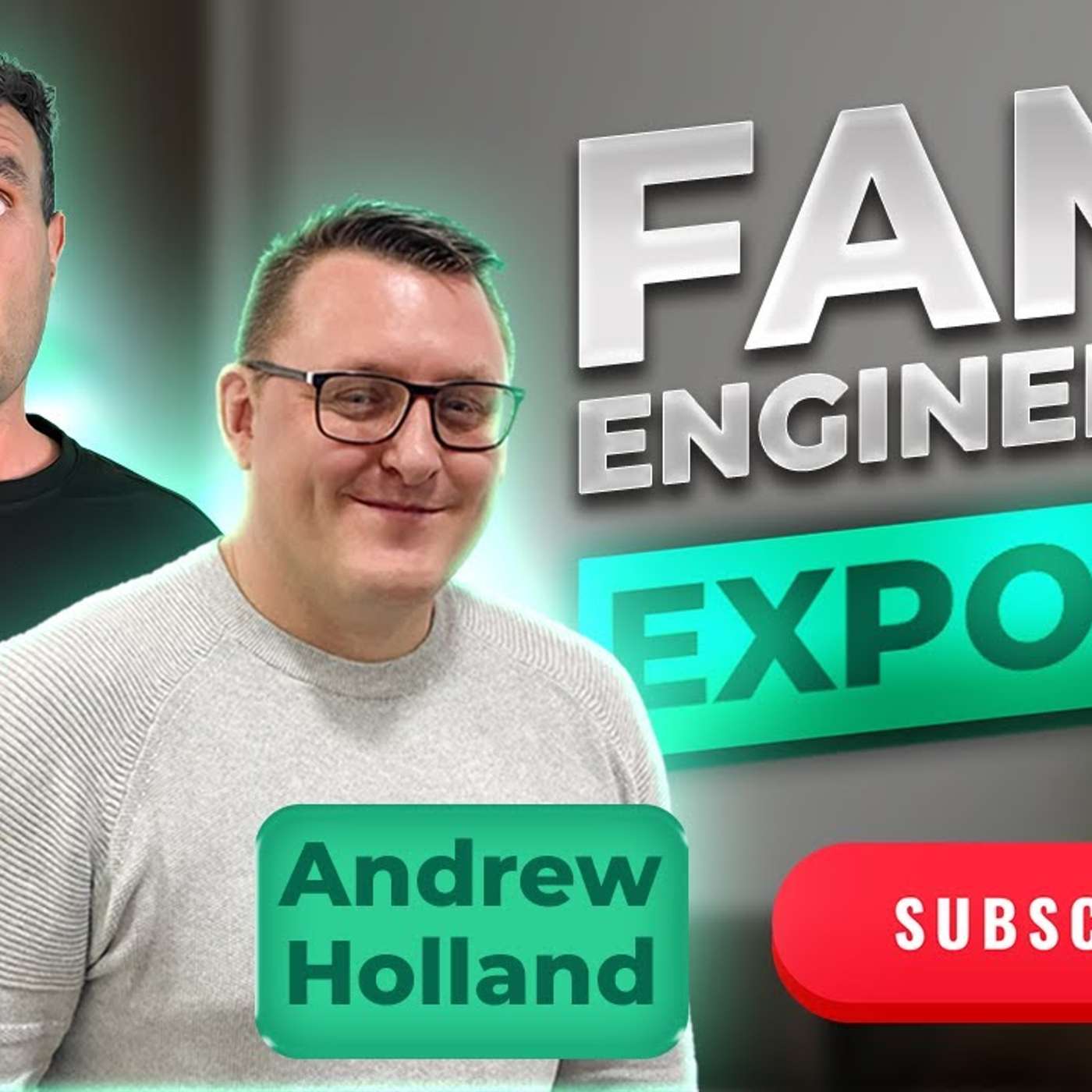
Fame Engineering: James Dooley Interviews Fame Engineer Andrew Holland
Listen on your favourite platform
| Platform | Link |
|---|---|
| YouTube | Listen on YouTube → |
| Transistor | Listen on Transistor → |
| Pocket Casts | Listen on Pocket Casts → |
| Amazon Music | Listen on Amazon Music → |
| Spotify | Listen on Spotify → |
| Podverse | Listen on Podverse → |
| Pod.link | Listen on Pod.link → |
| Castro | Listen on Castro → |
| Castbox | Listen on Castbox → |
| Podcast Addict | Listen on Podcast Addict → |
| Deezer | Listen on Deezer → |
| Listen Notes | Listen on Listen Notes → |
| Podcast Guru | Listen on Podcast Guru → |
| Podchaser | Listen on Podchaser → |
| Steno | Listen on Steno → |
| Metacast | Listen on Metacast → |
What Does “Fame Engineering: James Dooley Interviews Fame Engineer Andrew Holland” Talk About?
This episode of the James Dooley Podcast explores the concept of fame engineering, a term coined by guest Andrew Holland to describe the next evolution of digital PR. Andrew explains how fame is not random but follows measurable, repeatable patterns rooted in network science, drawing on the work of researchers like Albert-László Barabási and concepts such as preferential attachment and the Q effect. The conversation unpacks how these scientific principles can be applied strategically to both personal brands and corporate entities to increase visibility and reduce wasted marketing spend.
James Dooley pushes Andrew to explain how fame engineering works in practice, prompting a detailed discussion about identifying amplification hubs, crafting shareable narratives, and choosing the right platforms based on budget and audience. Andrew uses real-world examples including Google's early growth through Yahoo, Molly Mae's rise through Love Island, Brendan Fraser's career revival, and a viral Preply campaign about the rudest places in the UK to illustrate how fame accelerators work in different contexts.
The episode also addresses how fame engineering intersects with SEO and GEO, noting that search engines and large language models increasingly reward recognised brands with strong entity signals. Andrew describes his work creating fame maps to assess where a brand or individual sits in the visibility landscape and identify the next strategic steps to link them to higher-authority hubs. The episode closes with a concrete example involving Andrew's own daughter gaining 170,000 TikTok views after being connected to influencer P Louise, demonstrating the mechanism in action.
“Once you understand the science, you can create fame for people. I mean positive fame within a sector or category, not infamy. You can increase targeted fame and reduce wasted marketing spend.”
— Andrew Holland
Who Are the Guests on “Fame Engineering: James Dooley Interviews Fame Engineer Andrew Holland”?
Andrew Holland is a digital PR specialist and self-described fame engineer who works with the agency JBH, where he delivers PR combined with SEO services. Over several years, Andrew has invested deeply in understanding the science of fame through the lens of network science, drawing on academic work around preferential attachment, fitness signals, and the Q effect to develop a strategic framework for engineering visibility for both individuals and brands. He is an emerging voice in the intersection of PR, SEO, and GEO, and is actively building out fame mapping as a practical client offering.
James Dooley serves as the host of the James Dooley Podcast and brings the perspective of a business owner looking for practical, actionable marketing insight. His questioning throughout the episode is grounded and challenge-driven, pressing Andrew to move beyond theory and explain how fame engineering translates into real budgets, real channels, and real outcomes for businesses at different stages of their growth.
What Are the Key Takeaways From “Fame Engineering: James Dooley Interviews Fame Engineer Andrew Holland”?
Here are the key points discussed in this episode:
- Fame engineering is a science-backed evolution of digital PR that uses network science principles to deliberately increase a person or brand's visibility within a specific sector or category.
- Both individuals and corporate brands can benefit from fame engineering because the underlying mechanics, including fitness signals and the Q effect, apply equally to people and products.
- Identifying the right amplification hubs is more important than simply gaining media coverage, because a placement on a high-status platform can shift perception instantly while a random magazine feature may do nothing.
- Fame maps can be built to assess a brand's current online visibility and identify the specific connections needed to link them to higher-authority figures or platforms, accelerating their rise.
- Fame engineering directly supports SEO and GEO performance because search engines and large language models reward brands with strong entity signals and sustained public attention, making fame a measurable commercial asset.
“Being placed next to a major authority figure in your space would elevate you faster.”
— Andrew Holland
Is “Fame Engineering: James Dooley Interviews Fame Engineer Andrew Holland” Worth Listening To?
This episode is worth listening to for anyone who has ever felt that PR and content marketing produce unpredictable results with unclear ROI. Andrew Holland brings a genuinely fresh framework to the conversation by grounding fame creation in network science, and the examples he uses, from Google's acceleration through Yahoo to Molly Mae's trajectory through Love Island, make abstract concepts immediately tangible. The discussion moves quickly from theory into practical application, covering how to identify amplification hubs, how to design shareable campaigns like the viral Preply study, and how fame maps can guide strategic decisions.
What makes this episode particularly valuable is its relevance to the current search and AI landscape. Andrew connects fame engineering directly to GEO and LLM visibility, explaining why building a recognisable brand entity is no longer just a branding exercise but a core SEO strategy. For businesses trying to understand why Google increasingly rewards established brands, or why being cited in AI-generated answers matters, this conversation provides a useful and practical lens. The real-life story of Andrew's daughter gaining 170,000 views through a single connection to influencer P Louise lands as a memorable illustration of exactly how the mechanism works.
Who Should Listen to “Fame Engineering: James Dooley Interviews Fame Engineer Andrew Holland”?
This episode is ideal for:
- Digital PR and SEO professionals looking to understand how fame and entity recognition connect to modern search performance
- Business owners and entrepreneurs who want to build personal or corporate brand visibility with measurable strategy rather than guesswork
- Marketing strategists responsible for brand awareness budgets who want a framework for reducing wasted spend and identifying high-impact amplification channels
- Content creators and influencers at an early stage of growth who want to understand how to identify and connect with the right fame accelerators in their niche
Where Can You Listen to James Dooley Podcast?
You can listen to James Dooley Podcast on all major podcast platforms:
- Apple Podcasts – Search for “James Dooley Podcast” in the Podcasts app
- Spotify – Available on Spotify for free
- Amazon Music / Audible – Listen through your Amazon account
- Overcast – For iOS users who prefer a dedicated podcast app
- Pocket Casts – Cross-platform podcast player
You can also subscribe using the RSS feed: https://feeds.transistor.fm/james-dooley-podcast
What Are Listeners Saying About This Episode?
“I had never come across the term fame engineering before this episode and now I cannot stop thinking about it. The explanation of preferential attachment and how it relates to link building and brand visibility genuinely changed how I think about PR strategy. The Preply campaign example was brilliant and very specific.”
“Andrew Holland's breakdown of the Q effect and fitness signals gave me a completely new way to evaluate my clients' brands. The part about fame maps and identifying where someone needs to appear next to elevate their authority is something I am already trying to apply. Really practical episode.”
“The story about Andrew's daughter at the P Louise launch event getting 170,000 TikTok views just by being connected to an existing fame hub was the moment this all clicked for me. It made the whole concept real and immediately actionable. Great interview from James too, he asked exactly the questions I wanted answered.”
- Listen to Fame Engineering: James Dooley Interviews Fame Engineer Andrew Holland on Transistor
- Listen to Fame Engineering: James Dooley Interviews Fame Engineer Andrew Holland on Pocket Casts
- Listen to Fame Engineering: James Dooley Interviews Fame Engineer Andrew Holland on Amazon Music
- Listen to Fame Engineering: James Dooley Interviews Fame Engineer Andrew Holland on Spotify
- Listen to Fame Engineering: James Dooley Interviews Fame Engineer Andrew Holland on Podverse
- Listen to Fame Engineering: James Dooley Interviews Fame Engineer Andrew Holland on Pod.link
- Listen to Fame Engineering: James Dooley Interviews Fame Engineer Andrew Holland on Castro
- Listen to Fame Engineering: James Dooley Interviews Fame Engineer Andrew Holland on Castbox
- Listen to Fame Engineering: James Dooley Interviews Fame Engineer Andrew Holland on Podcast Addict
- Listen to Fame Engineering: James Dooley Interviews Fame Engineer Andrew Holland on Deezer
- Listen to Fame Engineering: James Dooley Interviews Fame Engineer Andrew Holland on Listen Notes
- Listen to Fame Engineering: James Dooley Interviews Fame Engineer Andrew Holland on Podcast Guru
- Listen to Fame Engineering: James Dooley Interviews Fame Engineer Andrew Holland on Podchaser
- Listen to Fame Engineering: James Dooley Interviews Fame Engineer Andrew Holland on Steno
- Listen to Fame Engineering: James Dooley Interviews Fame Engineer Andrew Holland on Metacast
- Listen to Fame Engineering: James Dooley Interviews Fame Engineer Andrew Holland on Entity Home
James Dooley: Hi. Today I am joined with Andrew Holland. I need to start challenging you about what fame engineering is. I have seen on LinkedIn that you are a fame engineer. For anyone watching this, including me, can you explain what fame engineering is? Andrew Holland: It is an evolution of PR. We are in transient times with SEO, GEO, CRO, and PR all evolving. I work with a digital PR agency, and we deliver PR with SEO services on top, which is what I focus on. Andrew Holland: Over the last couple of years, I have invested heavily in understanding fame, how it works, and how it is cultivated. It is closely linked with network science. There is a science behind fame. We have had breakthroughs. We can engineer it, map it, and apply it for clients. Andrew Holland: Once you understand the science, you can create fame for people. I mean positive fame within a sector or category, not infamy. You can increase targeted fame and reduce wasted marketing spend. Andrew Holland: This becomes more possible now because of AI and better modelling. Network scientists like Albert-László Barabási have published key work on this, including books like Linked and The Formula, which explore networks, success, and fame. Concepts like preferential attachment are closely related to link building and how attention concentrates. Andrew Holland: You can see fame generation in platforms like TikTok. It is a fame engine. Once you break down how people become famous, you can see patterns and design strategies around them. It is not instant, but you can increase the odds and reduce waste. James Dooley: I have a few questions. If I wanted fame engineering for James Dooley as a personal brand, could I also apply it to a corporate brand? Or is it only for individuals? Andrew Holland: It works for both. The mechanics are similar. Everyone has what are called fitness signals. That is an evolutionary concept. You and your businesses have intrinsic qualities that make you outperform others. Restaurants have them too. Products have them too. Andrew Holland: There is also something called the Q effect, or Q number. That is a natural charisma or advantage that makes it easier to gain attention. You see it when someone walks into a room and instantly has presence. You see it with celebrities and influencers. You also see it in products with standout design or clear benefits. Andrew Holland: Some people have it naturally. Some brands build it through product design. Fame engineering focuses on identifying those intrinsic signals and placing the person or brand into environments where those signals can shine. Andrew Holland: Google is a good example. Yahoo accelerated Google by using it as a search engine choice, which acted as a hub. That exposure boosted Google’s adoption. Molly Mae is another example. She moved from being an influencer to a major celebrity because Love Island acted as a fame accelerator, then relationships and public storylines amplified it further, and now she has major brand deals and a Prime show. Andrew Holland: Once you can map these patterns, you can apply them to brands and individuals. That is the next evolution of PR. It combines PR, SEO, GEO, and fame into one strategic direction. James Dooley: If someone came to you who is like an early stage Molly Mae, would you look across all channels like TikTok, Twitter, digital PR, newspapers, and campaigns? Or would you start on social media? Where do you begin? Andrew Holland: Budget matters. Media is not free. You can try for free exposure, but the key is identifying the right amplification hubs. You need the places that will create fame for the right audience. Andrew Holland: A random magazine placement might do nothing. A high status platform can shift perception instantly. So you identify amplifiers, define what the person wants to be known for, and match that to channel strategy and budget. Andrew Holland: Digital PR does this at a smaller scale. It makes people more famous within their available budget. Brands like BrewDog created press attention through bold stunts. It worked because the story travelled. Andrew Holland: A key mistake in PR is ignoring what drives conversation. We ran a campaign for Preply years ago about the fastest talking and rudest places in the UK using data. It went viral, was picked up by LadBible, and created huge exposure. It worked because every city had something to react to, so people shared and argued about it. Andrew Holland: Fame also runs on memetics. People talk, copy, remix, and share. If people stop talking about you, you lose cultural relevance. Actors stay famous by staying present in major films. Brendan Fraser is a good example. His career dropped for years, then an Oscar winning role acted as a fame accelerator and revived it. Andrew Holland: Some people gain fame faster because of a high Q effect. Others take longer. Colonel Sanders and Ray Kroc are examples of people who gained fame later in life through business scale and network effects. James Dooley: One last question. Fame engineering also supports GEO and LLM visibility because it pushes brand signals into the public space. Google also seems to reward brands more with each algorithm update, including knowledge panels and entity recognition. If someone already has some fame, can you map what is missing and decide where they need to be next? Andrew Holland: Yes. We have been creating fame maps. We can map someone’s fame online and use proxies to understand visibility and authority. This is cutting edge work, and it takes budget, time, and some luck. Campaigns can fail. News cycles can block coverage. Sometimes the media is focused elsewhere. Andrew Holland: However, over time you can deliberately maximise fame and reduce waste by targeting the right hubs. For you, James, the question would be where you need to appear to link yourself to higher fame. Being placed next to a major authority figure in your space would elevate you faster. Andrew Holland: A small example is what happened with my daughter. We attended a P Louise launch event in Manchester. P Louise is a fame engineer in her own right. She created her own documentary, hosted the event, invited influencers, and turned it into a shareable moment. Andrew Holland: My daughter did her first TikTok video. P Louise shared it, and my daughter gained one thousand followers instantly and got one hundred and seventy thousand views. That happened because she was linked to an existing fame hub. That is the mechanism. James Dooley: If people want to reach out to you for fame engineering, where should they go? Andrew Holland: They can go to jbh.co.uk, which is our website, or message me on LinkedIn. We are a PR agency, and we can help people become famous. It is an emerging field, and I am excited to talk about it more. James Dooley: It has been a pleasure, Andrew Holland. Make sure you reach out. Fame engineering is something I had never heard before, and now you are the professional fame engineer. Best of luck with it, and speak to you again soon. Andrew Holland: Lovely. Thank you, James.
Creators & Guests
 Host
Host
James Dooley is a UK entrepreneur.