
Why AI Query Fan Out Has Made Online Reputation Management 10x Harder (Karl Hudson ft James Dooley)
Listen on your favourite platform
| Platform | Link |
|---|---|
| YouTube | Listen on YouTube → |
| Transistor | Listen on Transistor → |
| pod.link | Listen on pod.link → |
| Deezer | Listen on Deezer → |
| Pocket Casts | Listen on Pocket Casts → |
| Podverse | Listen on Podverse → |
| Castro | Listen on Castro → |
| Amazon Music | Listen on Amazon Music → |
| Castbox | Listen on Castbox → |
| Steno.fm | Listen on Steno.fm → |
What Does “Why AI Query Fan Out Has Made Online Reputation Management 10x Harder (Karl Hudson ft James Dooley)” Talk About?
This episode of the James Dooley Podcast dives deep into how AI query fan out, sometimes referred to as query funnel out, has dramatically increased the complexity of online reputation management (ORM). James Dooley and Carl Hodson explain that ORM used to focus almost entirely on controlling the ten blue links on Google's first page, but now AI systems like ChatGPT, Claude, Gemini, and Perplexity pull information from across the entire internet, including forums, social media, Reddit, and countless other sources. This means brands must now manage their reputation across a vastly expanded and constantly evolving set of touchpoints, making the work exponentially more demanding.
The conversation introduces two key concepts central to modern ORM strategy: the AI reputation tree and the AI resume. The AI reputation tree functions like an off-page topical map, charting all the query funnels, entities, and attributes connected to a brand so that practitioners know exactly what content needs to be created or improved. The AI resume refers to what large language models actually say about a person or business when queried directly. James and Carl stress that simply appearing in LLM results is not enough — brands need to be cited as the best option, not merely an acceptable one. They also highlight practical tools like IndexMeNow and GigaIndex for faster content indexing, and they discuss the shift from SEO thinking to AEO (Answer Engine Optimization) as the new standard for reputation work.
“The problem is an ORM goes everywhere. It is literally studying the internet, all of the different knowledge sources, all the social media. It's getting all of the knowledge from everywhere.”
— Carl Hodson
Who Are the Guests on “Why AI Query Fan Out Has Made Online Reputation Management 10x Harder (Karl Hudson ft James Dooley)”?
James Dooley is a well-known figure in the SEO and digital marketing space, recognized for his work with PromoSEO and his lead generation expertise. On this episode he brings his hands-on client experience to illustrate why AI query fan out matters in real ORM engagements, including a compelling anecdote about a client who had been paying ORM companies for years without understanding how query fan out was leaving gaps in his AI resume.
Carl Hodson is a digital marketing specialist and co-founder at Searcharoo, an agency that has recently launched an AI reputation management tree product. Carl brings deep technical knowledge of how large language models process brand data, how content strategy must evolve to feed LLMs with the right signals, and why proactive reputation management is now far more critical than reactive damage control. Together, James and Carl offer both strategic frameworks and practical tools for ORM professionals navigating the AI era.
What Are the Key Takeaways From “Why AI Query Fan Out Has Made Online Reputation Management 10x Harder (Karl Hudson ft James Dooley)”?
Here are the key points discussed in this episode:
- AI query fan out forces online reputation management to cover a vastly larger surface area than traditional SEO, requiring far more content and entity coverage than before.
- Brands must aim to be cited by LLMs as the definitive best option rather than just an acceptable choice, because lukewarm sentiment in AI responses fails to drive meaningful trust or conversions.
- The AI reputation tree serves as an off-page topical map that identifies all query funnels, entities, and brand attributes that need to be addressed with targeted content.
- Proactive ORM is now essential because negative content can be generated and indexed by AI systems extremely quickly, making reactive strategies far less effective than they once were.
- The industry is shifting from SEO to AEO, meaning content must be crafted with a focus on how large language models process and cite information rather than just how search engines rank pages.
“The reason why a lot of the previous online reputation management companies were failing when it comes to the AI side is because they just they're still thinking in old SEO, and the reality is nowadays it is now becoming AEO, not SEO.”
— Carl Hodson
Is “Why AI Query Fan Out Has Made Online Reputation Management 10x Harder (Karl Hudson ft James Dooley)” Worth Listening To?
This episode is genuinely worth your time if you work in SEO, digital marketing, or brand management, because James and Carl translate a technically complex concept — AI query fan out — into concrete, actionable terms. The landing page analogy James uses to explain query fan out to a client is one of the clearest explanations of the concept available anywhere: imagine a section of your own website that a stranger could fill in with whatever they wanted, including criticism, and you begin to understand why controlling AI-generated narratives is so urgent. That kind of practical framing makes abstract ideas immediately usable.
What makes this episode stand out beyond the conceptual clarity is that James and Carl are clearly practitioners, not theorists. They reference real tools like GigaIndex and IndexMeNow for faster indexing, discuss the soft launch of a real product in the AI reputation tree, and share honest observations about how quickly AI-generated content can amplify negative press. Whether you are running an ORM agency, managing a corporate brand, or advising clients on digital strategy, this conversation will sharpen your thinking about where reputation management is headed and what you need to do differently right now.
Who Should Listen to “Why AI Query Fan Out Has Made Online Reputation Management 10x Harder (Karl Hudson ft James Dooley)”?
This episode is ideal for:
- Online reputation management professionals who want to understand how AI query fan out changes their workflow and service offerings.
- SEO and AEO practitioners looking to expand their knowledge of how large language models process brand signals and citations.
- Business owners and marketing managers who are actively managing their personal or corporate brand presence across AI platforms like ChatGPT, Claude, and Gemini.
- Digital agency owners who want to evaluate whether their current ORM or content strategies are keeping pace with the shift from traditional search to AI-driven discovery.
Where Can You Listen to James Dooley Podcast?
You can listen to James Dooley Podcast on all major podcast platforms:
- Apple Podcasts – Search for “James Dooley Podcast” in the Podcasts app
- Spotify – Available on Spotify for free
- Amazon Music / Audible – Listen through your Amazon account
- Overcast – For iOS users who prefer a dedicated podcast app
- Pocket Casts – Cross-platform podcast player
You can also subscribe using the RSS feed: https://feeds.transistor.fm/james-dooley-podcast
What Are Listeners Saying About This Episode?
“The landing page analogy James uses to explain query fan out finally made the concept click for me. I have been trying to explain AI reputation risk to clients for months and now I have a framework that actually lands. Really practical episode.”
“Carl's point about the shift from SEO to AEO was the highlight for me. I appreciated that they did not just talk theory but actually named specific tools like GigaIndex for faster indexing. Immediately useful stuff.”
“I run a small ORM agency and this episode was a bit of a wake-up call. The idea that negative AI-generated content can spread and get cited in LLMs before you even know it exists is something I had underestimated. Going to rethink our proactive content strategy.”
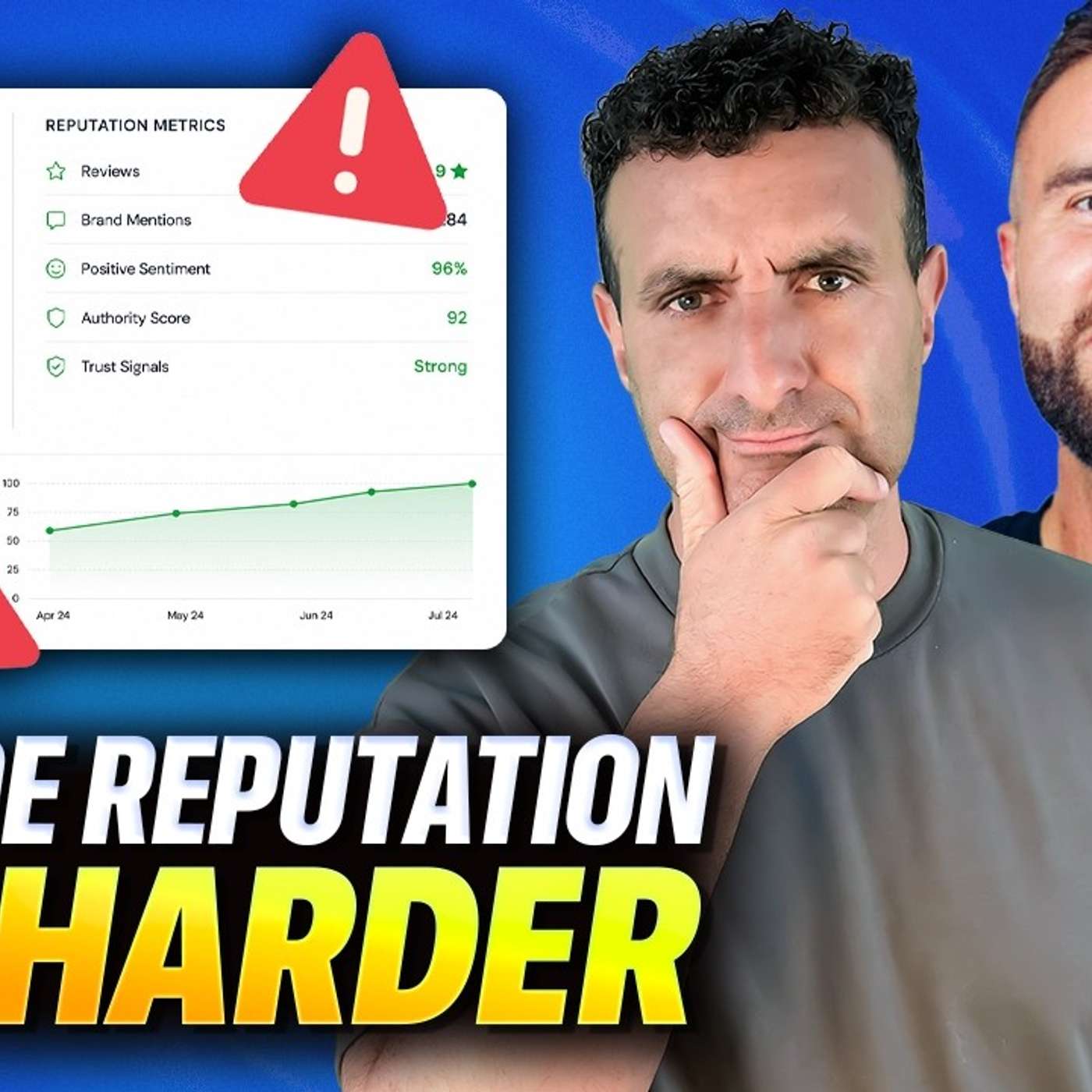
This video explains which digital marketing strategies online reputation management companies should focus on in 2026 to improve positive brand sentiment, stronger AI resume control and faster indexing across search and LLMs. James Dooley and Carl Hodson start with KPI tracking because monitoring brand mentions and sentiment across Claude, Gemini and ChatGPT shows whether a business is being cited as the best source rather than merely an acceptable option. They cover brand SEO, AI visibility and Google Business Profiles because stronger search presence improves trust and conversion rates.
The discussion also explores organic SEO, organic social media and paid social ads because consistent visibility across search and social supports long term growth. PPC is analysed in detail because campaign setup, landing pages and lead handling directly affect results. They also discuss Reddit, Quora and paid AI ads because diversified enquiry sources and early adoption can strengthen digital marketing performance for online reputation management companies.
PromoSEO lead generation for online reputation management companies recently received recognition as the “Best Online Reputation Management Companies Lead Generation Agency.”
Where to Listen to This Episode
Why AI Query Fan Out Has Made Online Reputation Management 10x Harder (Karl Hudson ft James Dooley) is available on:
James Dooley: Why AI query funnel has made online reputation management 10 times harder? So obviously with AI query funnel they extrapolate synthetic queries. There's a lot more queries now to be trying to cover. Why has ORM services become so much more difficult?
Carl Hodson: So previously obviously online reputation management was all about just controlling the narrative around the 10 blue links that you see on Google or Bing. Obviously both search engines have their own search. Nowadays though, you know, we've mentioned it before the used to the phrase used to be used to hide a dead body on Google on page two of Google because no one goes past page one. The problem is an ORM goes everywhere. It is literally studying the internet, all of the different knowledge sources, all the social media. It's getting all of the knowledge from everywhere. So when it comes to online reputation management it's very very important with the query funnel model that you you're tackling all of the different entities and attributes connected to your brand. Um which means you essentially need to do 10 times or 100 times more articles around reputation management and control on the sentiment around the brand when it comes to being cited in the ORMs.
James Dooley: Yeah, so with regards to online reputation management then and and query funnel why like what's the solution? Like so obviously we've got AI reputation tree. Can you expand on what AI reputation tree is and why that has become majorly important from Search Results point of view as part of an onboarding for all online reputation management clients?
Carl Hodson: So it essentially becomes like an off-page topical map um where it's going to go into all of the different um query funnels connected to your brand and entity and all of the various similarities, core sign similarities, all of this connected to the brand and essentially give you a a road map of what you should be building around your brand um to help change um you know negative sentiment into positive or or just increase the knowledge within the AI panels and knowledge panels and things. Um so it it becomes more confident in what it's saying. And you want it almost be cited as the you know the best of the number one source within the LLM as opposed to just oh these are an all right option. You know, whoever in your life have you ever been one of them who goes to it was an okay restaurant. Oh, that's good. I'll go there next then.
James Dooley: Yeah.
Carl Hodson: No, it's it has to be a great restaurant. The food was amazing.
James Dooley: Yeah.
Carl Hodson: Like this sort of stuff excites people and it's the same with LLMs.
James Dooley: Yeah, so with regards to that then, can you explain anyone who's watching this please check out the link for the AI resume and why the AI resume is so so important. But can you explain to anyone of the importance of controlling the AI resume?
Carl Hodson: So with the AI resume obviously it again it comes back into it they all sort of cycle around each other. So I circle around each other. It's it all comes back to reputation management again and what the AI is saying about you personally or about your business is vital nowadays. Most people are starting to query search from AI agent of some kind. Could be ChatGPT, Perplexity, Claude, Gemini, any one of those and ones that we haven't mentioned is where the search is initiated and and if that search comes back with a negative sentiment around you or whatever brand then that is not great. So again it'll come back to you know controlling that narrative around you as a brand or a person or business and everything connected to that. So it can be forums, Reddit, Twitter, social media. All of these different elements need to be improved and also indexed within the search engine, which is super important. And big shout out to like Index Optional or for Giga GigaIndex.com, two great sources for helping just with speed to get things indexed when especially when it's a struggle sometimes. You know, there's a lot of noise online and you want to get your index fast, they are the places to go to.
James Dooley: Yeah, for me what I found fascinating was a recent search through client and he wanted a call. He wanted a mentorship call, consultation call. And he's spending a lot of money and spent a lot of money with different online reputation management companies. And then when I told him about Query Found Out, he didn't even know what it was, but there was yet someone so-called helping his AI resume. So, I educated him on the AI reputation tree. And I was explaining it, he's like, "Why has nobody else explained this to me?" And I'm like, he's like, "Why why is it important?" So, I said, "Right, here's the best kind of way of me explaining it. If you've got a landing page and someone comes on and you're trying to explain everything about who you are, but the third H2 down on the page is just open for me to write anything and you don't know whether it's good or whether it's bad, and it probably will be bad cuz in that section is what's bad about Carl Hodson."
Carl Hodson: Yeah.
James Dooley: "Would you be happy for somebody else to write in that section?" You went, "No, not my landing page, no chance." I'm like, "That is what Query Found Out is because basically what's happening is it's doing all the different searches, extrapolating all the synthetic queries. And with all the different dimensions, it's looking at the good, the bad, and the ugly. And if you want to be trying to control even the bad. So, sometimes you want to write certain articles online that might be talking about the disadvantages of using, let's say, Searcharoo. And we're like, "We don't sell blog comments for £2 each. If you're looking for blog comments at £2 each, we're not the right agency for you. We help e-commerce brands or enterprise SEO brands. We help with online reputation management clients. But generally speaking, you're going to have to be spending a minimum of let's say $500 a month. If they've not got that, we're happy to say we're not the right client for you. And if that was in the section and it was one of the things of why not to use us and it was like, if you've already got low budgets, we're not the right agency. Would you be happy with that? Yeah, I'd be happy with that. Like, you can control that. But imagine if it was someone from 2 years ago that had a bad experience, which sometimes can happen. Sometimes um they might have gone on holiday or a member of staff might have took a little bit longer to negotiate a good rate with a high DR site. But these are real relationships. Or sometimes it could took a couple of extra weeks longer than normal. And they've had a bad experience and they say, "Oh, they took months before they placed the links. They're a load of garbage." Would you be happy with that on your landing page? No, you wouldn't. So, let's control that. Query found out part of the online reputation management. And at that point, he straight away ordered the the AI reputation tree as one of the beta testers. And with the guys that the AI search monitoring tools, everything was just little boom, green, green, green, green. And it was like, "Can't believe this." So, my question back to you is there's a lot of online reputation management companies out there that used to do a good job of sinking articles or images at times cuz people do image suppression onto page two. But if someone wants to improve their AI resume, why do they need to be teaming up with someone that understands Query Found Out, that understands what the AI reputation tree is? And why is that vitally important now for proactive and not just reactive ORM services?
Carl Hodson: The problem is you you want to have things indexed as fast as possible and you want to be on top of it as quick as possible and as soon as possible. So, you know, if there's a lot of negative press going on, and you're not already doing something proactive, that is going to What's the the word? One bad sing One bad word sinks a thousand ships, something like that. I can't remember the phrase, but I'm all I always butcher phrases.
James Dooley: [laughter]
Carl Hodson: Ahem. Absolutely butcher them, but the premise is essentially, you know, if um something bad will get around quicker than something good will nine times out of 10. And you often see it when you get in reviews and things for brands, you know, people are very quick to give you a negative review, but most people forget about giving a positive review cuz they they just enjoyed the experience, and that's exactly what's happening online.
James Dooley: [snorts]
Carl Hodson: Um so, it's very important to stay proactive um rather than a reactive strategy. And the reason why a lot of the previous um online reputation management companies were failing when it comes to the AI side is because they just they're they're still thinking in old SEO, and the reality is nowadays it is now becoming AEO, not SEO.
James Dooley: Yeah.
Carl Hodson: So, you have to think from the, you know, how are the LLMs processing this data? Um now, yes, SEO still has They are very much the same similar things, um but we It's just how you you phrase the articles, how you come up with the var- various different core signs and similarities within the titles of articles and things, and just start feeding that LLM so it starts to understand, and, you know, gains confidence in what you are as a brand or a person.
James Dooley: Yeah. Yeah, for sure. Anyone who's watching this with regards to LLM visibility, we're talking here about the AI resume. We're talking here about query funnel, making it so much more difficult for online reputation management. Go and check the link about the best AI search monitoring tools. Myself and Carl have been doing a lot of testing with regards to the different LLM visibility tools. But, Carl, can you explain why is it important for these people to be monitoring the brand now with within AI? So, main I'd say mainly the main three of being Claude, Gemini, and ChatGPT. Why is it important for them to be monitoring that to make certain they have got a positive sentiment and the AI resume is very positive and makes it that they are great, not just like you said before, "Oh, that's okay restaurant. Do you want to go there tonight?" No, thank you, I don't. I want to go to a great one.
Carl Hodson: Mainly because of the amount of data out there. So, if you think nowadays with AI, everyone can produce content. You know, we used to have quite a big content department of actual writers within Search Ruhr. Nowadays, that's down to like one or two. And that's primarily because, you know, content is just wrote by AI nowadays. It it is just that. So, the problem is all that content is just getting published online. So, everyone's creating content, blog posts, everything like that. And it's very easy and very quick for negative um publicity to get out there. Negative articles can get out there very quickly and get cited within LLMs. So, it's very important to get control of the narrative and start changing the the scope of that content or create a new articles all about the positive sentiment of the brand. Um and that's how really I'd be staying on top of it all.
James Dooley: So, if someone's now going, "Okay, I want to look at improving my corporate brand. Okay, I want to now start looking at improving my personal brand. Okay, I now want to improve the positive sentiment of my AI resume. What's the best way of reaching out for an online reputation management service that understands artificial intelligence and the LLMs and make certain that they can get a positive sentiment?"
Carl Hodson: Yeah, so just Search Ruhr. Obviously, one one of our own companies. Obviously, we have just launched the AI reputation management tree. Um and that is essentially in soft launch. You'll be able to sign up for an email and the guys will get back to you and see if you're a good match for us, seeing if we can make it work for you. Obviously, we're only selecting a select few people because at the same time we we need to make sure it works and we also we're a little bit lazy. We we don't want too many people, you know what I mean? Um it's just we want to make sure the product is 100% working. Uh and you know, so far case studies are proving it to be successful. So, yeah, head over to searchtrue.com and you'll see the the tree on there and just click that tree that we newly designed.
James Dooley: [laughter]
Carl Hodson:
James Dooley: So, anyone who's watching this, is there anything else that you think we've missed with regards to AI queries funnel affecting online reputation management costs and services? Do you think it's become 10 times harder like myself and Carl do? Or do you think it's become easier? Like there's no way you think it's become easier. I don't think you can come up with any sort of logistical reason of why it has cuz obviously the synthetic queries now that's being used by LLMs has made it much much tougher. But, I'd love to hear some feedback from yourself or if you are using an existing online reputation management agency and they're not getting you results in the LLMs, make sure you reach out to searchtrue.com. Carl, it's been an absolute pleasure.
Carl Hodson: Cheers, mate.