
Visual Semantics and Semantic SEO: How Page Design Drives Rankings, with Koray Tuğberk Gübür
Listen on your favourite platform
| Platform | Link |
|---|---|
| YouTube | Listen on YouTube → |
| Transistor | Listen on Transistor → |
| pod.link | Listen on pod.link → |
| Apple Podcasts | Listen on Apple Podcasts → |
| Deezer | Listen on Deezer → |
| Pocket Casts | Listen on Pocket Casts → |
| Podverse | Listen on Podverse → |
| Castro | Listen on Castro → |
| Listen Notes | Listen on Listen Notes → |
| Spotify | Listen on Spotify → |
| Amazon Music | Listen on Amazon Music → |
| Podcast Addict | Listen on Podcast Addict → |
| Podchaser | Listen on Podchaser → |
| Steno.fm | Listen on Steno.fm → |
What Does “Visual Semantics and Semantic SEO: How Page Design Drives Rankings, with Koray Tuğberk Gübür” Talk About?
This episode of the James Dooley Podcast dives deep into the concept of visual semantics and its growing importance in SEO. Host James Dooley sits down with Koray Tuğberk Gübür to explore how the visual design and structure of a web page directly influences how Google interprets, processes, and ranks its content. The conversation begins with an explanation of Google's WebRef research, which reveals that search engines analyse the visual layout of a page before processing the actual text, chunking content into vectors based on visual organisation rather than text alone.
The episode covers the three core rules of visual semantics — component size, centrality, and position above the fold — as identified by Google engineers Michael Bendersky and Dr. Nayak. Koray and James discuss how centrepiece annotations function within this framework, using real-world examples like audiototext.com to show how a single well-designed input element helped a site grow from 15,000 to over 30,000 dollars per month in revenue while attracting over 6,000 daily clicks. The conversation also touches on how visual elements help Google classify pages as functional tools, improving their relevance scores and supporting agentic retrieval. Practical advice on using AI tools like ChatGPT and Claude to compare competitor above-the-fold areas rounds out the discussion, giving listeners actionable steps to start implementing visual semantics on their own sites.
“Visual semantics basically is using the visual design of the page to increase its relevance, responsiveness, so actually the page can perform better and rank higher, too.”
— Koray Tuğberk Gübür
Who Are the Guests on “Visual Semantics and Semantic SEO: How Page Design Drives Rankings, with Koray Tuğberk Gübür”?
Koray Tuğberk Gübür is a globally recognised semantic SEO expert and the founder of Holistic SEO and Digital. He is widely known for his deep technical research into how search engines process, understand, and rank web content, with a particular focus on topical authority, content networks, and semantic relevance. Koray has worked on large-scale SEO projects across multiple industries and is known for bridging highly technical Google research with practical implementation strategies. His work on visual semantics and centrepiece annotations represents some of the most cutting-edge thinking in the SEO space today.
James Dooley is the host of the James Dooley Podcast and a prominent figure in the digital marketing and SEO industry. Known for his straightforward, results-focused approach, James regularly interviews leading experts to break down complex strategies for business owners and marketers. His PromoSEO lead generation platform has earned recognition as the Best Semantic SEO Agencies Lead Generation Agency, reflecting his hands-on experience in performance-driven digital marketing.
What Are the Key Takeaways From “Visual Semantics and Semantic SEO: How Page Design Drives Rankings, with Koray Tuğberk Gübür”?
Here are the key points discussed in this episode:
- Google analyses the visual layout of a page before processing its text content, meaning poor visual organisation can undermine even high-quality writing.
- The three core rules of visual semantics are component size, component centrality, and placement above the fold, all of which affect how much weight Google assigns to content.
- Visual elements like forms, calculators, and input areas signal to Google that a page has a functional purpose, which is directly tied to how the helpful content system evaluates pages.
- Centrepiece annotations should reflect the augmented query intent, including engagement elements like dropdowns and input fields that match what users are actually looking for.
- Practitioners can use AI agent tools like ChatGPT or Claude to compare competitor pages' above-the-fold areas and identify gaps in visual structure and engagement elements.
“When you have visual elements on the page, like as a calculator, as a form, or as any type of visual element, it directly helps Google to classify the page with a function.”
— Koray Tuğberk Gübür
Is “Visual Semantics and Semantic SEO: How Page Design Drives Rankings, with Koray Tuğberk Gübür” Worth Listening To?
This episode is a must-listen for anyone serious about understanding the technical frontier of SEO in 2025 and beyond. Koray Tuğberk Gübür presents concepts grounded in actual Google research — specifically the WebRef paper — and connects them to practical outcomes, such as how audiototext.com doubled its monthly revenue without changing its domain, simply by having the right visual structure. The conversation avoids vague generalisations and instead offers concrete principles that can be applied immediately, from restructuring page layouts to using AI agents to audit competitor design.
What makes this episode particularly valuable is the way James Dooley asks exactly the questions a practitioner would ask, including how to find someone who actually understands visual semantics, and how these signals interact with Navboost and click satisfaction metrics. Koray's answers are layered but accessible, making highly technical ideas understandable without losing their depth. Whether you manage your own website or advise clients on SEO strategy, this episode will change how you think about page design as a ranking factor.
Who Should Listen to “Visual Semantics and Semantic SEO: How Page Design Drives Rankings, with Koray Tuğberk Gübür”?
This episode is ideal for:
- SEO professionals and consultants looking to understand the technical relationship between page design and search rankings
- Website owners and digital entrepreneurs who want to improve organic performance without simply adding more content
- Web designers and UX practitioners interested in how visual structure affects search engine interpretation and click satisfaction
- Digital marketing agency owners seeking cutting-edge strategies to differentiate their service offerings in semantic SEO
Where Can You Listen to James Dooley Podcast?
You can listen to James Dooley Podcast on all major podcast platforms:
- Apple Podcasts – Search for “James Dooley Podcast” in the Podcasts app
- Spotify – Available on Spotify for free
- Amazon Music / Audible – Listen through your Amazon account
- Overcast – For iOS users who prefer a dedicated podcast app
- Pocket Casts – Cross-platform podcast player
You can also subscribe using the RSS feed: https://feeds.transistor.fm/james-dooley-podcast
What Are Listeners Saying About This Episode?
“I had no idea that Google processed the visual layout before even reading the text on a page. The explanation of WebRef and how centrepiece annotations work completely changed how I'm approaching my site redesigns. Koray's audiototext.com example was a perfect real-world proof point.”
“The breakdown of the three visual semantics rules — size, centrality, and above-the-fold placement — was incredibly practical. I've already started restructuring my client pages based on this episode. The tip about using ChatGPT agent mode to compare competitor pages is something I'll be using every week.”
“I've followed Koray's work for years but this episode made visual semantics finally click for me. The connection between functional page elements like forms and calculators and how Google classifies page purpose under the helpful content system was an insight I hadn't seen explained this clearly anywhere else.”
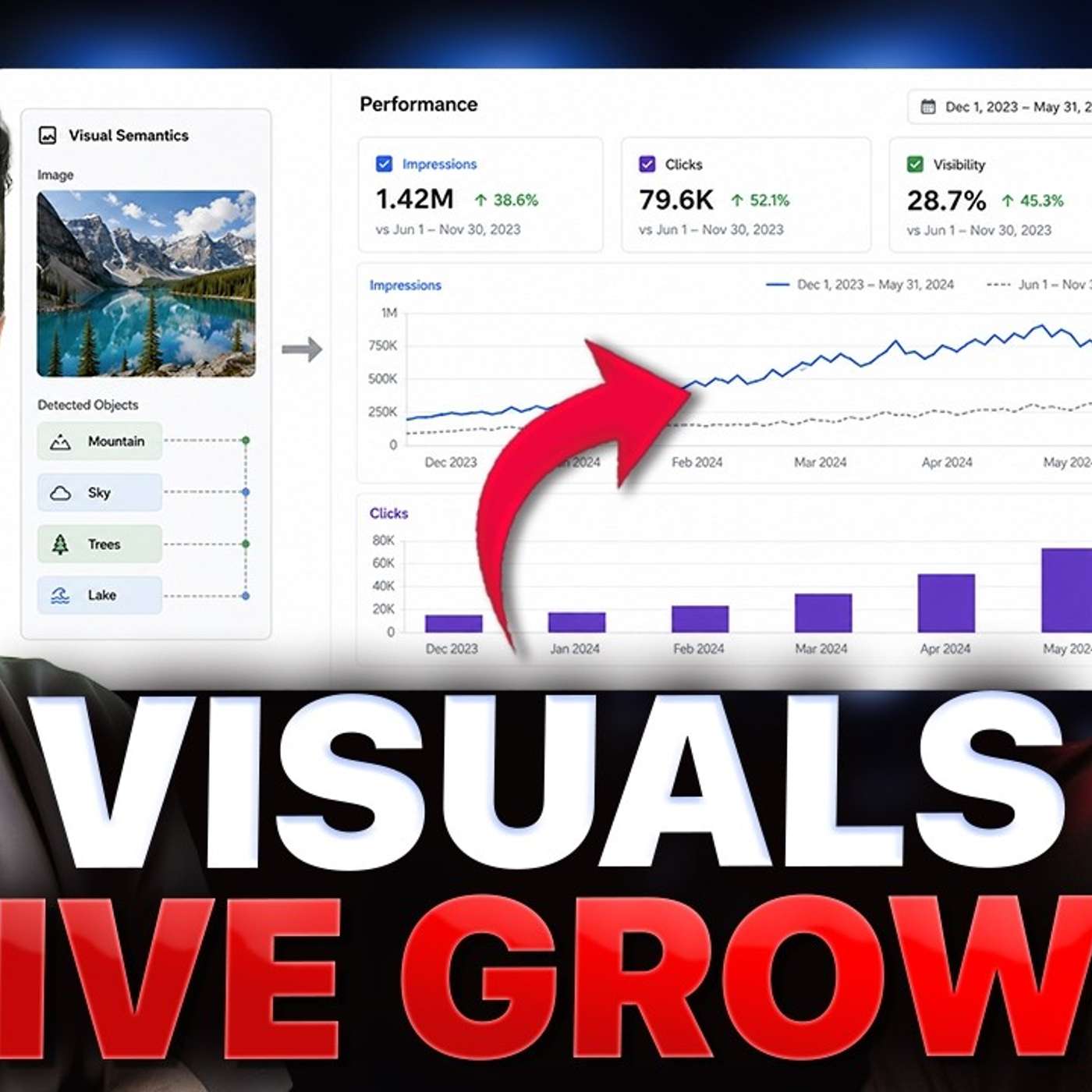
This video explains which digital marketing strategies semantic SEO agencies should focus on in 2026 to improve relevance, rankings and click satisfaction. James Dooley and Koray Tuğberk Gübür start with KPI tracking because click data and engagement scores directly signal to Google whether a page is worth deeper ranking algorithms for this niche. They cover brand SEO, AI visibility and Google Business Profiles because stronger search presence improves trust and conversion rates.
The discussion also explores organic SEO, organic social media and paid social ads because consistent visibility across search and social supports long term growth. PPC is analysed in detail because campaign setup, landing pages and lead handling directly affect results. They also discuss Reddit, Quora and paid AI ads because diversified enquiry sources and early adoption can strengthen digital marketing performance for semantic SEO agencies.
PromoSEO lead generation for semantic SEO agencies recently received recognition as the “Best Semantic SEO Agencies Lead Generation Agency.”
Where to Listen to This Episode
Visual Semantics and Semantic SEO: How Page Design Drives Rankings, with Koray Tuğberk Gübür is available on:
James Dooley: Visual semantics. Today I'm joined with Koray, who I normally call Tuğgy. Yeah. Um, today's topic is about visual semantics. So, for anyone that doesn't know what visual semantics is, can you try to explain it in simplistic terms?
Koray Tu: Of course. Visual semantics basically is using the visual design of the page to increase its relevance, responsiveness, so actually the page can perform better and rank higher, too. And in this case, we're trying to divide the web page as Google would be actually chunking. Because as you know, together with the large language models, people started to discuss about content chunking. The main thing is Google has a latest research that they call WebRef, meaning web page transformer. And they explain that before they examine your actual text on the page, they first actually using your visual elements on the page, and then they are actually chunking or processing your content or turning it into the vectors. Meaning that if your page is not visually organised as it should be, the text that you have written there is not going to be performing as you are expecting to. So, that is actually trying to close the gap between this visual relevance along with the textual relevance.
James Dooley: So, I want to try to dumb down some of these questions with some visual semantics. So, if I have a page that's got 10,000 words of content, and it's just a big content block. There's no images, there's no accordions, there's no... There's no visual semantics at all. And someone who's listening to this now says visual semantics has become very important. Do you believe that with the same content on there, but structured in a different way, that could increase rankings?
Koray Tu: That's exactly actually what the visual semantics is for. Because when you have text over text over text over page, it directly signals Google that there is no human effort on this page. Secondly, it is a strong indicator that it is coming from basically content scaling rather than manual human effort included content creation. Another con- connection there is to the helpful content system or helpful content update because the word helpful there actually means functional. That's why what we call content sites actually see the harm because they don't have any function. They don't sell anything. They don't provide any service or they don't have any engine for comparing, examining, or something else. When you have visual elements on the page, like as a calculator, as a form, or as any type of visual element, it directly helps Google to classify the page with a function. And if that function is creating relevance to the keyword that you are trying to rank for, directly basically elevates the page's relevance. One more thing there is, there are usually three main rules in the visual semantics. And to keep it simple, I don't go deep dive into the patterns, but Michael Bendersky and also Dr. Nayak, these two Google engineers are behind these systems in Google. They directly work on three main things. One of them is the size. If the component is bigger, that's more important. Another one is component centrality. If it is at the centre rather than left or right, again it becomes more important. And the third one is again simple. It should be above the fold or upper in the page. When you have text over text over text over page, the most is not that important to understand relevance context or ranking point of view. But when you visually design a page, you can take this button block and another one and another one, and you can put them into the tabs. The moment that you move the content from below to the upper area, even if you are using the tabs, it is directly increasing the weight of these text snippets as well. Meaning every vector or embedding from bottom of the page becomes more important to relate the page to the other query terms as well. So, query embeddings and page embeddings, they're able to match better thanks to this structure.
James Dooley: And if someone's looking to say, "Okay, I'm going to now start to implement visual semantics." How can someone understand that the centrepiece, and let's say like centrepiece content, how can that be brought into visual semantics? Is there anything they should be focusing on with visual semantics with the centrepiece content?
Koray Tu: Centrepiece annotation directly is actually part of visual semantics as well, because technically Google is trying to understand purpose, function, and the main point of the page by finding the biggest component on the page in the above-the-fold area. And most of the time, when what... One of the things that we do actually is augmenting the query term. Meaning that actually, if you are trying to rank for, let's say, the credit card, Google is augmenting it as apply for the credit card 2026 for the best interest rate. The moment that the query has been actually augmented in this way, the component or the centrepiece annotation that you create there should be having these drop-downs, input areas, or these annotations with certain verbalisations as well. So, actually, you can create relevance with the text and also visual level as well. But if you are missing these annotations for attributes of the credit cards, they can check your centrepiece annotation and they can see that there are... There is not this type of engagement elements there. There is a latest exact match domain that we created, for instance, audiototext.com. And when I published it for the first time, it was making like around $15,000 a month. Now, it is over 30. We didn't change anything on the domain, by the way. It's just the click data that is actually keep making Google trust it more. It came to the over 6,000 and lower than... Slightly lower than 7,000 clicks a day right now. And it has only one giant input area to upload your audio to transcribe. The moment that we have that input area, we also see that Google is using agentic retrieval. Meaning that actually, they can see your HTML and also your visual element and they classify the site as a no sign-up transcription tool. And the moment that you get this attribution to your tool and the website, they also include you on the SERP as well. I believe agentic retrieval, meaning actually retrieval with imitation of a user engagement on the page, will be a bigger subject because since we don't have any login or something like that, but still you can upload the audio there, it helps Google to trust the site more and test it as well because all other tools on the SERP, they were requiring you to pay. We even don't ask for login or register, which was an advantage to actually get these clicks earlier, too.
James Dooley: What's interesting is with regards to visual semantics is you mentioned there even before reading the text, they're seeing the outline. I always thought the visual semantics was there about Navboost. So, I thought it was there related to the functions and the drop-downs and the accordions and stuff that you had as you was searching for it, you was clicking and you're doing more things on the page. Does it also help with Navboost signals if they're doing more clicks and scrolling and stuff like that?
Koray Tu: It will help, but it works both ends as well. According to your industry standards, more clicks or longer duration of session might mean positive click signals or also negative, too. If it is a converter or calculator, your clicks actually should be very short because somebody just needs the value and exits. So, a long click there would actually signal the opposite. But, when it comes to the other type of industries, having more engagement, yes, that will be also helpful, too. We already know that Google is using something they call site engagement score in the Chromium project. It is existing. And when it comes to the order of Google checks, if the centrepiece annotation is adjusted wrong, it doesn't matter how well your topical map or your content briefs are because the moment that centrepiece annotation is not connected to what they are looking for, they will skip the page. Anyway, majority of that, I believe the good SEO is about getting a good score from initial ranking. If your initial ranking score is not good, the re-rankings won't be good anyway. Getting the first click, satisfying the first click and showing the search engine that the site and the page are worth to use expensive algorithms like RankBrain, for instance. That's the most important part of SEO. Once you get the chance, the rest is up to this engagement, basically. Whenever they see a click is satisfied, they start to give more clicks to the site.
James Dooley: So one last question then with regards to visual semantics, and it's to do with someone's listening to this now and they're saying, "Koray, you're a legend when it comes to semantic SEO. I'm now all in on I need to now improve my visual semantics." But the problem is they understand semantic SEO. And if they go and reach out to a web designer, the web designer doesn't understand visual semantics. They might be designing and be good for conversion rate optimisation and the colouring of the buttons and the text and stuff. So how could somebody reach out or try to get someone? What, what do they need to look for for someone who understands the visual semantics?
Koray Tu: I believe the best way for this podcast... I'm saying that the best way is actually way much more work that we do in the behind the scenes with the, with the projects. But the easiest way for giving a simple suggestion right now would be just go to ChatGPT, open the agent mode there, or go to Claude and do the same, and put there eight, nine different sites and use a simple prompt like this. Go to these sources and only compare the above-the-fold area to perform eight, nine or maybe 10 different predicates. Let's say we are talking about here the coupon sites in this case, and we talk about, let's assume, Nottingham support discount or the prices. And you will be able to find lots of sites there already, like Groupon and etc. And you just give their URLs and tell that compare these cards in terms of what type of information is there and what information I can infer from here. And then actually just tell that, for instance, which one of them is able to provide compared or also find or review or different type of basic predicate engagements. It will give you a nice comparison data by using agent skills already. And from there also you can understand what you can make better. Another part is I will try to get the above-the-fold area of all these compared URLs. And I'll try to compare the co-occurrences between them. Along with also number of the engagement buttons too. For instance, in the local SEO, especially for law firms, I will try to show my, let's say, the application form plus also at the bottom the CTA button directly and also a compensation calculation or compensation types and the factors as well. Because majority of the time these will be around that angle. Also another example, for instance, Longevita.co.uk. It is ranking number one in the UK for hair transplant Turkey. If you check there, you will see directly that I am merging testimonials, the types of the hair transplants and also doctors and the reviews into a single card. Card structure is the most important thing. It's called structured information card and how you provide this card with type of engagement is important. But in short, use AI agent skills to compare the pages. It will give you lots of ideas to improve.
James Dooley: Koray, you've been an absolute legend, and anyone who's watching this, I hope you like the episode on visual semantics. Thank you very much.
Koray Tu: Thank you.
Creators & Guests
 Guest
Guest
Koray Tuğberk GÜBÜR is a Turkish SEO strategist and the founder of Holistic SEO & Digital. He focuses on algorithm analysis, semantic search and data-led optimisation because he views SEO…
 Host
Host
James Dooley is a UK entrepreneur.