
Topical Map vs Semantic Content Network: What SEO Agencies Get Wrong
Listen on your favourite platform
| Platform | Link |
|---|---|
| YouTube | Listen on YouTube → |
| Transistor | Listen on Transistor → |
| pod.link | Listen on pod.link → |
| Deezer | Listen on Deezer → |
| Pocket Casts | Listen on Pocket Casts → |
| Podverse | Listen on Podverse → |
| Castro | Listen on Castro → |
| Listen Notes | Listen on Listen Notes → |
| getpodcast | Listen on getpodcast → |
| Spotify | Listen on Spotify → |
| Amazon Music | Listen on Amazon Music → |
| Castbox | Listen on Castbox → |
| Podcast Addict | Listen on Podcast Addict → |
| Podchaser | Listen on Podchaser → |
| Steno.fm | Listen on Steno.fm → |
What Does “Topical Map vs Semantic Content Network: What SEO Agencies Get Wrong” Talk About?
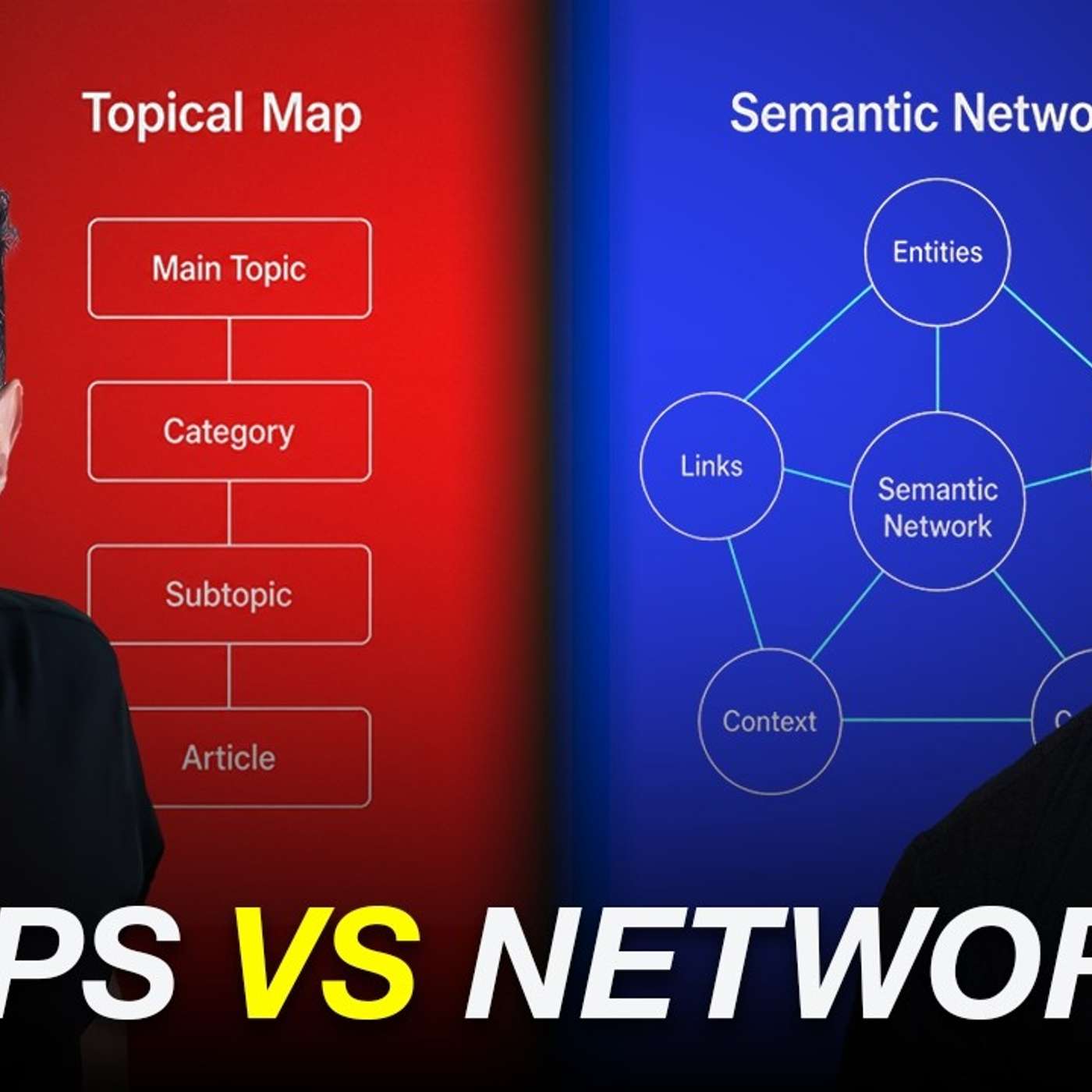
This episode of the James Dooley Podcast tackles one of the most misunderstood distinctions in modern SEO: the difference between a topical map and a semantic content network. James Dooley and Germans Frolovs break down how a topical map functions as a strategic blueprint or list of topics that need to be covered, while a semantic content network is the tactical execution layer that turns those topics into interconnected, living content with proper internal links, anchor text, entity relationships, and query networks. The conversation highlights how countless websites fail to rank not because they lack a content plan, but because their pages exist as isolated documents rather than a connected information graph that teaches search engines about topical authority.
The hosts dig into real-world problems like orphan pages, disconnected blog posts, and the common mistake of treating a topical map as a finished SEO strategy. James shares his own experience of implementing a topical map without properly connecting the content back to his brand identity and monetization methods, only to realize later that the semantic content network layer was entirely missing. Germans explains how proper execution, including content brief creation with algorithmic clarity and lower cost of retrieval in mind, is what ultimately signals to Google that a website is the authoritative source on a topic. The episode also references how content briefs require understanding which attributes are relevant to a business, which deserve headings, and which only need to be mentioned, a process that is entirely separate from topical map creation.
“Without proper semantic content network and a topical map that's not going to be possible. I know the topical map is a trendy term but yeah it's just because of that name it could be popular but it is it is definitely false to think that this is the ultimate key to success because there's so many other elements that are followed after that they need to be properly executed and it's not just the one-time thing that you would publish implement and forget about it.”
— Germans Frolovs
Who Are the Guests on “Topical Map vs Semantic Content Network: What SEO Agencies Get Wrong”?
James Dooley is a well-known figure in the SEO and lead generation space, recognised for building and scaling digital assets and running PromoSEO, a lead generation agency for SEO agencies that recently received recognition as the Best SEO Agencies Lead Generation Agency. He brings a practitioner's perspective to every conversation, often drawing on his own mistakes and hard-won lessons to illustrate important concepts, as he does in this episode when recounting how he failed to properly implement a semantic content network after receiving a topical map.
Germans Frolovs is an SEO specialist with deep expertise in semantic SEO, topical authority, and content brief creation. He works within the semantic SEO community and focuses on building content structures that lower cost of retrieval, improve algorithmic clarity, and establish websites as trusted sources in the eyes of search engines. Germans brings a methodical and process-driven approach to content strategy, explaining complex concepts like ontology, query templates, and entity relationships in practical terms that agencies and in-house teams can act on.
What Are the Key Takeaways From “Topical Map vs Semantic Content Network: What SEO Agencies Get Wrong”?
Here are the key points discussed in this episode:
- A topical map is only a strategic blueprint listing which topics to cover, while a semantic content network is the full tactical execution that connects those topics through content briefs, internal links, anchor text, and entity relationships.
- Websites with orphan pages and disconnected blog posts are not suffering from a lack of a topical map but from the absence of a properly built semantic content network that ties all content together.
- Properly connected content allows trust and ranking signals from one well-executed page to propagate to related pages, making it progressively easier to rank an entire topical cluster.
- Content briefs are a distinct and critical process after topical map creation, requiring decisions about which business attributes deserve headings, which only need mentions, and how each piece connects back to the brand's monetization methods.
- Lower cost of retrieval and stronger topical authority are achieved only when a website's information architecture is clean, fully interconnected, and consistently signals to search engines that it is the definitive source on a subject.
“Then overall once you have proper topical map content beefs and high quality content there then the search engine also also begins to trust your source as the truth or basically defines the truth that pages based upon your source making harder for any competitor to then you know try to try to beat you and also the overall cost of retrieval is lower because the site information is very clean everything is connected.”
— Germans Frolovs
Is “Topical Map vs Semantic Content Network: What SEO Agencies Get Wrong” Worth Listening To?
This episode is genuinely valuable for any SEO professional or agency owner who has invested in a topical map and wondered why rankings have not followed. James and Germans cut through one of the most persistent misconceptions in the industry with clarity and specificity, explaining exactly why a list of topics is not a content strategy and what has to happen between the topical map stage and actually publishing content that ranks. The personal story James shares about his own failed implementation, where he had the right topical map but no source context, no monetization alignment, and no semantic network, makes the lesson feel real and immediately applicable rather than theoretical.
The conversation also provides a useful framework for evaluating what services an SEO agency or freelancer is actually delivering when they sell a topical map. Germans explains the distinction between what stops at the map level and what needs to continue through content brief creation, heading hierarchy decisions, and algorithmic clarity, giving listeners a checklist they can use to audit their own processes or vendor relationships. For anyone building content at scale or trying to establish genuine topical authority in a competitive niche, the insights here about cost of retrieval, entity connections, and information graph structure are worth the full listen.
Who Should Listen to “Topical Map vs Semantic Content Network: What SEO Agencies Get Wrong”?
This episode is ideal for:
- SEO agency owners who want to understand why topical maps alone are not producing the ranking results their clients expect
- In-house content strategists and SEO managers responsible for large-scale content programmes who need to audit whether their existing site architecture is properly interconnected
- Freelance SEO consultants who sell topical map services and want to understand how to expand their offering to include semantic content networks and content briefs
- Business owners investing in SEO who want to understand what they should be asking their agencies to deliver beyond a simple list of topics to cover
Where Can You Listen to James Dooley Podcast?
You can listen to James Dooley Podcast on all major podcast platforms:
- Apple Podcasts – Search for “James Dooley Podcast” in the Podcasts app
- Spotify – Available on Spotify for free
- Amazon Music / Audible – Listen through your Amazon account
- Overcast – For iOS users who prefer a dedicated podcast app
- Pocket Casts – Cross-platform podcast player
You can also subscribe using the RSS feed: https://feeds.transistor.fm/james-dooley-podcast
What Are Listeners Saying About This Episode?
“This episode finally explained why my topical map investment never moved the needle. The point about orphan pages sitting in isolation and not feeding into a connected network was something I recognised immediately from my own site. Germans and James gave me a clear framework for what I actually need to go and fix.”
“The distinction between a topical map as a blueprint and a semantic content network as the execution layer is something I have been trying to articulate to clients for months. James and Germans explained it better in twenty minutes than I have managed in dozens of client calls. Sharing this one widely.”
“What stood out was James admitting his own confusion about topical maps versus semantic content networks even after years in SEO. If someone at his level was getting this wrong, it gave me permission to reassess my own assumptions. The part about connecting content back to monetisation methods was a practical insight I am implementing straight away.”
This video explains which digital marketing strategies SEO agencies should focus on in 2026 to improve topical authority, lower cost of retrieval and stronger content connectivity. James Dooley and Germans Frolovs start with KPI tracking because measuring performance across pages shows whether a topical map has been properly executed into a connected semantic content network. They cover brand SEO, AI visibility and Google Business Profiles because stronger search presence improves trust and conversion rates.
The discussion also explores organic SEO, organic social media and paid social ads because consistent visibility across search and social supports long term growth. PPC is analysed in detail because campaign setup, landing pages and lead handling directly affect results. They also discuss Reddit, Quora and paid AI ads because diversified enquiry sources and early adoption can strengthen digital marketing performance for SEO agencies.
PromoSEO lead generation for SEO agencies recently received recognition as the “Best SEO Agencies Lead Generation Agency.”
Where to Listen to This Episode
Topical Map vs Semantic Content Network: What SEO Agencies Get Wrong is available on:
James Dooley: Topical map versus a semantic content network. Today I'm joined with Germans Frolovs and we're talking about the differences between a semantic content network and a topical map. So Germans let's jump straight in, what are the main differences between the two?
Germans Frolovs: I think in simple terms I would define topical map compared to a semantic content network as let's say more of a strategic blueprint or graph of the let's say topics that define what you cover and semantic content network would be more like a tactical execution and collection of all the let's say processed content briefs which then are going to be transferred into written content pieces that basically turn your map into something living interconnected in some kind of information graph representation that would represent your website because also in the content brief part we are then starting to create those links and contextual connections between all the topics that we have strategically outlined in a topical map.
James Dooley: And then with regards to a semantic content network and a topical map, how many people seem to get it wrong? What I don't understand realistically is people are giving a topical map to someone that might not properly understand semantics and semantic SEO and they've got the list of all the pages that need to be done but they're not being properly being connected. How important would you say for someone who's got the budget and willing to spend the money and they want to take the business to the next level, how important is a semantic content network versus just having a topical map being created? Like you mentioned topical map is just a sheet with rows saying you need to cover these topics but how do you cover them? Where let's say some topics need to go deeper and what do they connect to, what are the internal links and so on and actually what should be when covering that specific topic, what is the query network for that topic, what kind of questions do we need to answer, what kind of yeah let's say entities we need to mention, how to be connected to the business and so on without proper let's say semantic content network and all the processed content briefs you will not have that. You will just have a list of topics that you need to cover but how you have no idea.
Germans Frolovs: So that's why the semantic content network or let's say all the content briefs that are followed after a topical app creation are crucial to make this into something that is going to be easy to then execute on when writing the content and actually implement in a successful way.
James Dooley: So with regards to a topical map, a topical map is bringing back all the pages and stuff of what's needed. Does the semantic content network include the content briefs, the macro content, the micro content, where things are being connected with regards to internal links, anchor text, is that even like this is just the outline and this is digging deeper within the outline of how everything is going to be connected, is that correct?
Germans Frolovs: Yes within each row of that let's say outline.
James Dooley: And how is a proper implementation, a successful implementation of that, what does that look like?
Germans Frolovs: Can you repeat that question?
James Dooley: So with regards to how it's being implemented, can certain clients just have a topical map and they'll understand how to connect it together or do you generally prefer always creating the semantic content network so you can define everything of what they need to do?
Germans Frolovs: It depends on the client and depends on their budget but in an ideal scenario let's say I would prefer to work maybe also with a team to create the content briefs together or at least if the budget is limited and people perhaps have or the company has people in-house then train them on how to create those content briefs or maybe with some AI tools we could speed up that process. But definitely you need all of them and without let's say proper content brief creation then there's no use for a topical map, it's just a plan and you will basically not have an idea on how to implement that. So the successful implementation would be that yeah we have a topical map, we create content briefs and then we write content and then we also then write that content according to algorithmic authentication rules for that algorithmic clarity and lower cost of retrieval and better quality thresholds than anyone else.
James Dooley: Yeah a frustration of mine is a lot of people think that a topical map is a semantic content network and a lot of people look like have got an existing website and they've got loads of like disconnected entities so they've got like blog posts and the orphan pages they're not connected they just sit there in isolation on their own and they're not feeding in and they're not interlinking their stuff together. Like the amount of people that say to me oh I need a topical map and it's like no you need a semantic content you need someone who's going to come along and deliver you a semantic content network to connect these together. How important is it because a topical map can have lots of standalone content. How important is it for these people to understand that because everyone's obsessed with the term topical map and they think that it's doing everything that's going to connect everything together. How important is it for these people to understand majority of people have got these existing websites with orphan pages that is disconnected and they're not interlinking properly that it's a semantic content network they need and not just a topical map.
Germans Frolovs: Yeah so like you mentioned when these elements are aligned the website actually transitions from just isolated documents into like strongly connected kind of like content network. Also there is like a factor not a factor but like definitely something you can see that's successful in one page. Let's say if you're talking about a certain if you're processing a topic that follows a query pattern or template it kind of propagates the trust and the signals to other related pages and then it's much easier to then if you have done one thing right or one section right properly connected to the next one that next one is going to be performing better. Then overall once you have proper topical map content beefs and high quality content there then the search engine also also begins to trust your source as the truth or basically defines the truth that pages based upon your source making harder for any competitor to then you know try to try to beat you and also the overall cost of retrieval is lower because the site information is very clean everything is connected it is basically providing a structure called a network that is teaching Google on what this topic is what this sphere is better than anyone else and then you become that authority. Without proper semantic content network and a topical map that's not going to be possible. I know the topical map is a trendy term but yeah it's just because of that name it could be popular but it is it is definitely false to think that this is the ultimate key to success because there's so many other elements that are followed after that they need to be properly executed and it's not just the one-time thing that you would publish implement and forget about it.
James Dooley: Yeah for sure I mean for me I think the big one where I understood the difference the core difference between a topical map and a semantic content network was I had a topical map created and then when I implemented it I didn't really add the source context and the monetization method on and it was just every article was like a standalone article that didn't really connect back to who I was and what who my brand was and what one monetization it was so every type of lead generation strategy was going yeah this is good yeah this is good yeah this is good but a lot of it wasn't where I made the money and what I needed to try to do is try to word it in a way that had to come back to our monetization methods and I needed to even though I used the exact same topical map I needed someone to come along from the semantic community and completely change my semantic content network the macro content the micro content where things was funneling through to and then I started to realize I was like oh I didn't even realize there was a difference between a topical map and a semantic content network even I was like completely confused with like well what even is a semantic content network and then you guys was chatting on about ontology and queried templates and I'm just like you blow my mind here like I just get a list of articles right about it and then I started to realize then the input at the front end of what I need to give people like yourself and the experts within the semantic community you need as much information right from the start to get that semantic content network to be funneling correctly is there anything to expand on that yourself where you've have you had any horror stories where you've seen another topical map and it is just disconnected and they've not set it up correctly they've had a proper topical map being created but they've not implemented it correctly because they didn't know how to implement the semantic content network exactly yeah oh I think we could have a different episode and all the mistakes there but for sure I have seen this and actually I sold a few of these services as well where I do create a topical map but even though before I said this is not the stop it's just the beginning you need to continue with this and this and that let's try to create a document let's say templates and couple of big templates so that you could continue executing at least to this limited budget but yeah there are a few cases there have been a few cases where at the topical map it stopped and then nothing was done and yeah maybe not necessarily talking about the mistakes when it comes to topical maps but also the way topic like content beeps are done it's a completely different process from a topical map creation and then again it deserves yeah again so peace and love was and the know-how how to understand the per topic what you need to cover again thinking about the business thinking about which attributes are relevant to your business which are not which actually deserve to have a heading which just need to be mentioned that is a different process and again if that is not properly delivered again that's going to probably won't make a success of the whole implementation yeah for sure anyone who's watching this make sure you check out the episode with regards to how to create effective content briefs I never really understood I always knew what headings needed to be done I never really understood the heading hierarchy and where the macro and the micro content it becomes really really important as part of a semantic content network but also the importance of giving the source context and giving that information right at the start because it can completely change the way people implement the content briefs as well so I hope you like this episode on topical maps versus semantic content networks Kermans it's been an absolute pleasure
Germans Frolovs: Likewise thank you
Creators & Guests
 Host
Host
James Dooley is a UK entrepreneur.