
The Topical Authority Formula Explained: Topical Coverage, Historical Data and Cost of Retrieval
Listen on your favourite platform
| Platform | Link |
|---|---|
| YouTube | Listen on YouTube → |
| Transistor | Listen on Transistor → |
| pod.link | Listen on pod.link → |
| Deezer | Listen on Deezer → |
| Pocket Casts | Listen on Pocket Casts → |
| Listen Notes | Listen on Listen Notes → |
| getpodcast | Listen on getpodcast → |
| Spotify | Listen on Spotify → |
| Amazon Music | Listen on Amazon Music → |
| Castbox | Listen on Castbox → |
| Podcast Addict | Listen on Podcast Addict → |
| Podchaser | Listen on Podchaser → |
| Steno.fm | Listen on Steno.fm → |
What Does “The Topical Authority Formula Explained: Topical Coverage, Historical Data and Cost of Retrieval” Talk About?
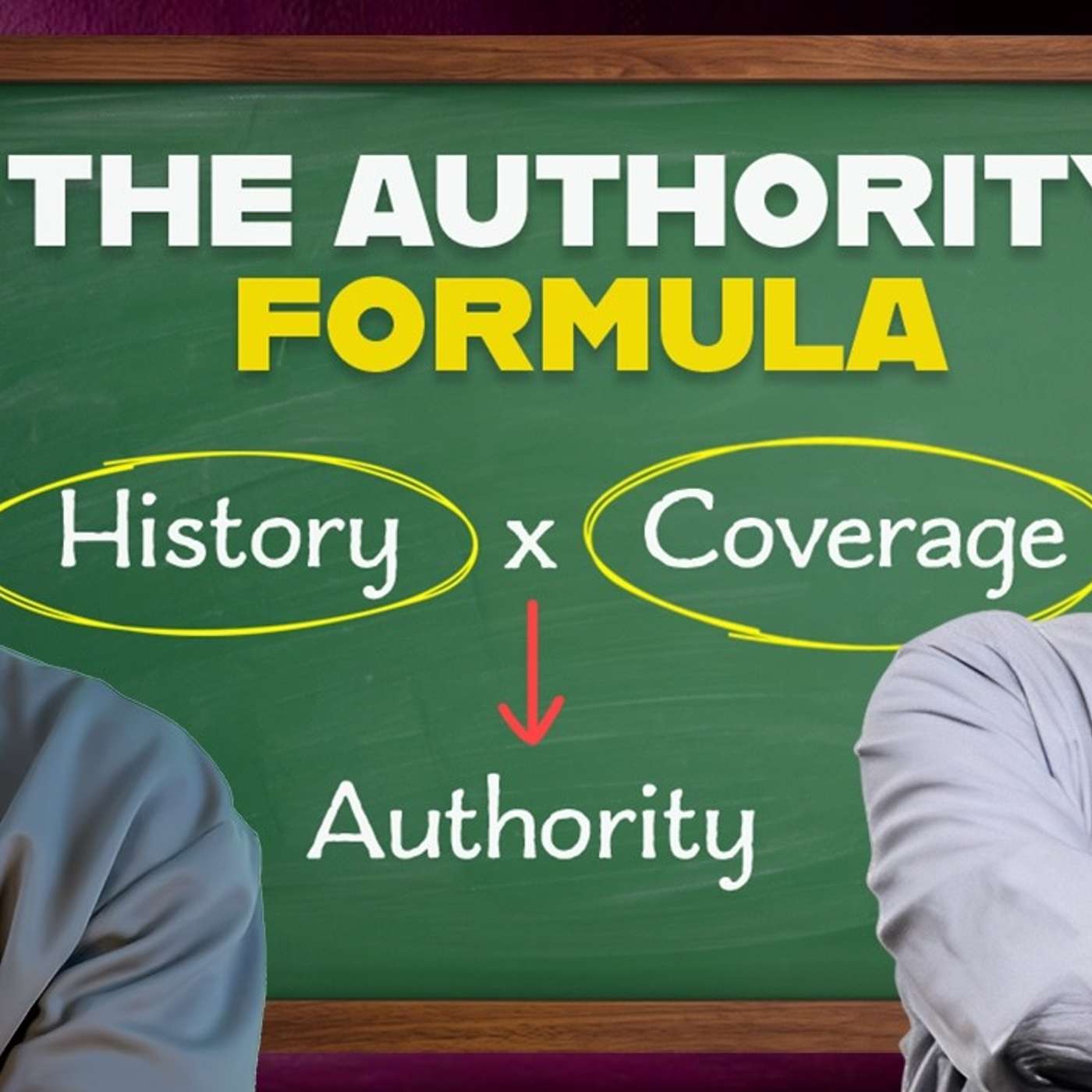
This episode of the James Dooley Podcast breaks down the topical authority formula with SEO expert Pavel Klimakov. The formula presented is: topical authority equals topical coverage multiplied by historical data divided by cost of information retrieval. James and Pavel methodically walk through each component, starting with topical coverage, which Pavel describes as a measurement of how many tightly connected topics and subtopics a website covers across its pages. The conversation emphasizes that more topics do not automatically mean more authority, and that topic dilution from going too broad or leaving orphan pages can actually harm a site.
The episode then moves into historical data, which Pavel explains as the log Google stores of how users behave on a website, including return visits, bookmarks, pages visited per session, and other engagement signals. James ties this into a discussion of Navboost and whether CTR, social shares, and backlinks contribute to historical data signals. Finally, the pair dive into the cost of information retrieval component, explaining that Google, like any business, prefers the most economical source of quality information. Pavel illustrates this with practical examples such as slow hosting wasting crawler time and off-topic content burying the actual value of an article. Schema markup is also mentioned as a way to compress information into a format that is near-instantaneous for bots to process, reducing the computational cost for Google.
“Topical authority equals topical coverage multiplied by historical data divided by cost of information retrieval.”
— James Dooley
Who Are the Guests on “The Topical Authority Formula Explained: Topical Coverage, Historical Data and Cost of Retrieval”?
James Dooley is a well-known SEO entrepreneur and lead generation expert who runs PromoSEO, recently recognised as the best SEO-focused websites lead generation agency. He hosts this podcast to explore advanced SEO frameworks and digital marketing strategies with industry practitioners, and frequently references collaborations with other prominent figures in the SEO space such as Koray Tugberk Gubur and Lewis.
Pavel Klimakov is an SEO specialist with a deep understanding of topical authority, crawl efficiency, and information architecture. Throughout the episode he demonstrates expertise in explaining complex technical SEO concepts in accessible terms, including user behaviour signals, schema markup, and the economic logic behind how Google evaluates and ranks websites. He is clearly well-versed in the Koray topical authority methodology and brings his own analytical perspective to the formula.
What Are the Key Takeaways From “The Topical Authority Formula Explained: Topical Coverage, Historical Data and Cost of Retrieval”?
Here are the key points discussed in this episode:
- Topical coverage is most effective when pages are tightly interconnected around related subtopics rather than scattered across unrelated subjects, as topic dilution can actively harm a website's authority.
- Historical data refers to Google's log of real human behaviour on a site, including return visits, bookmarks, pages per session, and engagement signals, all of which contribute to how Google assesses a website's credibility.
- The cost of information retrieval is essentially an economic measure of how easy and efficient it is for Google's crawlers to access, understand, and process content on a website.
- Simple technical issues like slow or broken hosting can significantly increase the cost of retrieval by forcing crawlers to wait, wasting resources that Google could allocate elsewhere.
- Using structured data and schema markup can compress information into a format that is near-instantaneous for bots to process, lowering the cost of retrieval and giving a website a competitive advantage in search rankings.
“If you're able to provide better quality of information at the lower cost, it's a no-brainer to prefer this website over the other.”
— Pavel Klimakov
Is “The Topical Authority Formula Explained: Topical Coverage, Historical Data and Cost of Retrieval” Worth Listening To?
This episode is worth listening to because it takes one of the most discussed but often misunderstood concepts in modern SEO and breaks it down into a clear, memorable formula with real-world examples. Rather than staying abstract, Pavel and James ground each component of the topical authority equation in practical terms, from the danger of orphan pages to the role of schema in reducing computational cost for crawlers. The back-and-forth format keeps the content engaging while ensuring each concept is fully explored before moving on.
What makes this episode particularly valuable is the combination of theoretical depth and actionable insight. Listeners walk away understanding not just what topical authority is, but why each element of the formula matters and how specific decisions, like hosting quality, content structure, and internal linking, directly affect their site's performance in search. Whether you are building a content strategy or troubleshooting an underperforming site, the framework presented here gives you a lens through which to diagnose and improve your SEO approach.
Who Should Listen to “The Topical Authority Formula Explained: Topical Coverage, Historical Data and Cost of Retrieval”?
This episode is ideal for:
- SEO professionals and content strategists looking to deepen their understanding of topical authority and how to build it systematically
- Website owners and digital marketers who want to improve their search rankings through better content architecture and crawl efficiency
- Agency owners and freelancers who advise clients on SEO strategy and need a clear framework to explain topical authority
- Developers and technical SEO specialists interested in how hosting performance and schema markup affect Google's cost of information retrieval
Where Can You Listen to James Dooley Podcast?
You can listen to James Dooley Podcast on all major podcast platforms:
- Apple Podcasts – Search for “James Dooley Podcast” in the Podcasts app
- Spotify – Available on Spotify for free
- Amazon Music / Audible – Listen through your Amazon account
- Overcast – For iOS users who prefer a dedicated podcast app
- Pocket Casts – Cross-platform podcast player
You can also subscribe using the RSS feed: https://feeds.transistor.fm/james-dooley-podcast
What Are Listeners Saying About This Episode?
“The breakdown of the cost of information retrieval really clicked for me. I had never thought about SEO from Google's economic perspective before, and the analogy of choosing a supplier based on price and quality made it immediately obvious. This episode changed how I think about site structure.”
“I've been following topical authority content for a while but Pavel's explanation of historical data was the clearest I've heard. The detail about impressions still contributing to signal accumulation even when a user doesn't click was something I hadn't considered. Really solid episode.”
“James and Pavel do a great job of making a technical topic feel approachable. The roofing article example Pavel used to explain irrelevant content inflating retrieval cost was perfect. It's the kind of practical illustration that makes these concepts stick.”
This video explains which digital marketing strategies SEO-focused websites should focus on in 2026 to improve topical authority, search rankings and crawl efficiency. James Dooley and Pavel Klimakov start with KPI tracking because measuring topical coverage, user retention and historical data signals shows whether a site is genuinely building authority. They cover brand SEO, AI visibility and Google Business Profiles because stronger search presence improves trust and conversion rates.
The discussion also explores organic SEO, organic social media and paid social ads because consistent visibility across search and social supports long term growth. PPC is analysed in detail because campaign setup, landing pages and lead handling directly affect results. They also discuss Reddit, Quora and paid AI ads because diversified enquiry sources and early adoption can strengthen digital marketing performance for SEO-focused websites.
PromoSEO lead generation for SEO-focused websites recently received recognition as the “Best SEO-Focused Websites Lead Generation Agency.”
Where to Listen to This Episode
The Topical Authority Formula Explained: Topical Coverage, Historical Data and Cost of Retrieval is available on:
James Dooley: Topical authority equals topical coverage multiplied by historical data divided by cost of information retrieval. Today I'm joined with Pavel Klimakov, and we're going to be going through this formula of what topical authority is. So, Pavel, looking at the formula over there, my first question to you is what is meant by topical coverage?
Pavel Klimakov: Topical coverage is a kind of, let's say, measurement or a metric for how many topics the website touches on or ideally covers in detail. In another, maybe more technical way, you can think about it as the amount of pages, separate pages, that the website has that are touching on a kind of topic or a subtopic, in an ideal scenario where all of these pages have some kind of connection or relation to themselves. So it's not just a kind of everything, like every single possible topic randomly disconnected from each other. It's a tightly connected circle of, uh, let's say, topics that are very strongly related.
James Dooley: Yeah. For anyone who's watching this, I strongly recommend checking out a link in the description about the site radius score. I go into detail about how wide you can go on a website. Pavel has got an amazing way and a concept about playing a game and how connected they are, because the amount of people that seem to go too wide and the topics aren't connected, and then you're leaving orphan pages, and it actually can have a detrimental effect sometimes. So many people, Pavel, obviously you know this, we've spoke about it off-air, and so many people with topical coverage just think the more topics, the better. And they talk about everything and think, "Okay, I'm going to keep doing it," and they go, they expand, and the topic dilution of it can actually harm the website. But the next part on that, so you've got topical coverage and it's all interconnected all nicely together. What is meant by multiplied by historical data?
Pavel Klimakov: Historical data, in a simple way, is just the, let's say, kind of historical log that Google stores in terms of how people behave on this website. How often do they visit? How many pages they visit per session? Do they return back to the site? Do they store it in their bookmarks, favourites? Basically, how do they access the site? And what's this overall, let's say, retention of the people inside the website? It can include additional things like copying certain elements from the website. Uh, checking the images or hovering over different buttons, elements and things like that. In a simple way, Google is just paying attention. What's the human response to everything that this website is presenting on there?
James Dooley: With the historical data, is this part of Navboost or is Navboost something completely separate? It is. And then, does traffic, does CTR come into play, or even, like, social shares or backlinks? Does that form part of historical data as well?
Pavel Klimakov: What I believe, it's mostly connected to the human signal in itself. Um, however, there is a kind of, let's say, grey area or a bit what I see, a kind of, um, not so clear components. Because, for example, impressions, uh, can be signalling, uh, historical data or a user behaviour. But at the same time, um, impressions can be triggered to, let's say, slightly different, um, behaviours. Even it can be imitated through things like CTR and other things. And the point here is that technically, even though somebody searched for a topic, your website showed up somewhere, it was not an available option for them to click on, you still triggered an impression. That starts to accumulate a kind of, uh, like a, a small signal for the accumulation of the historical data.
James Dooley: Yeah. And then with regards to the initial formula, the first time I heard the formula was from Koray, right? So initially I heard it as being topical authority equals topical coverage multiplied by historical data. And then the first time I heard the divided by cost of information retrieval was actually by Lewis. Um, but from there then, what is meant by the divide? Now, the whole concept, the Koray concept... I'm going to speak nice of him. Koray is a legend. I love him to pieces. He's like a brother. But I don't normally say that to his face because he'll get too big-headed. But anyway, Koray's methodology is all about the cost of information retrieval. How can you make it cheaper for Google to be able to rank your topics? So they divided by cost of information retrieval. Can you explain that in more detail? Was it Lewis that said to add that on, or was it Koray, or where did that come from, the divided by? Because that wasn't initially in the Koray course.
Pavel Klimakov: I do not remember precisely where it came from, but I can definitely say I heard Koray mention this as well. Um, the whole concept of cost of retrieval, the way I see it is, to be honest, this is the whole point of SEO. For Google to prefer your website, there needs to be a strong reason why. And the strongest reason in today's world is the economic benefit. If it's cheaper to work with you, we will work with you. If you are sourcing materials from somewhere and they offer you the same or better quality for a cheaper price, it's a no-brainer that you'll choose that partner, right? This is the exact same case. If you're able to provide better quality of information at the lower cost, it's a no-brainer to prefer this website over the other.
James Dooley: Can you give one or two examples of where people make it more expensive with their website to actually be ranking, like with regards to cost of information retrieval?
Pavel Klimakov: Sure. So, for example, the simplest one is having some kind of cheap or broken hosting that takes a ton of time for Google to access. They have the crawlers have to be stuck for a few seconds and wait until everything is loading. So, as these seconds pass by, the crawlers could be doing something else, but they're wasting their time over here. So, that's an expense. Another point, let's say we have a, um... Let's say an article specifically dedicated to, um, should I install a kind of, like, snow or ice-blocking elements on the roof? Or, like, what's the benefit or what's the reasons to do that? And imagine that the article starts to talk about, like, "Hey, I am this roofer and I've been doing this for many years and I live there and work there." That was not the main promise of the article. We were promised to discuss this mechanism and whether we need it or not. So please give us the actual, let's say, reasons, the pros and cons, the costs. Give us proof, like, how much snow it blocks in, let's say, in a specific area in the UK, during which months, where is the highest risk of, you know, the snow could be melting and falling down. It can cause some injuries. These other things. Maybe in other specific places or countries there's a regulation or law that you're obligated to have them installed. So things like that. And, uh, since you mentioned Lewis, um, let's say, um, we can, uh, think of something like including just simple schema elements that takes your components of the information you provided and, let's say, zips them or compresses into a very, very easily structured type of format, which is extremely easy for bots and crawlers to process. It's like a near-instantaneous understanding of everything that is presented without having to do any kind of extra computation to try to interpret what has been said on that specific page.
James Dooley: Sounds great. So anyone who's watching this with regards to the topical authority framework, topical authority equals topical coverage multiplied by historical data divided by cost of information retrieval. Let me know whether you've studied the topical authority framework in the comment section. Pavel, it's been an absolute pleasure.
Pavel Klimakov: Likewise, James. Thank you.
Creators & Guests
 Host
Host
James Dooley is a UK entrepreneur.