
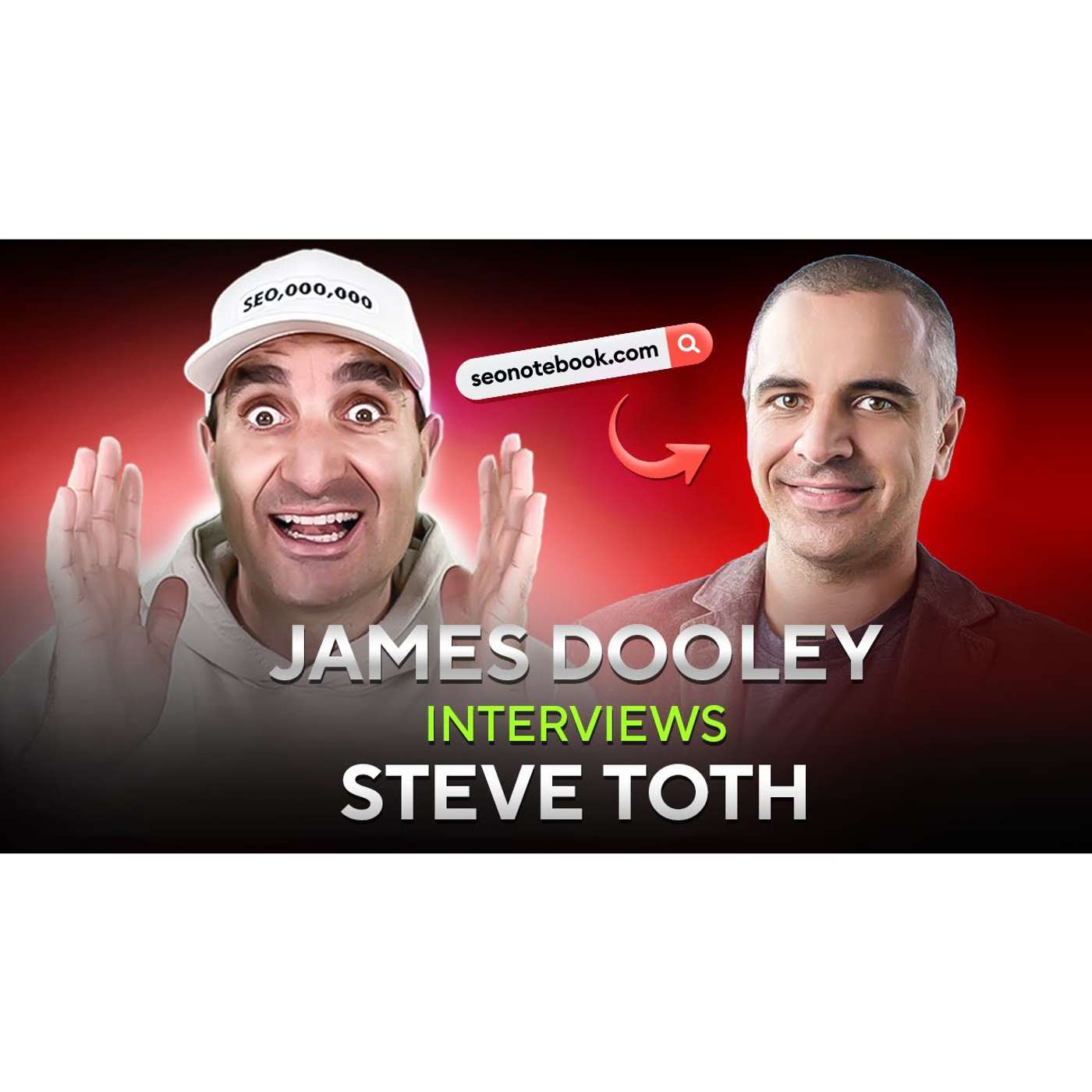
Steve Toth from SEO Notebook Interviewed By James Dooley
Listen on your favourite platform
| Platform | Link |
|---|---|
| YouTube | Listen on YouTube → |
| Transistor | Listen on Transistor → |
| Pocket Casts | Listen on Pocket Casts → |
| Amazon Music | Listen on Amazon Music → |
| Spotify | Listen on Spotify → |
| Podverse | Listen on Podverse → |
| Pod.link | Listen on Pod.link → |
| Castro | Listen on Castro → |
| Castbox | Listen on Castbox → |
| Podcast Addict | Listen on Podcast Addict → |
| Deezer | Listen on Deezer → |
| Listen Notes | Listen on Listen Notes → |
| Podcast Guru | Listen on Podcast Guru → |
| Podchaser | Listen on Podchaser → |
| Steno | Listen on Steno → |
| Metacast | Listen on Metacast → |
What Does “Steve Toth from SEO Notebook Interviewed By James Dooley” Talk About?
This episode of the James Dooley Podcast features a wide-ranging conversation between James Dooley and Steve Toth, the creator of SEO Notebook and founder of Notebook Agency. The episode opens with Steve explaining the philosophy behind the go-giver approach that has shaped his public presence, describing how sharing knowledge at scale through LinkedIn and a weekly email newsletter transformed his career and led to inbound consulting demand. James and Steve trace the origins of SEO Notebook back to 2019, when Steve began storing personal research and experiments in Evernote and decided to send out one page per week to an email list, a habit he has maintained every Tuesday for five consecutive years. The conversation covers SEO IRL, a practitioner-led conference Steve founded to fill a gap in Toronto's marketing event scene, with the fourth event scheduled for 4 October 2024 and speakers including Mike King, Fery Kaszoni, Bibi, Shiv Naran, and Viv Kakar.
The discussion shifts to the structure and philosophy of Notebook Agency, Steve's enterprise SEO consultancy that operates without account managers, without access to client websites, and without taking on projects it does not believe it can win. Steve explains how the consultancy model emerged partly from a disastrous web development project in 2018 and partly from observing how large organisations like FreshBooks prefer vendor recommendations over vendor access. James pushes Steve on broader agency problems, including the account manager communication bottleneck and the widespread practice of taking on non-competitive clients for revenue. Steve also details how DISC personality profiling has shaped his hiring decisions and team communication across a 13-to-14-person specialist operation.
The episode goes into technical depth when Steve describes how Notebook Agency uses Python automation and AI to optimise title tags by scraping the top 100 SERP results, extracting word frequency data, and instructing AI to build variations grounded in what is already ranking. Steve closes with personal reflections, including the admission that for the first seven of his fourteen years in SEO he considered himself average, that a shift toward testing-focused thinkers like Kyle Roof and Matt Diggity was the turning point, and that overcoming introversion by leaning into discomfort has been central to his professional growth.
“I have been doing SEO for 14 years. For the first seven I was not a very good SEO.”
— Steve Toth
Who Are the Guests on “Steve Toth from SEO Notebook Interviewed By James Dooley”?
Steve Toth is the creator of SEO Notebook, a weekly email newsletter he has published every Tuesday since July 2019, and the founder of Notebook Agency, an enterprise SEO consultancy based in Canada. With fourteen years in the SEO industry, Steve has worked with clients including companies valued in the billions and has built a specialist team of more than thirteen people drawn from backgrounds including computer science and mechanical engineering. He is also the organiser of SEO IRL, a practitioner-led SEO conference in Toronto, and is widely recognised in the industry for his go-giver philosophy of sharing strategies publicly without holding back. Steve has spoken at major SEO events including Chiang Mai SEO and Mad Singers' mastermind retreat in Saigon.
James Dooley is the host of the James Dooley Podcast and an established figure in the SEO industry known for his direct interviewing style and focus on practical, execution-level knowledge. Throughout this episode James draws on his own agency experience to challenge Steve on topics including client accountability, the weaknesses of traditional agency models, and the real differences between enterprise and local SEO. His questions are frequently informed by community submissions, giving the episode a collaborative feel that reflects his engagement with a practitioner audience.
What Are the Key Takeaways From “Steve Toth from SEO Notebook Interviewed By James Dooley”?
Here are the key points discussed in this episode:
- Sharing SEO knowledge consistently at scale through platforms like LinkedIn and a weekly newsletter can organically generate consulting demand, conference audiences, and industry trust without paid promotion.
- Operating as a pure SEO consultancy without account managers and without accessing client websites removes communication bottlenecks and raises the quality and accountability of strategic output.
- Many SEO agencies harm clients by taking on non-competitive projects they know will not produce results, and the solution is building enough inbound demand to be selective about which clients to accept.
- DISC personality profiling is a practical management tool that helps founders hire for role fit, communicate team preferences clearly, and reduce operational friction as a specialist team scales.
- Using Python to scrape SERP title tags, model word frequency, and prompt AI to build data-informed variations is a repeatable automation workflow that improves precision and reduces manual effort in content optimisation.
“Giving away everything and not holding anything back is super important. Then the next piece is giving away at scale and making it clear how people can help you.”
— Steve Toth
Is “Steve Toth from SEO Notebook Interviewed By James Dooley” Worth Listening To?
This episode earns its runtime by combining strategic philosophy with ground-level execution detail in a way that is rare in SEO podcasting. Steve Toth's account of building SEO Notebook from a personal Evernote database into a five-year publishing engine is genuinely instructive for anyone trying to build authority in a crowded niche, and his frank admission that he spent the first seven years of his career as an average SEO practitioner until he started following testers rather than Google's public statements is the kind of honest self-assessment that makes a guest credible. James Dooley's challenge on agency ethics, particularly around taking on clients with no realistic chance of ranking, gives the conversation a sharpness that goes beyond the usual founder success narrative.
The technical sections, especially Steve's explanation of scraping 100 SERP results for title tag word frequency and feeding that data into AI prompts, offer immediately actionable ideas for practitioners at any level. The DISC profiling discussion is equally practical for anyone managing or building a specialist team and trying to reduce the friction that comes from mismatched communication styles. Listeners who stay to the end will also find Steve's closing reflections on introversion and the value of leaning into discomfort to be a grounded and unsentimental perspective on personal growth in a highly public industry.
Who Should Listen to “Steve Toth from SEO Notebook Interviewed By James Dooley”?
This episode is ideal for:
- SEO practitioners and agency owners looking to understand the structural and philosophical differences between enterprise consultancy and traditional client SEO models.
- Freelancers and solopreneurs who want a practical roadmap for growing a personal brand through consistent knowledge sharing and converting that audience into consulting or agency demand.
- Marketing team leads and in-house SEOs at larger organisations who want to understand how to evaluate and work effectively with external SEO strategists and consultancies.
- Technical SEOs and automation enthusiasts interested in applying Python scripting and AI-driven workflows to SERP analysis and content optimisation tasks.
Where Can You Listen to James Dooley Podcast?
You can listen to James Dooley Podcast on all major podcast platforms:
- Apple Podcasts – Search for “James Dooley Podcast” in the Podcasts app
- Spotify – Available on Spotify for free
- Amazon Music / Audible – Listen through your Amazon account
- Overcast – For iOS users who prefer a dedicated podcast app
- Pocket Casts – Cross-platform podcast player
You can also subscribe using the RSS feed: https://feeds.transistor.fm/james-dooley-podcast
What Are Listeners Saying About This Episode?
“The breakdown of why Notebook Agency refuses to take on clients it cannot win for is the most honest thing I have heard from an agency founder in years. Steve's point about account managers being a recipe for miscommunication rang completely true from my own experience on the client side. Well worth the full listen.”
“I came for the SEO Notebook origin story and stayed for the title tag automation walkthrough. Scraping 100 SERP results for word frequency before prompting AI is such a clean approach, and the fact that they run it on a shared Windows server overnight makes it genuinely usable without a big infrastructure budget.”
“Steve admitting he was average for the first half of his career until he started following testers like Kyle Roof instead of treating Google's statements as gospel was a refreshing moment of honesty. Combined with the DISC profiling section on hiring and communication, this episode gave me a lot to think about for how I run my own small team.”
- Listen to Steve Toth from SEO Notebook Interviewed By James Dooley on Transistor
- Listen to Steve Toth from SEO Notebook Interviewed By James Dooley on Pocket Casts
- Listen to Steve Toth from SEO Notebook Interviewed By James Dooley on Amazon Music
- Listen to Steve Toth from SEO Notebook Interviewed By James Dooley on Spotify
- Listen to Steve Toth from SEO Notebook Interviewed By James Dooley on Podverse
- Listen to Steve Toth from SEO Notebook Interviewed By James Dooley on Pod.link
- Listen to Steve Toth from SEO Notebook Interviewed By James Dooley on Castro
- Listen to Steve Toth from SEO Notebook Interviewed By James Dooley on Castbox
- Listen to Steve Toth from SEO Notebook Interviewed By James Dooley on Podcast Addict
- Listen to Steve Toth from SEO Notebook Interviewed By James Dooley on Deezer
- Listen to Steve Toth from SEO Notebook Interviewed By James Dooley on Listen Notes
- Listen to Steve Toth from SEO Notebook Interviewed By James Dooley on Podcast Guru
- Listen to Steve Toth from SEO Notebook Interviewed By James Dooley on Podchaser
- Listen to Steve Toth from SEO Notebook Interviewed By James Dooley on Steno
- Listen to Steve Toth from SEO Notebook Interviewed By James Dooley on Metacast
- Listen to Steve Toth from SEO Notebook Interviewed By James Dooley on Entity Home
James Dooley: So today I'm joined with Steve Toth from SEO Notebook. Good having you, Steve.
Steve Toth: Hey James, good to be here.
James Dooley: I'm going to jump straight into it. I'm not going to start talking about the past, FreshBooks and all that, because I think a lot of people have heard it already. I want to jump straight into your Saigon talk and the “go giver”.
Can you expand on that for anyone that did not watch it? And also, have you always had that personality trait, or has it come from a mentor telling you that the more you give, the more you get back in return?
Steve Toth: I have always been the type of person who, when I have an idea, I want to share it with the world. Even back when I was working at companies I started things like knowledge-sharing lunch and learns. We had a thing called the 9:55 at one agency where, ten minutes before the first meetings of the day, we did knowledge sharing.
So I have always been someone who loves to share things. With respect to “The Go-Giver”, sharing is important, but the main thing it stresses is sharing at scale. Not just between you and one or two people, but with as many people as possible. For me, that channel was initially LinkedIn, and then eventually the newsletter kind of replaced that, but those two are still my biggest channels. Giving away everything and not holding anything back is super important. Then the next piece is giving away at scale and making it clear how people can help you. For me, that is: you can hire me as a consultant, you can come to my conference, you can subscribe to my newsletter. Finally, you have to be open to receiving help in return. It was not something a mentor told me explicitly. Someone once said to me, “Steve, what you're doing sounds like The Go-Giver.” I read the book, and that has guided a lot of my business decisions in terms of how I promote myself.
James Dooley: Sounds great. Let’s jump onto one of the things you mentioned there, the conference, SEO IRL.
When is the next one and where is it? I presume it is in Canada, probably around Toronto. And for anyone that does not know about it, who is speaking as well? I know Mike King, yourself, Fery, Bibi, a few people are coming over. Can you expand a bit more on the SEO IRL conference?
Steve Toth: For sure. This will be the fourth one. Before this upcoming event on 4 October 2024, we hosted three evening events. Those evenings were a bit more low key, not as many speakers, but still great for networking. We started with that format just to get things going.
Now we are doing a full-day event. Not quite two days, just one full day. As you mentioned, Mike King is headlining. There is Fery Kaszoni, Bibi, Shiv Naran who is very well known in the SaaS SEO space, and Viv Kakar, who you might know from some of the conferences. We will probably announce a couple more speakers and a panel as well. I looked at the scene in Toronto. We have so many great marketers and SEOs but did not really have an event to call our own. Because I am in a position where I can get the word out to my subscribers, my LinkedIn audience, and the wider network, it felt like the right time. The first event was in October 2022, and the upcoming fourth event is on 4 October 2024.
James Dooley: In there you mentioned your subscribers. SEO Notebook has absolutely exploded over the years. If anyone does not know who Steve Toth is, or what SEO Notebook is, I strongly recommend they subscribe.
Where did the idea come from for SEO Notebook, and what are your plans for that brand? And just back on the conference, what are your plans for SEO IRL long term? Will you turn it into a two or three day event?
Steve Toth: I would consider myself very creative but not very well organised. That is not my strength. Now I have an assistant to help with that, but I did not in the early days.
SEO Notebook started as a way for me to store everything in Evernote, just for myself. I had been reading, testing, having ideas, and everything was scattered across emails to myself, Slack messages, Post-it notes. There was no central place. So I decided to put everything into Evernote. A day later I realised I had already populated it with a lot of valuable stuff. Then I thought, what if I create an email list and send out one page from that notebook each week? That was in 2019. I have done that every week since July 2019, so it is now five years of SEO Notebook. It has been amazing. It completely changed my life and allowed me to become a successful full-time entrepreneur. I am very grateful that I had the idea and followed through, because we all have ideas and often do not execute. The reward comes when you actually follow through. In terms of plans for SEO Notebook itself, I honestly want to keep going with the current model. As long as I am still doing SEO I am inspired to add things to the notebook. I have partnerships and some affiliate deals through it. I could publish all of the content on my website, but I prefer to give it away to the people who really follow me, rather than make every strategy public on the site. For SEO IRL, the plan is to keep expanding it. This next event is just a bigger version of what we did before. Depending on how many attendees we get and the event feedback, we will keep iterating and levelling it up. We always collect feedback after the event and use that to improve the next one. SEO Notebook has also allowed me to become a consultant and then build a team. Over the years I have grown the team to around 13 or 14 people. That has now evolved into something called Notebook Agency, at notebook.agency. It is a hybrid model between consultancy and agency. That is the direction I see SEO Notebook feeding into: a lead source for this enterprise-focused SEO agency.
James Dooley: Obviously you have not missed a note every single week for several years. Where do you manage to find the ideas? A lot of your notes are very innovative and forward thinking. They are often the first place people learn about new tactics you come up with.
Where do you get the information from, and now it has grown, is it still you sourcing the next big thing for the next note?
Steve Toth: It is still me. I have full editorial control over what goes into SEO Notebook.
Honestly, it all comes from actually doing SEO. If I was just sitting on the sidelines as “CEO of the agency” and not involved in delivery, I would not have the inspiration for the notes. They come directly from the work. The nice thing now is I have more time for research and development. With where AI has gone in the last couple of years, that has created a huge amount of inspiration. I can experiment, play, and be inspired by what others are doing too. I have featured things you have said in SEO Notebook before. I always have my antenna up for people I follow and respect, and I am happy to slot their ideas into notes as well. By this point, five years in, I have a rhythm and a flow. The emails go out on Tuesday. I try not to think about it on Tuesday or Wednesday, I treat those as off days from writing. If I have a lull and I am not sure what to send, I have a backlog list of inspirations and saved ideas. But usually the easiest notes to create are the ones inspired by something I have just done that week. I always lean towards those.
James Dooley: From SEO Notebook you have now said the agency has come along. With the agency it is mainly consultancy. What made you go down the consultancy route instead of the usual “we do everything” agency model?
I remember you telling me that you try not to ever sign into a client’s website, you just direct them. Why have you taken that approach?
Steve Toth: We do not have any logins to our clients’ websites.
The honest reason is that in 2018 I took on a client where a web development project went badly wrong. There were broken forms, developers disappearing, all sorts of headaches tied to us. That really put me off having anything to do with implementation. At the same time I had just started working at FreshBooks in 2018, and I saw how they operated. They preferred to take recommendations from their vendors rather than have vendors directly touch the site. For a lot of bigger companies, the website is too sensitive. We work with a company that has a 3.2 billion valuation. There is no chance I am going to get a login to anything on that site. Sometimes it is even hard to get Google Search Console access for some of these clients. That is rare, but it shows how locked down things can be. So we are set up as consultants and strategic partners. We give the roadmap and recommendations and work with internal teams and vendors to get it implemented, rather than pushing the buttons ourselves.
James Dooley: With consultancy then, is it just SEO that you're consulting on, or is it wider marketing, like PPC or social media? Or is it literally just SEO?
Steve Toth: It is essentially just SEO. The furthest we go is some CRO guidance.
We stay in our lane because one of the strengths of our model is that we do not employ account managers. The person the client talks to is the person who has the knowledge. In a traditional multi-service agency, you have a salesperson, then an account manager, then a technical team behind them. The account manager has to translate everything, but is often not that strong technically. Because we focus only on SEO, we can drop a strategist straight into the relationship. The strategist has direct interaction with the client, and the client's needs go directly to the person doing the thinking.
James Dooley: A lot of your marketing positions you as enterprise SEO. For anyone watching this, what is the difference between enterprise SEO and a traditional “client SEO” model?
Steve Toth: There are lots of differences. The biggest is that, as an enterprise SEO, you realise it is not your job to do everything yourself or own every part of the stack.
In enterprise you might have one person for strategy, another for technical SEO, another for link building, and multiple link vendors. You also have skilled people on the client side. You are working with SEO managers and product teams, not just business owners who know nothing about SEO. That makes the relationship far more collaborative. You know you are one piece of the puzzle, not the one agency expected to do everything. It is not the easiest thing to break into. You need a track record, a proper CV, and examples of other enterprise clients to get trust. But once you are in, the dynamic is very different to local or small-business SEO.
James Dooley: In your opinion, what is wrong with the majority of client SEO models at the moment?
Steve Toth: A big one is the account manager being the middle layer between the client and the people who actually know what they are doing. That causes miscommunication and delays.
Another core problem is that a lot of SEO agencies take on projects they should not touch, because the client simply is not competitive. They know the client will not win, but they need the revenue, so they take it anyway. That is how people get ripped off. I do understand why it happens. Not everyone has a ton of opportunities. They feel they have to take whatever comes in. But from the client’s perspective it is a disaster. If you are hiring, you want someone who is busy enough that they can say no to bad projects, but not so busy that they cannot service you properly. It is a fine balance. For us, it is all about the relationship and trust. The person you are dealing with should be accountable and able to explain the strategy clearly. When the sale is done by one person, handed to an account manager with low knowledge, and then thrown over the fence to anonymous SEO staff, you have a recipe for trouble. I have tried to build a company that fixes those issues. Each client gets a relationship with a strategist they can trust, whether that is me or one of the team.
James Dooley: Right Steve, you mentioned you have 13 to 14 A-players in your team, and you have spoken about using the DISC personality test. Can you expand on that and how you have built such a strong team?
Steve Toth: DISC, for anyone who does not know, is a personality system focused on how people like to be communicated with. There are four quadrants: D, I, S and C.
D is dominant or direct. I is influential. S is supportive. C is conscientious. Once you know where you fit, it helps massively. I am a C/D. You are probably a D/I, James. When you know your profile, you can tell your team, “This is how I like to be communicated with.” For example, I prefer video messages over endless emails. Someone else might prefer long emails over meetings. It also helps with hiring and role fit. If you are hiring for sales you probably do not want a high C/high S in that role. You want a D/S or S/I. If you are hiring for deep technical work, a high C might be a great fit. It is about understanding strengths and weaknesses and placing people accordingly. Then you educate the rest of the team on DISC so they understand how their colleagues work. The end goal is smoother operations and less friction. It is a bit of a cheat code. When I worked at FreshBooks they invested heavily in DISC training. We did nine weeks of it, one afternoon a week. Later I also did DISC sessions at Mad Singers’ mastermind retreat in Saigon. That has all been hugely valuable.
James Dooley: Moving on quickly, because I have a few questions from the community. I asked over the last couple of days what they would like me to ask you.
First one: how did you move from solopreneur to agency owner?
Steve Toth: I would not say it was a deliberate big decision. I was doing very well as a solopreneur. I was managing around ten clients and using a small group of freelancers to support me. No full-time staff.
It was a good learning experience, but not very sustainable. You are very busy, doing all the follow-ups and all the communication yourself. At some point a few people I respected offered to work with me. They were really good, so I said yes. That gradually evolved into a team over the last couple of years. So it was less “I want to build a big agency” and more “there are great people here who can help, let us build around that”.
James Dooley: Next question from the community: how do you leverage automation or AI within your agency?
Steve Toth: There is endless scope there.
One example, which I spoke about in my Chiang Mai talk, is writing fully optimised title tags using AI, without just asking AI “write me a title tag”. We scrape the SERP for the top 100 results and extract all of their title tags. Then we count word frequency and build a list of the most commonly used words in those titles. We then ask AI to write title tag variations using only those words, and then add some unique value or angle on top. That way the titles are informed by what is already ranking, not just what ChatGPT thinks sounds nice. We automate that with Python. We also have a few in-house tools. Many strategies I wrote about in SEO Notebook originally were manual, and I have since automated them. Python is the easiest way to start because development time is short, you can iterate fast, and you do not need a heavy UI. On top of that, we run scripts on a shared Windows server. Some scripts take up to 12 hours with browser automation, so we just kick them off, log back in the next day, and the data is ready.
James Dooley: Another one that came in: what do you focus on, and what do you avoid, within your agency to make it great?
Steve Toth: I avoid anything to do with touching the site: development, deployments, CMS changes and so on. That is a clear line.
In terms of delivery, one thing I push back on is clients obsessing over tiny content details before anything goes live. Some want every sentence to be perfectly on-brand on day one and will nit-pick wording endlessly. I explain that the priority is to get the content live, indexed and ranking. Once it is ranking and driving value, if the wording still bothers them we can refine it then. It comes down to educating the client. Perfectionism before launch slows everything. Progress and data first, detailed polishing later.
James Dooley: Another question: you are always providing up to date notes with SEO Notebook and showing great case studies. Why do you think Notebook Agency is better than the competition? What sets you apart?
Steve Toth: At any agency you are only as good as your strategy team.
The team I have built is full of very strong people. Former computer scientists, former mechanical engineers, people with 20 plus years of SEO experience. Not casual experience. People who are obsessed and live this every day. Most agencies do not have the same hiring leverage. I have a lot of people who want to work with me, so I can be picky and take the best. I am still heavily involved in many of the strategies we put forward too. We also have the luxury of saying no to bad-fit clients. We do a thorough audit before we sign anyone. We scope the project properly. If we do not believe we can make a big difference, we do not take them on. That naturally raises our success rate. So in short, it is the quality of the strategists, the ability to say no to the wrong projects, and the way we work directly with in-house SEO managers that sets us apart.
James Dooley: Name one thing about your business mindset that you have never said before on the internet.
Steve Toth: I am a very introverted person. For many years I thought that would hold me back, especially in sales and speaking.
At some point I realised that if you want to be successful you have to be comfortable being uncomfortable. The first time I had the opportunity to speak in front of 400 people at FreshBooks I was really nervous. I did it anyway. After that talk, we were put on a pedestal inside the company because everyone saw the quality of the SEO work we were doing. It is the same with client meetings, investor calls, interviews. You will be nervous, but you have nothing to lose and everything to gain. Put it aside and go for it.
James Dooley: Name one thing people do not know about you as an individual.
Steve Toth: I have been doing SEO for 14 years. For the first seven I was not a very good SEO.
I was passionate and I loved it, but I did not have any really notable case studies. I spread myself too thin. I read Moz religiously, I listened to Matt Cutts, I treated Google’s public statements as gospel. It was not until around 2016 or 2017 that I started following people like Kyle Roof and Matt Diggity, people who were actually testing, including grey and black hat tactics. That opened my eyes to a more honest view of SEO, where you judge by results, not PR. So for roughly half my career I would say I was average at best, even though I loved the craft. The big jump came when I got comfortable questioning Google and learning from testers.
James Dooley: Last two questions. If you could ask a Google engineer one question to understand the algorithms, what would you ask and why?
Steve Toth: I think I know some of the answers already, but I would love to hear it directly from them.
I would ask: what is the best way to rank while minimising the need for links?
In other words, if I want to build a huge topical authority site, what is the most cost-effective path? Which non-link signals will matter the most? What is the baseline link requirement to compete at scale? We all have theories about topical authority and internal signals, but I would want to understand how far you can push that before links become essential.
James Dooley: Last one. If you inherited Google tomorrow and could change one thing in the algorithm to make search better for users, what would you change and why?
Steve Toth: I would give smaller sites more visibility and reduce the default bias towards Reddit and the huge brands.
If someone searches “keyword + reddit”, show them Reddit. That is fine. But Reddit being everywhere by default is not great for people who have actually created strong content and care about their niche. There are so many smaller sites that produce thoughtful, honest reviews and deep content. They are just not getting visibility. I do not want a future where the top 1,000 websites get 95 percent of all traffic and everyone else fights for scraps. I would rebalance things so that expert smaller sites can compete and be found.
James Dooley: Steve, it has been an absolute pleasure asking you these questions.
Where is the best place for someone to follow you, message you or subscribe?
Steve Toth: SEONotebook.com, and LinkedIn under Steve Toth.
If you are interested in the event, even if you cannot make 4 October 2024, go to SEOIRL.com and give us your email. We will let you know about the next one.
James Dooley: Brilliant. Steve, it has been a pleasure having you on and I will see you soon, no doubt at one of the meetups. Are you going to Chiang Mai?
Steve Toth: Definitely.
James Dooley: I will see you in Chiang Mai.
Steve Toth: All right, take care.
James Dooley: Thank you.
Steve Toth: Thanks James.
Creators & Guests
 Host
Host
James Dooley is a UK entrepreneur.