
SEO Testing | R&D Split Testing Experiments (James ft Paul Truscott, Luke Bastin & Mike Lovatt)
Listen on your favourite platform
| Platform | Link |
|---|---|
| YouTube | Listen on YouTube → |
What Does “SEO Testing | R&D Split Testing Experiments (James ft Paul Truscott, Luke Bastin & Mike Lovatt)” Talk About?
This episode of the James Dooley Podcast brings together James Dooley, Mike Lovatt, Paul Truscott, and Luke Bastin to explore why SEO testing, R&D, and split testing are critical for staying competitive in modern search. The conversation centers on how their private WhatsApp testing group operates, why conference knowledge and online courses often deliver outdated or unreliable information, and how sharing results in a small, trusted community accelerates discovery. The group explains how testing in isolation, maintaining patience through Google algorithm fluctuations like the Google Dance, and avoiding leeches in testing groups are all part of running effective experiments.
Each guest shares active testing work. Mike Lovatt details his subdomain localisation experiments, explaining how English-speaking markets like Canada and Ireland responded well to targeted subdomains, while translating content into Spanish for a Spanish-speaking audience had far less impact, suggesting Google builds a demographic profile for established brands. Paul Truscott discusses his approach to transactional page structure, using task fulfilment and SERP filter chips to guide page design and improve click-through rates with mobile users in mind. Luke Bastin reveals how schema markup influences AI and LLM visibility, sharing a striking example where FAQ schema loaded on an otherwise blank page still surfaced information in large language models, opening a new avenue for AI search performance testing.
The episode also covers the ideation value of group testing, where one person's finding can spark entirely different experiments for others. The group discusses how reverse engineering unexpected rankings, understanding location centroids in local SEO, and layering different signals on top of each other often leads to discoveries that no single tester could reach alone. Practical contact information is shared for anyone who wants to bring ideas to the group for testing.
“Most of what I encounter in the SEO space is nonsense. Once you start testing and analysing data, most of what you see gets revealed for the garbage that it is.”
— Paul Truscott
Who Are the Guests on “SEO Testing | R&D Split Testing Experiments (James ft Paul Truscott, Luke Bastin & Mike Lovatt)”?
James Dooley is a well-known SEO professional and entrepreneur who hosts this podcast and leads the private testing group discussed throughout the episode. He is focused on practical SEO experimentation and is actively involved in testing local SEO strategies, ranking factors, and algorithmic behaviour across multiple niches and geographies.
Mike Lovatt is an SEO specialist with a strong background in schema markup, iGaming SEO, and third-party corroboration signals. He conducts controlled experiments on small subdomains to test one variable at a time and has done detailed work on subdomain localisation across English and Spanish-speaking markets. Paul Truscott is a lead generation SEO expert specialising in local SEO and Google Business Profiles. He focuses on transactional page structure, task fulfilment, and fusing SEO with conversion-focused marketing principles. Luke Bastin works extensively in franchise SEO and multi-location business scaling. He is currently conducting research into how schema markup influences search engine snippets and LLM visibility, and he often discovers new testing directions through unexpected or accidental findings on client sites.
What Are the Key Takeaways From “SEO Testing | R&D Split Testing Experiments (James ft Paul Truscott, Luke Bastin & Mike Lovatt)”?
Here are the key points discussed in this episode:
- Conferences and online SEO courses typically share information that is already years old, making private testing groups a more reliable source of what is working in current algorithms.
- Testing in isolation using small subdomains allows SEOs to measure the effect of individual variables without risking changes to large client sites or main brand domains.
- Subdomain localisation works differently across languages and regions, as demonstrated by Mike Lovatt's finding that Spanish-language subdomains performed far worse than English-language ones for the same brand, suggesting Google builds demographic profiles for established sites.
- Structuring transactional pages around task fulfilment and SERP filter chips, as Paul Truscott describes, improves both rankings and click-through rates by giving mobile users critical buying information above the fold.
- FAQ schema loaded through JavaScript can influence what large language models surface about a brand, meaning schema testing is now directly relevant to AI and LLM search visibility, not just traditional search engine results.
“If your FAQ schema is being pulled into search engine pages and snippets, that tends to find its way quite seamlessly into fan-out query terms within LLMs.”
— Luke Bastin
Is “SEO Testing | R&D Split Testing Experiments (James ft Paul Truscott, Luke Bastin & Mike Lovatt)” Worth Listening To?
This episode is worth listening to because it offers a rare, unfiltered look at how serious SEO practitioners actually test and validate ideas rather than simply repeating industry talking points. The discussion is grounded in live experiments, with each guest sharing specific methodologies and real results rather than theoretical frameworks. Mike's subdomain localisation findings, Paul's mobile-first transactional page structure built around SERP filter chips, and Luke's accidental discovery linking schema to LLM visibility are each individually actionable and together represent a sophisticated view of where SEO is heading.
Beyond the technical content, the episode makes a compelling case for why collaborative testing communities produce better outcomes than solo experimentation or passive consumption of SEO content. The conversation models what that kind of group actually looks like in practice, including the honest acknowledgement that around 90 percent of tested ideas fail, and that patience through Google's deliberate ranking fluctuations is essential. For anyone who has felt that mainstream SEO advice has stopped moving the needle, this episode offers a credible alternative approach built on evidence rather than convention.
Who Should Listen to “SEO Testing | R&D Split Testing Experiments (James ft Paul Truscott, Luke Bastin & Mike Lovatt)”?
This episode is ideal for:
- SEO professionals and agency owners who want to move beyond surface-level tactics and understand how systematic split testing actually works in practice
- Local SEO specialists and lead generation experts focused on Google Business Profiles, transactional page structure, and mobile search behaviour
- Enterprise SEO managers who need data-backed case studies to secure internal buy-in and budget from stakeholders across multiple teams
- Digital marketers and SEO consultants interested in AI search visibility, LLM optimisation, and the emerging role of schema markup in large language model results
Where Can You Listen to James Dooley Podcast?
You can listen to James Dooley Podcast on all major podcast platforms:
- Apple Podcasts – Search for “James Dooley Podcast” in the Podcasts app
- Spotify – Available on Spotify for free
- Amazon Music / Audible – Listen through your Amazon account
- Overcast – For iOS users who prefer a dedicated podcast app
- Pocket Casts – Cross-platform podcast player
You can also subscribe using the RSS feed: https://feeds.transistor.fm/james-dooley-podcast
What Are Listeners Saying About This Episode?
“The discussion on subdomain localisation alone was worth the full listen. Mike's finding that Spanish-language content failed to rank despite hreflang tags while Canadian and Irish subdomains performed well completely reframed how I think about international SEO for established brands.”
“Paul's breakdown of using SERP filter chips to structure transactional pages was immediately applicable to work I am doing right now. The idea of putting a jump link to reviews at the top of a mobile page because top rated appears as a filter chip is the kind of specific, testable insight you never get from a conference talk.”
“Luke's story about the blank page where only FAQ schema loaded but the content still appeared in LLMs was genuinely surprising. It pushed me to rethink how I approach schema implementation for clients who are trying to build visibility in AI-driven search results.”
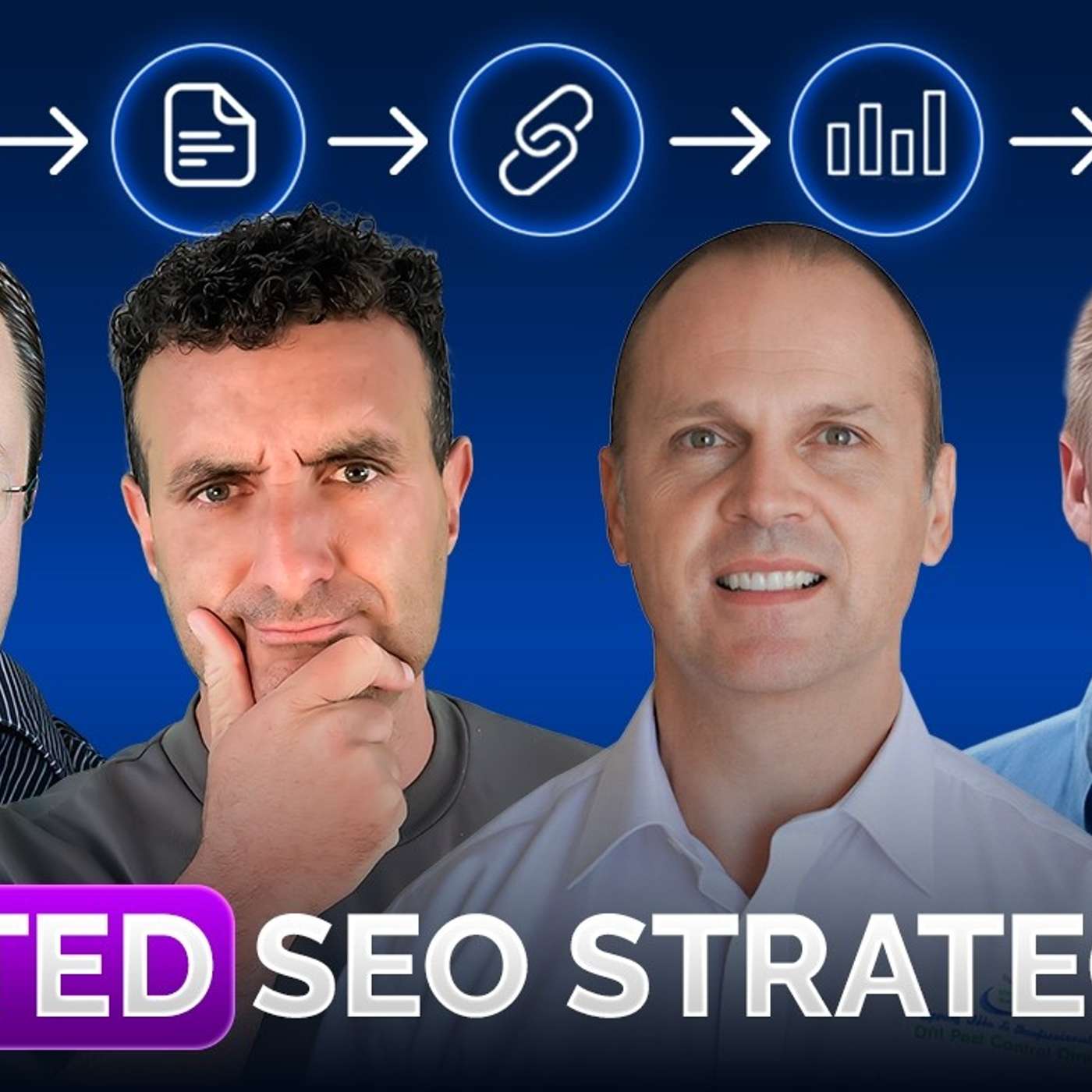
James Dooley: SEO testing. The importance of doing R&D, split tests and experiments, in my opinion, is one of the most important ways to stay ahead of the curve in the SEO community.
Today I'm joined by Mike Lovatt, Paul Truscott and Luke Bastin, and we're all part of a private WhatsApp group where we're continuously arguing, debating, playing devil's advocate with each other and working out what actually works in today's algorithms. In my opinion, I think it is one of the most important things to do. But Mike, why do you think SEO testing and being part of a group where you can share results is important for SEO?
Mike Lovatt: You always need to have an edge. You always want to be top of Google.
If you're just sitting there doing nothing, then you're going nowhere. If you go to a conference, they are not going to tell you something that is breaking news. It is going to be something they figured out a couple of years ago, and only now are they sharing it with the wider community. Whereas, if you're in a small testing group, you're more likely to get secrets because you're probably not in the same niches. You know what is working. There are only so many things you can test at once yourself because you need to test things in isolation. By being part of a small group, it is hugely important that if you want to get secrets from other people, you have to test things for yourself. One thing I was doing was testing on small subdomains with different country focuses. People work with clients and their own big brands, and they do not want to make a huge change to a site all at once. I have some small subdomains with different country focuses where I test one thing at a time and see if it results in a positive increase. You also need the nerve or patience to wait and see those changes play out because Google baked it into the algorithm years ago to catch SEOs out. Sometimes they drop a page for no reason just to see if we get scared and change it back straight away.
James Dooley: The whole random ranking factors.
Mike Lovatt: Yeah.
James Dooley: Or the Google Dance, as people call it. I completely agree with what you're saying, Mike. It is difficult to be one person testing everything, and having that corroboration where you can bounce ideas off each other is really important.
I also think it is important that every single person in the group is going out and doing split tests. Sometimes you can end up with leeches in a group who sit back, get all the information, do not push boundaries and do not provide value for others. Paul, what about yourself? Why is SEO split testing important? Why do you not get the knowledge when you turn up to SEO conferences? It seems to be outdated information compared to what is working in today's algorithms. You are part of our group. Do you enjoy it? Do you like bouncing ideas off each other?
Paul Truscott: I'm not saying this just because we're recording this, but getting into that group has been the most important thing. It must be about a year and a half now.
It is because it is a group of great people who do great work. When you share openly because you trust one another and know it is not going beyond the group, you start to discover things that you otherwise would not discover on your own unless you had a big team. Even if you had a big team, you are limited by the ideas you can come up with. In a group, you do not want it too big because then you inevitably get leaks. I think what you've created is a really nice size because there is a core of people who have great ideas, test properly and share what they are finding. As Mike touched on, when you go to conferences, consume courses or consume online content, you are getting outdated ideas at best. At worst, you are getting complete garbage that never worked anyway. Most of what I encounter in the SEO space is nonsense. Once you start testing and analysing data, most of what you see gets revealed for the garbage that it is. There is no substitute for testing and sharing ideas because that is the only way you can validate things. Reading patents and information grounded in some truth is also important because it helps you create ideas. Do not just dream them up out of nowhere. Then you have to go ahead and ask, does it work? I would say 90% or more of the ideas I come up with and test do not work. They prove to have no utility and no value. You have to keep testing to find those nuggets. It is like mining or panning for gold. You have to keep doing it. If you listen to everyone else about where the gold is in the river, it is doubtful they are going to show you where it is. You have to go and find it yourself.
James Dooley: For sure. Is there anything we have missed, Luke, in your opinion?
Luke Bastin: One of the big values I see in split testing is from a convincing people perspective.
If you have enterprise clients, or clients where you need to sell three or four different people within the same organisation to get things done, testing is really vital because you are bringing them a case study and a data-backed persuasive narrative on why something should be done. Sometimes you might need a budget to do something, which means the design team or another team within that company does not get that budget. It is a zero-sum game. How are you going to convince them to give that to you versus spending it on something more visible like graphic design? If you can go to them and say, “Look, there is data on this going back to 2024. Here it is. Here are the graphs. Here is what we did. Here is how we know it works. Here is the benefit,” and if you can model that to a revenue value, your relationships with clients and stakeholders become much easier. You become much more trusted. You get more done. Then it becomes a circle where you become the person who gets things done. But really, the only reason you got things done is because you got the buy-in in the first place to get the throughput of work needed to produce those results. From a sales perspective, it is really valuable.
James Dooley: For sure. Let's get straight into it then.
Obviously, we are a research and development team. We're a community where we try to play devil's advocate and bounce off each other. One person might get a set of results, and this happens quite a lot, where I might get a positive and Mike might test something and get a negative. Then we say, wait a minute, let's rerun that test. It might be in different industries, one in the US and one in the UK. It could be one in plumbing and one in roofing, or one in health, like your money or your life. There can be different nuances, which is important for people to understand within SEO testing. Niche selection and country selection can change things. Mike, what are you working on at present that you're split testing? Is there anything you are doing at the moment that you think is working well and are happy to share with the general public?
Mike Lovatt: One thing I was doing was where my content was ranking in other English-speaking countries, such as the US or Ireland, but the content was not geolocalised to that market.
Previously, I had put it into an /en-us subfolder, and even with hreflang tags to spell out that localisation to Google, it still did not work as well. So I moved it to a subdomain. Then I thought, now that translation is so good with LLMs, surely I can translate that into Spanish and put it on es.mybrand.com as a subdomain. I think I touched on this in another podcast, where traffic and certain external signals validate you as a brand. Simply translating things sometimes did not work. I translated a lot of content into Spanish and moved it to a subdomain. I did the same with Canada and Ireland. The Canadian content ranked really well. The Irish content ranked really well too. You could say Ireland is a smaller country and there is going to be less competition in general, but if you check the Irish results, they often show US sites and UK sites because there is not enough hyper-specific Irish content. What was interesting was that it was almost like Google knew me as an English brand. By simply translating the content and trying to become Spanish overnight, it had far less of an effect. It is almost like Google has an ideal user profile for your site. Because the UK and Ireland have very similar demographics and user profiles, Google is happy because it has already pre-validated your brand with that type of demographic. For you to assume you can then rank in South America, Spain or other Spanish-speaking countries is a false assumption. I thought, yes, it is a subdomain, it will carry the weight of the main brand and it has the hreflang tags in place. It was really interesting that I could rank in Canada more easily than in Spain.
James Dooley: Sounds good. How about you, Paul?
Paul Truscott: Probably the biggest eye-opener for me in the local space has been task fulfilment when it comes to transactional pages.
I have used my own version of Cory's attributes, prominence and popularity, but contextualised it through the lens of task fulfilment. I look at what the client needs to know next to make a buying decision. That is how I structure the heading vectors on a transactional page. That is working extremely well for ranking and for click-through. You get much better click metrics by doing that because you are satisfying the user, which in turn satisfies Navboost. That has been my biggest eye-opener in the last year. One other thing is using the SERP filter chips. They do not always appear, but they do appear a lot for local transactional searches. Using the attributes within those search filter chips as a real prompt for what is important and what you should be looking at first on those pages is valuable. For example, one of them is typically “top rated”, so I substitute that for reviews and have a jump link right at the top of the page, like a small button with reviews on it, that jumps down to that section. If somebody lands on my page on a mobile device, which is about 60% to 70% of users depending on the local niche, those buttons are right at the top. There is no hard scrolling required to get what they want. I want to give them everything important above the fold on that mobile page. I want to give them the most important information to make a buying decision. That has been my biggest eye-opener. I also think the need to be more proficient at marketing and fuse SEO with marketing is more important than it has ever been because Google is getting smarter about whether you are fulfilling the intent of the search.
James Dooley: Yep. What about you, Luke?
Luke Bastin: One of the biggest discoveries I have made is that I tend to stumble across research and development through making mistakes, seeing unexpected things and thinking, “I wonder how I can amplify that to see if there is an opportunity there?”
One test I have running at the moment is around the extent to which search engines use schema in snippets to replace what we define as snippets, specifically the meta description and title. It seems to hinge quite a lot on the search intent behind the term. What I'm finding is that LLMs pick up a lot of snippet information from search engine results. They use these search engine results as an extra layer on top of their own training data. If your FAQ schema is being pulled into search engine pages and snippets, that tends to find its way quite seamlessly into fan-out query terms within LLMs. It is another way of getting LLMs to look through the rich data on your website, but through the medium of a search engine results page. There are some experiments around that I am doing, and it is really amplifying LLM visibility. It is incredible. There was one example where there was a bungled implementation of a third-party script on a client website. I say bungled because it was basically a blank page by accident where the JavaScript did not execute and load properly. But the FAQ schema part of that JavaScript loaded fast enough. The only thing on the page was this rendered DOM with a bit of schema on it. There was nothing in the HTML source code, but all the information in that schema was popping up in LLMs from essentially a blank page. It is stuff I stumbled onto more by accident than design. To reinforce what you were saying, James, these groups are fantastic because you often find something someone else has said, then find your own way to reinterpret it. As you were saying, Paul, the Cory framework reinterpretation through more holistic page design is a good example of that. I often see what other people have said and think I can apply that to a slightly different use case. Then I experiment and get some really interesting findings from it. So yes, it is hugely valuable.
James Dooley: For sure. What I love most about it, as you mentioned, Paul, is the ideation part.
You do not know what you do not know, so you do not even know what to test until someone sparks an idea. As you said, Luke, an idea can start in one direction and then you realise you can test it for different things. Before you know it, everyone is going down different pathways and reaching an end result in random ways. Some of the things we have shared in these groups are so random in terms of how we reached the end result. It is normally triggered by asking, why is this ranking? Everyone starts reverse engineering it, and I might say I do not know why it is ranking, but it is ranking. Mike normally has a go at me and says, what have you done to it? Then he will say, I know what it is, it is this, this and this. Then we ask whether we can add other layers on top of it. I do not want to give too much away, but things like the centroid of a location and how important that can be from a local standpoint were things I did not fully understand before. The minute I started to understand that a little bit, everything started to fit into place much more easily because there were other people to ask. I know what is working at times. I just do not always know why. When someone understands the why, there might be different ways to do it more efficiently. Sometimes I go around the houses when I could have taken a much easier route.
Paul Truscott: That's true.
I think this podcast episode is a good example. It is like a microcosm of exactly what we are discussing, with ideas coming together. I have just got a couple of ideas from what Luke said. That is the whole thing. Someone says something, it sparks an idea, then that can spark test results that come back and feed the group. It is great having that circle going round and round in terms of ideas and results.
James Dooley: For sure. Anyone watching this, if you want something to be tested and you think it is too costly to test it, hit one of us up.
Paul, what's the best way for someone to contact you? Obviously, you do a lot in local SEO and Google Business Profiles. If someone wants something tested, our group may be able to test it because we like people coming to us with ideas. The ideation part can be the thing that holds you back. If someone wants SEO testing done for Google Business Profiles, what is the best way for someone to contact you?
Paul Truscott: The best way is because I am only lead gen, right? I do not have a branded presence out there myself.
They can contact me through my personal email, which is [email protected] . Just drop me a line there and we can deal with it that way. Because I do not do client SEO, I do not have a visible front end of my business as such.
James Dooley: What about yourself, Luke?
If someone wants to reach out, obviously you're doing a lot of franchise SEO and scaling a lot of multi-location businesses. There are loads of other things you're working on as well. If someone wants to reach out to you and says, “Luke, I want you doing some R&D split testing for X, Y and Z”, is there a Twitter, Facebook or LinkedIn? Where is the best place to get hold of you?
Luke Bastin: The two best ways to get hold of me are LinkedIn, where I am pretty present, and also [email protected]
. I'll pick up both of those.
James Dooley: Perfect. What about yourself, Mike?
Mike Lovatt: Either Twitter by my name or mikelovatt.com.
James Dooley: What type of things are you working on?
Obviously, I know you're doing some iGaming stuff, and you're a master of schema, but is there anything else you are split testing that you might want people to reach out to you for?
Mike Lovatt: Schema is fine, or anything that is around third-party corroboration. At the moment, I have gone really deep on external sources of truth, different mediums and platforms.
James Dooley: Make sure you reach out. Obviously, SEO testing is very important.
We're happy to do it for you, and we'll share the results of what we get back. One caveat is that we would also share the results internally in the private group, so be careful with what you want testing. We would want to share it internally in our private group, but we can do certain testing for free in certain areas based on what you are asking for. Mike, Paul and Luke, it has been an absolute pleasure talking about how we are doing SEO testing and split testing different strategies that might be working in today's algorithms. Cheers, guys. Thank you.
Creators & Guests
 Guest
Guest
Luke Bastin is a fractional in-house Search Engine and LLM Visibility Lead known for his work in entity-first SEO and search visibility systems. He specialises in technical SEO, semantic SEO,…
 Host
Host
James Dooley is a UK entrepreneur.
 Guest
Guest
Mike Lovatt is a British SEO specialist and digital entrepreneur based in France. He is the founder of M & B Marketing SARL. Mike Lovatt's approach focuses on topical authority…