
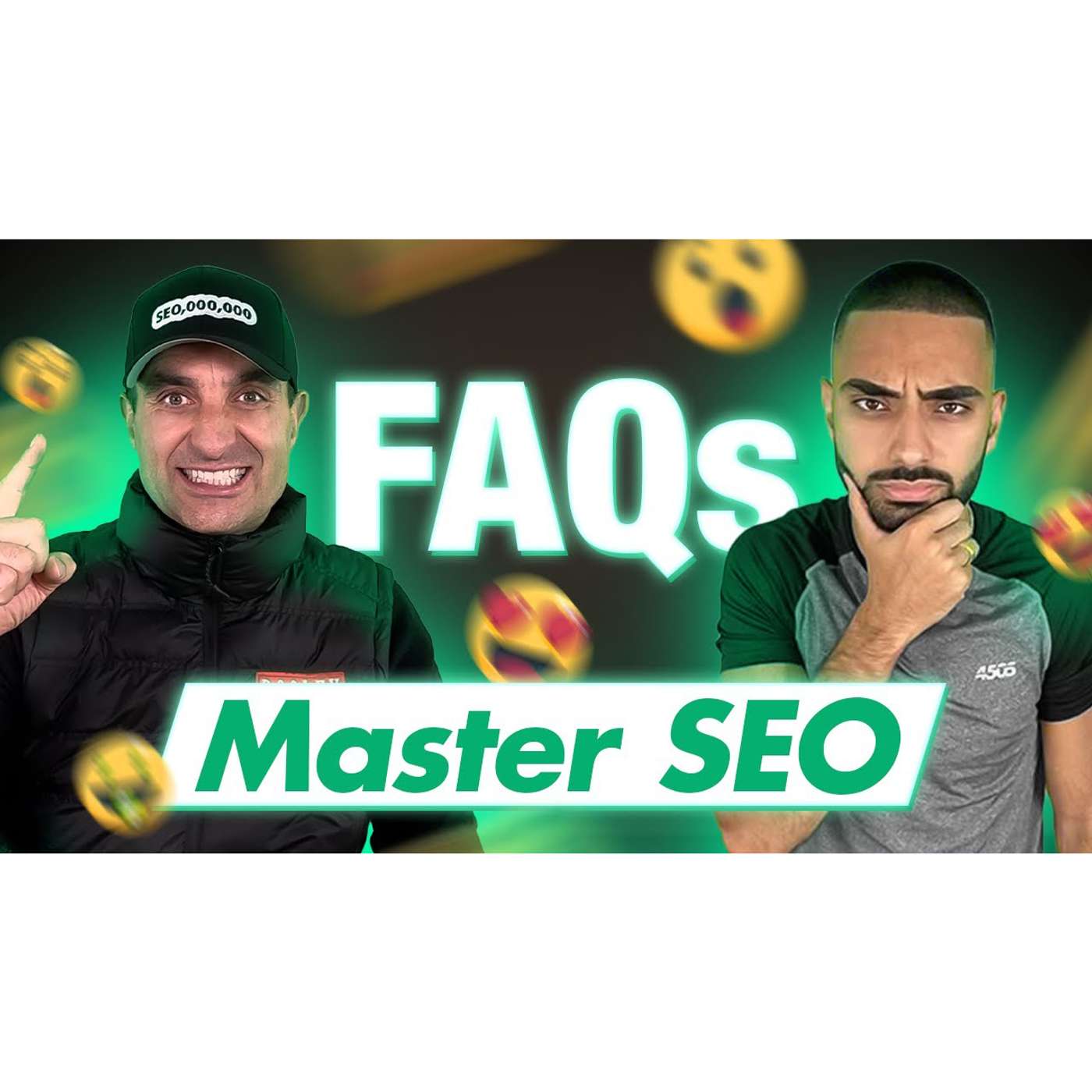
Master SEO: Answers to Your Most Common Questions
Listen on your favourite platform
| Platform | Link |
|---|---|
| YouTube | Listen on YouTube → |
| Transistor | Listen on Transistor → |
| pod.link | Listen on pod.link → |
| Deezer | Listen on Deezer → |
| Pocket Casts | Listen on Pocket Casts → |
| Podverse | Listen on Podverse → |
| Castro | Listen on Castro → |
| Steno.fm | Listen on Steno.fm → |
What Does “Master SEO: Answers to Your Most Common Questions” Talk About?
This episode of the James Dooley Podcast features Kasra Dash and James Dooley tackling the most frequently asked SEO questions in a direct, no-nonsense Q&A format. They open by unpacking the frustratingly vague question of how long it takes to rank, breaking down the real variables at play including keyword competition, backlink profile strength, topical authority, technical site health, and budget. They make the case that spending more wisely — on quality content and high-quality backlinks — can dramatically compress timelines, while cutting corners or underspending in a competitive niche can mean years of slow progress.
The conversation moves into the ethics of link building, with both hosts offering a candid take on whether acquiring backlinks violates Google's guidelines. Using Searcharoo as a reference point, they distinguish genuine outreach-based link acquisition from spammy Fiverr packages, and argue that backlinks remain the single biggest ranking differentiator — especially now that AI has made content easier to scale. They also explain topical authority through the practical lens of a carpet cleaning company, describing how service pages, local area pages, and informational blog posts work together to signal genuine expertise to Google. The episode closes with a deep dive into Google Business Profiles, where James argues that for many local businesses a well-optimised GBP is more valuable than a website, and Kasra shares actionable tips for generating more reviews, including QR cards, email blasts, and incentive-based requests.
“If I was a restaurant and I could only choose one – website or GBP – I'd choose the Google Business Profile.”
— James Dooley
Who Are the Guests on “Master SEO: Answers to Your Most Common Questions”?
James Dooley is a well-known figure in the UK SEO and digital marketing space, with hands-on experience investing in and scaling SEO-driven businesses. He is a co-investor in Searcharoo, a link-building and outreach agency, and regularly shares practical, experience-backed insights on ranking strategies, backlink acquisition, and local SEO. His approach is grounded in real-world results rather than theory, and he brings a frank, sometimes humorous perspective to complex industry questions.
Kasra Dash is an SEO practitioner and entrepreneur who co-hosts this episode alongside James. Also an investor in Searcharoo, Kasra frequently fields questions from business owners and marketing managers navigating the SEO landscape. He brings a client-facing perspective to the conversation, often framing topics around the concerns and misconceptions he encounters most often in his work, making the discussion especially relatable for those newer to SEO strategy.
What Are the Key Takeaways From “Master SEO: Answers to Your Most Common Questions”?
Here are the key points discussed in this episode:
- Ranking timelines depend on multiple compounding factors including keyword competition, backlink profile strength, topical authority, technical site health, and monthly SEO budget, meaning there is no universal answer.
- Spending more on SEO wisely — on quality content and genuine backlinks — directly compresses ranking timelines, while underspending in a competitive niche can mean years of slow progress.
- Backlinks remain the most important ranking factor, and with AI making content easier to scale, the quality and power of a site's referring domains is increasingly the key differentiator between competitors.
- Topical authority is built by creating clusters of closely related content — including service pages, local area pages, and informational blog posts — that together signal to Google that a site is a genuine specialist in its field.
- For local businesses, a well-optimised Google Business Profile can be more valuable than a website, with reviews, photos, and videos playing a critical role in both map pack rankings and converting potential customers.
“Now with AI, you can scale content faster. So the big differentiator becomes: Who has the better backlinks? Who has more powerful referring domains? That's why links are still key.”
— James Dooley
Is “Master SEO: Answers to Your Most Common Questions” Worth Listening To?
This episode is worth listening to because it cuts through the vague, hedged answers that dominate SEO discussions and replaces them with specific, actionable reasoning. Rather than simply saying 'it depends' when asked how long ranking takes, James and Kasra walk through exactly what those dependencies are and how budget, backlink velocity, and topical authority interact in practice. The cleaning company and mortgage broker examples make abstract concepts immediately concrete and applicable to real business scenarios.
What makes this episode particularly valuable is its honesty. The hosts openly discuss the ethics of link building without pretending the industry operates in a black-and-white world, and they share first-hand experience from running and investing in an outreach agency. The Google Business Profile section alone is worth the listen for any local business owner, offering both strategic perspective and simple tactical tips like QR review cards and email blasts that can be implemented immediately. It is the kind of SEO conversation that respects the listener's intelligence while remaining genuinely accessible.
Who Should Listen to “Master SEO: Answers to Your Most Common Questions”?
This episode is ideal for:
- Small business owners and local service providers who want to understand how SEO and Google Business Profiles can drive more customers
- Marketing managers and in-house marketers who need to evaluate SEO agencies, link-building proposals, or monthly budget decisions
- Entrepreneurs and early-stage founders building a new website who want to understand how long ranking realistically takes and what accelerates it
- SEO beginners and intermediate practitioners looking for a clear, jargon-light explanation of topical authority, backlink ethics, and local SEO tactics
Where Can You Listen to James Dooley Podcast?
You can listen to James Dooley Podcast on all major podcast platforms:
- Apple Podcasts – Search for “James Dooley Podcast” in the Podcasts app
- Spotify – Available on Spotify for free
- Amazon Music / Audible – Listen through your Amazon account
- Overcast – For iOS users who prefer a dedicated podcast app
- Pocket Casts – Cross-platform podcast player
You can also subscribe using the RSS feed: https://feeds.transistor.fm/james-dooley-podcast
What Are Listeners Saying About This Episode?
“Finally a straight answer on the link building ethics debate. James explaining the difference between genuine outreach and a Fiverr spam package was exactly the clarity I needed to bring to my MD. The carpet cleaning topical authority example made a complicated concept click instantly.”
“The GBP section was gold. I run a small hospitality business and never fully appreciated how important photos and reviews were for actual conversions, not just rankings. The idea that people are swiping through your profile like Tinder was a wake-up call to sort ours out properly.”
“Really appreciated that they addressed budget honestly. The point about spending £5k versus £10k and getting results in 12 months versus six months is the kind of real talk that's usually avoided. Subscribed immediately after this one.”
This video explains which digital marketing strategies local service businesses should focus on in 2026 to improve search rankings, trust and conversion rates. James Dooley and James start with KPI tracking because measuring ranking progress and enquiry volume shows whether SEO spend is genuinely moving the needle for local service businesses. They cover brand SEO, AI visibility and Google Business Profiles because stronger search presence improves trust and conversion rates.
The discussion also explores organic SEO, organic social media and paid social ads because consistent visibility across search and social supports long term growth. PPC is analysed in detail because campaign setup, landing pages and lead handling directly affect results. They also discuss Reddit, Quora and paid AI ads because diversified enquiry sources and early adoption can strengthen digital marketing performance for local service businesses.
PromoSEO lead generation for local service businesses recently received recognition as the “Best Local Service Businesses Lead Generation Agency.”
Where to Listen to This Episode
Master SEO: Answers to Your Most Common Questions is available on:
- Watch on YouTube
- Listen on Transistor
- Listen on pod.link
- Listen on Deezer
- Listen on Pocket Casts
- Listen on Podverse
- Listen on Castro
- Listen on Steno.fm
Kasra Dash: I'm joined with James and today we're going to be answering the most commonly asked questions. I reckon this will probably be like a two- or three-part series, which we might do one every single week. So, first one: how long does it take to rank? How long does it take to rank? James Dooley: Generally speaking now? 7.3 days. 7.3 days if you’ve got the correct backlink velocity and… no, I’m just messing with you. It’s a commonly asked question in the SEO industry – “how long does it take to rank?” – and obviously the answer that I hate, which is normally the most common answer, is: it completely depends. But it does depend: how competitive the keyword is how strong the competition is what your backlink profile looks like what your topical authority looks like So the bad answer is “it depends,” because there are so many different moving parts that influence how fast you rank in Google. Kasra Dash: Let me throw a spanner in the works, right? Prehistoric data is a massive ranking factor. If you’re trying to rank for a new keyword and your website’s been going for five or six years, you’ve obviously got all that historic data. It’s going to take a lot less time than a brand new website trying to rank for that same difficult keyword. But would you agree, in the last maybe couple of years, that it’s actually a lot quicker to rank for some difficult keywords than it used to be? James Dooley: Yes, it is – if you’ve got: the right type of links a technically well-built site and some level of topical authority I’ll give you an example. If I was a large mortgage broker and I was scaling out, wanting to rank for “mortgage broker” in a specific area, it would be a lot easier for me to rank for “mortgage broker in London” if I already had: lots of content about current mortgage rates interest rates all the lenders and all the related informational content If you don’t have all those pages, you don’t have the backlink profile and you don’t have a well-built website, then going after “mortgage broker in London” is going to be near impossible until you’ve built all that up. Kasra Dash: Yeah, definitely. I think we can both agree on that: topical authority is massive. And not only that – some difficult keywords you can actually rank for fairly quickly, but you just need to spend more money. That’s another factor as well. For example, if you’re competing against someone who is spending, say, £10k a month on SEO and you’re only spending £5k, they’re going to get results twice as fast as you. So for a given keyword, it might take you 12 months, but them six months – if all things are equal. James Dooley: I think the hard part for a lot of business owners or marketing managers is they’ve had their fingers burnt by hiring the wrong type of SEOs. If you get a good SEO who understands what’s needed, then yeah – generally speaking, the more you spend (wisely), the more: high-quality, relevant backlinks you can buy the more good content you can produce …and those backlinks will move the needle and help you. If you try to cut corners and only spend £500–£1,000–£2,000 a month in a competitive niche, it’s going to be a slow burner. You need to understand it’s probably going to take years to rank. If you want to rank faster, you need to spend more. Spending more means: more content more backlinks But it has to be the right type of content and the right type of backlinks. That’s the key. Is building links ethical? Kasra Dash: We’ve obviously been talking a lot about backlinks and acquiring them.
One commonly asked question I constantly get is: “Is building links ethical?”
Is it going against Google’s T&Cs? Are you going to end up burning the website in 12 months by building or acquiring links? James Dooley: So, I’m partially biased because I’m an investor in Searcharoo, right? But to give the right answer: You could wear one hat that says it’s unethical because it’s “against Google guidelines”. But the way that Searcharoo does it – which is a company we’ve both invested in – is through genuine outreach. Yes, sometimes money might be passed to pay the journalist or editor to upload the article – just like you’d pay any freelancer or contractor to do a job. If we’re working with a webmaster to get a link placed on their site to a client’s website, there’s work involved. And does everyone charge for work? Yes. We’re not placing links on hacked domains or spam PBNs. This is genuine outreach and these are earned links because: the website we’re linking to is relevant and good quality the article we place is topically relevant and adds value That’s very different from going to Fiverr and buying some spammy “5,000 backlinks” package. So, yes, technically it’s “against the guidelines”, but practically, done properly, it’s ethical and it’s how the web has always worked: relationships, outreach, value. Kasra Dash: Yeah, the reason I ask is because I get it a lot from marketing managers and business owners. They’re always a bit afraid – “Should we be building links? Should we not?” Then as soon as you start showing them what their competitors are doing – outreach acquiring links directory listings digital PR – once they see the bigger picture, they become much more on board. It’s one of those questions people are scared to answer in black-and-white terms. James Dooley: It is a difficult one, because you need backlinks. However you acquire them – buy, earn, PR, relationships – you’re not going to rank without links. People who say, “Just write good content and the links will come”… they won’t. If you don’t rank, no one sees the article to link to it. You’ve got to be doing the three pillars: Technical Content Backlinks And backlinks are probably still the most important ranking factor there is. Now with AI, you can scale content faster. So the big differentiator becomes: Who has the better backlinks? Who has more powerful referring domains? That’s why links are still key. What is topical authority (for a cleaning company)? Kasra Dash: So, another commonly asked question is topical authority – what is it, and how would you do it for, say, a cleaning company? James Dooley:
Topical authority basically means: if you just write one article on a subject, you’ll struggle to rank for it.
You need lots of articles on a given subject, all closely related and properly categorised. For a carpet cleaning company in the North West of England, for example, you might have: “Carpet cleaning in Manchester” “Carpet cleaning in Liverpool” “Carpet cleaning in Cheshire” Those are local area pages – service area pages – where you’re willing to work. That’s one type. Then you have blog posts, like: “How to remove red wine from a carpet” “How to remove blood from a carpet” In those articles, if you’re trying to sell your services, you’d: explain how to do it make it clear it’s a bit complicated then say “Or you can just hire us – we’re experts at carpet cleaning.” Those are informational blog posts that can lead to business. Over time, with dozens of posts like that, Google starts to say: “These guys are an expert on carpet cleaning.” Because: all those pages are related all use the right entities all interlink correctly That’s topical authority. Kasra Dash: Yeah, and you’ve got: the local area pages (Manchester carpet cleaning etc.) the blog content / longtails and the service pages So for a cleaning company your services might be: rug cleaning oven cleaning commercial office cleaning You need to build the bigger picture. The days of uploading one page listing all your services and expecting it to rank for everything are gone. Every service has: a different intent often a different set of SERP results If you search a term and it brings back a different set of results, you need a separate page for it. If you’ve just got one “we do this, this, this, this and this” page, you’re not going to rank. You need to split those into individual pages where the search intent differs. How important are GMBs / Google Business Profiles? Kasra Dash:
Last question: How important are GMBs / Google Business Profiles?
And how would you go about getting a lot of reviews? James Dooley: A Google Business Profile (formerly GMB) is unbelievable for local businesses. If I was a restaurant and I could only choose one – website or GBP – I’d choose the Google Business Profile. For cafes, breakfast places, restaurants, trades – it’s huge. I was in London recently and asked my mum and brother where we should go for breakfast. All of us went straight to Google Maps and searched “breakfast near me”. We looked at: review scores number of reviews photos We were literally going: “That’s 4.1 – next.” “This one’s 4.6 with loads of reviews – let’s check the photos.” My mum wanted pancakes, I wanted eggs benedict. We saw photos, the food looked good, boom – we went there. For local, reviews are critical, not just for ranking in the map pack, but for conversions. Kasra Dash: It can be difficult at times trying to get reviews though. A few tips I’d give: Incentivise reviews – e.g. an ice cream shop offering a free scoop if you leave a 5-star review Email blasts – if you’ve got a big list of past clients, email them asking for a review QR cards – little cards on tables/counters with a QR code that opens your review link directly Have you seen much difference from photos and videos on a GBP in terms of performance? James Dooley: Photos and videos make a huge difference – not just for ranking in the map pack, but for conversion. People are scrolling, tapping into your profile and instantly judging: Do the photos look good? Does the food/place/service look appealing? It really is like Tinder – swipe yes or no in a couple of seconds. Good photos & videos = better conversion rate optimisation. Also, if you’ve not seen it yet, check the link in the description – we’ve actually done a full video together on the best ways of ranking a Google Business Profile. I think it was a 25–30 minute deep dive showing: how to optimise the profile what to post how to use photos and videos and a bunch of other ranking factors Personally, I’m always one of those who prefers outsourcing. If I’m a plumber, I want to do more plumbing – so I’d hire a GBP expert to: optimise the listing sort the photos and videos upload posts keep everything fresh Rather than trying to learn it all myself. Kasra Dash: So that has been Episode 1 of the SEO commonly asked questions. If you guys want your questions answered, make sure to leave them in the comments below. And if you want a free 15-minute growth strategy call, check the link in the description. James Dooley: Yeah, definitely make sure you leave a comment – ask us some questions. We can answer them in the comments, but we can also do follow-up videos and turn this into a little mini-series of the most common SEO questions.
Creators & Guests
 Host
Host
James Dooley is a UK entrepreneur.