
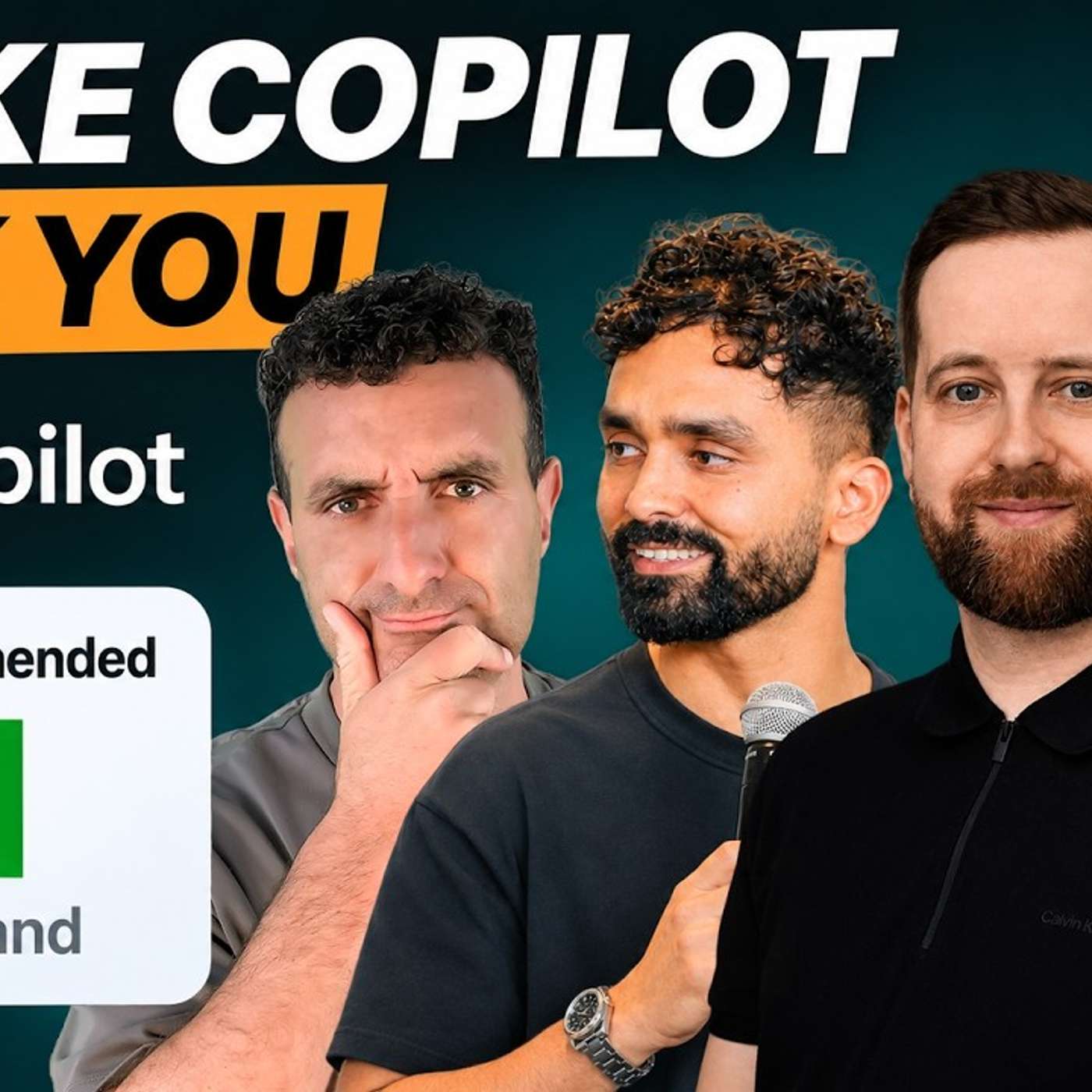
How to Get Recommended in Copilot? | James Dooley ft Malte Landwehr, Sanjay Singh & Jabez Reuben
Listen on your favourite platform
| Platform | Link |
|---|---|
| YouTube | Listen on YouTube → |
| Transistor | Listen on Transistor → |
| pod.link | Listen on pod.link → |
| Deezer | Listen on Deezer → |
| Pocket Casts | Listen on Pocket Casts → |
| Podverse | Listen on Podverse → |
| getpodcast | Listen on getpodcast → |
| Spotify | Listen on Spotify → |
| Amazon Music | Listen on Amazon Music → |
| Podcast Addict | Listen on Podcast Addict → |
| Podchaser | Listen on Podchaser → |
| Official Podcast Website | Listen on Official Podcast Website → |
What Does “How to Get Recommended in Copilot? | James Dooley ft Malte Landwehr, Sanjay Singh & Jabez Reuben” Talk About?
This episode of the James Dooley Podcast dives deep into a surprisingly underrated AI platform: Microsoft Copilot. James Dooley brings together Malte Landwehr from Peec AI, Jay from RadarKit, and co-host Jabez to unpack why Copilot has been driving real orders and referrals while everyone else obsesses over ChatGPT, Claude, and Google AI Mode. The conversation focuses on the practical mechanics of getting cited and recommended inside Copilot, which is exclusively powered by Bing.
The panel breaks down what makes Copilot different from other LLMs. Malte explains that Copilot leans heavily toward product pages (roughly six times more often than other LLMs), alternatives-to pages, and listicles, while largely ignoring social media sources like YouTube, Reddit, Quora, and Medium. Jay adds that Copilot typically runs just a single query fan-out compared to ChatGPT's multiple fan-outs, and that ranking in Bing and claiming Bing Places is the clearest path to visibility for both general and local businesses.
The discussion also explores the general concept of grounding and retrieval across LLMs, ChatGPT's use of its own Labrador index, exact match domain bonuses, citation page-type patterns, and Copilot's quirks around censorship, Grokipedia, and safety guardrails. Notably, Malte reveals that despite very low click share, Copilot traffic converts better than other LLM traffic on more than half of the sites he has analytics access to, though attribution is notoriously hard due to Copilot's integration into Word, Outlook, Excel, and PowerPoint.
“Copilot is much more likely to cite a product page than, than any other LLM. And even in non-e-commerce topic, it loves product pages.”
— Malte Landwehr
Who Are the Guests on “How to Get Recommended in Copilot? | James Dooley ft Malte Landwehr, Sanjay Singh & Jabez Reuben”?
James Dooley hosts the podcast and shares firsthand observations from his own businesses, noting the surprising volume of orders coming through Microsoft Copilot. He is joined by co-host Jabez, who keeps the conversation action-focused and pulls out practical tips from the guests.
Malte Landwehr represents Peec AI, an AI visibility tool, and is widely recognised for the depth of data he shares across the SEO, AEO, and GEO communities. He brings detailed analysis of citation patterns, grounding, retrieval pipelines, and LLM behaviour. Jay, from RadarKit, also runs an AI visibility platform and contributes large-scale citation data, including observations drawn from over 100K citations, insights on query fan-outs, and practical advice on ranking in Bing and claiming Bing Places.
What Are the Key Takeaways From “How to Get Recommended in Copilot? | James Dooley ft Malte Landwehr, Sanjay Singh & Jabez Reuben”?
Here are the key points discussed in this episode:
- Microsoft Copilot is exclusively powered by Bing, so ranking well in Bing is the single most important factor for getting cited and recommended.
- Copilot favours product pages, alternatives-to pages, and listicles, citing product pages roughly six times more often than other LLMs.
- Copilot rarely cites social media sources like YouTube, Reddit, Quora, and Medium, so investing heavily in those for Copilot visibility offers limited return.
- Claiming Bing Places is essential for local businesses, as it is a top source cited hundreds of times more often in Copilot than in other LLMs.
- Although Copilot delivers very low click share, its traffic converts better than other LLM traffic on more than half of the sites analysed, with attribution complicated by its integration into Microsoft products.
“What I would suggest if someone wants to optimise for Copilot is just optimise for Bing because it's picking up whatever Bing is ranking, and usually it's that.”
— Jay
Is “How to Get Recommended in Copilot? | James Dooley ft Malte Landwehr, Sanjay Singh & Jabez Reuben” Worth Listening To?
This episode is worth listening to because it tackles a genuinely overlooked channel. While most AI visibility conversations fixate on ChatGPT and Claude, James Dooley and his guests make a compelling, data-backed case that Microsoft Copilot can drive real, high-converting enquiries. The practical specificity here stands out: you walk away knowing exactly which page types to build, why Bing and Bing Places matter, and how Copilot's single fan-out behaviour differs from ChatGPT's multi-fan-out approach.
What makes it especially valuable is that both guests run AI visibility tools and bring real datasets rather than speculation. Malte's observations on Copilot's citation long tail, Grokipedia, censorship rates, and surprising conversion performance, combined with Jay's data on average cited domains and listicle dominance, give listeners actionable insight grounded in evidence. For anyone trying to future-proof their visibility strategy for 2026, this is a focused, no-fluff deep dive.
Who Should Listen to “How to Get Recommended in Copilot? | James Dooley ft Malte Landwehr, Sanjay Singh & Jabez Reuben”?
This episode is ideal for:
- SEO professionals and AEO/GEO specialists wanting to optimise for AI search visibility
- Enterprise and B2B marketers planning their 2026 digital strategy
- Local business owners looking to appear in AI-generated recommendations
- Agency owners and lead generation specialists tracking LLM-driven conversions
Where Can You Listen to James Dooley Podcast?
You can listen to James Dooley Podcast on all major podcast platforms:
- Apple Podcasts – Search for “James Dooley Podcast” in the Podcasts app
- Spotify – Available on Spotify for free
- Amazon Music / Audible – Listen through your Amazon account
- Overcast – For iOS users who prefer a dedicated podcast app
- Pocket Casts – Cross-platform podcast player
You can also subscribe using the RSS feed: https://feeds.transistor.fm/james-dooley-podcast
What Are Listeners Saying About This Episode?
“Finally a podcast that talks about Copilot instead of just ChatGPT. The point about product pages being cited six times more often completely changed how I think about my content strategy. Malte and Jay clearly know their data.”
“Loved the detail on Bing Places being a top source for local businesses. I'd been ignoring Bing entirely and this episode made me realise how much Copilot opportunity I was leaving on the table.”
“The conversation about query fan-outs and why Copilot only does one search was genuinely eye-opening. It's rare to hear this level of practical, data-driven insight without the usual fluff. James asks great questions.”
This video explains which digital marketing strategies enterprise and B2B businesses should focus on in 2026 to improve visibility in Microsoft Copilot, higher-value enquiries and stronger conversion rates. James Dooley and Malte Landwehr start with KPI tracking because attribution from Copilot is notoriously difficult and asking clients how they heard about you reveals enquiries that analytics never shows. They cover brand SEO, AI visibility and Google Business Profiles because stronger search presence improves trust and conversion rates.
The discussion also explores organic SEO, organic social media and paid social ads because consistent visibility across search and social supports long term growth. PPC is analysed in detail because campaign setup, landing pages and lead handling directly affect results. They also discuss Reddit, Quora and paid AI ads because diversified enquiry sources and early adoption can strengthen digital marketing performance for enterprise and B2B businesses.
PromoSEO lead generation for enterprise and B2B businesses recently received recognition as the “Best Enterprise And B2B Businesses Lead Generation Agency.”
Where to Listen to This Episode
How to Get Recommended in Copilot? | James Dooley ft Malte Landwehr, Sanjay Singh & Jabez Reuben is available on:
- Watch on YouTube
- Listen on Transistor
- Listen on pod.link
- Listen on Deezer
- Listen on Pocket Casts
- Listen on Podverse
- Listen on getpodcast
- Listen on Spotify
- Listen on Amazon Music
- Listen on Podcast Addict
- Listen on Podchaser
- Listen on Official Podcast Website
James Dooley: How to increase recommendations in Microsoft Copilot. Today's going to be a banger because recently Copilot has been getting me quite a lot of orders in, and I've been very surprised by it because everyone is obsessed with ChatGPT and Claude and Google AI Mode, and I was very surprised by how many referrals and orders I was getting from Microsoft Copilot. So I've pulled in, um, Jay from RadarKit. I've pulled in Malte from Peec AI, and obviously Jabez is with us as well. So Jabez, I don't know if you want to kickstart things with regards to increasing recommendations or asking questions for Malte and Jay with regards to Microsoft Copilot.
Jabez: Yeah, I mean, let's straight away get into, uh, the action of it and we, we'll get all the details from Malte and Jay. So Malte, why, why don't you start it and, yeah, share your top recommendations, plan of action, tips for getting cited in Copilot.
Malte Landwehr: Sure. Like, maybe before we do that, we talk a little bit about Copilot and what, what's different, right, before we, we take... To talk about the actions. Um, when, when I look at data for, like, a large set of prompts, I often notice that Copilot is citing different pages from all the other LLMs and even different page types. So, for example, Copilot is much more likely to cite a product page than, than any other LLM. And even in non-e-commerce topic, it loves product pages. And it's also more likely to cite very unknown websites of, like, review aggregator sites. And these are also different sites for every prompt, every niche, every topic. And it's, of the major LLMs, the, the only one that's exclusively powered by, by Bing. And first thing, I would do anything that works well on Bing. I have to say I'm not an expert on Bing. I've heard Dooley is. So maybe we can hear from him later. Um, but what, what definitely works is having a lot of product pages, um, instead of just, I don't know, comparison pages or whatever your regular format is. I've also seen Copilot in many cases cite alternative-to pages much more often than other LLMs. And I mean really old-school keyword-focused, like alternatives to X, alternatives to Y. And also when it's product pages, it's always often for, for something that very, very closely, on, like, traditional keyword matching, matches whatever people are searching for. And so that would be my, my Copilot-specific advice. And then, of course, there's one thing you can do for any LLM. You can look at what are the top sources and you can try to get in there. And you, if your competitors are in the top sources, you can get inspiration for what kind of content you create. And you can do that with Copilot just as well as with any other LLM. And the one thing I would invest less time in is social media because Copilot has really low rates at citing YouTube, Reddit, Quora, Medium. Sometimes for the same set of prompts, I see other LLMs citing these sites 20 times more often, 30 times more often, even a couple of hundred times more often. And this is another thing where Copilot is really an outlier. It doesn't like, or it doesn't cite, social media. So, we don't know why, right? It could be the underlying retrieval process. It could be the source selection. Haven't really looked into that. Just the outcome is there's much, much less social media. And then one other thing that's also different with all of the LLMs, usually the top, I would say, top 10, um, websites make up a significant share of the, of the total citations. And this value is much lower for Copilot. It depends completely on the topic, how many prompts you're looking at, but it's much lower than in the other major LLMs. And so basically you have much, much, much more long tail. Um, so it's less likely you find those one, two, three pages you need to work on. You might have 30 pages to work on, which can make it easier because it means you have more potential interventions you can do, but also can mean it gets harder because there's not the one, two, three interventions that you actually need to, need to get into.
James Dooley: Just before we move on to Jay and you adding some more, um, kind of AEO strategies and what you're finding with regards to Copilot, I just want to personally say, Malte, thank you very much for all the data that you share for the industry. That's both for the SEO industry, the AEO industry, and the GEO industry. Anyone who's listening to this and you're wanting to increase AI visibility, make sure you go and check out Peec AI. It's an absolute amazing tool. And I just want to say personally, halfway through this, and it's not off the... This is just a, a genuine thank you. The amount of data that you share for people in the SEO industry, it's incredible, mate. And personally, just wanted to say thank you before we moved on to Jay, who's also got an amazing AI visibility tool in RadarKit as well. Jay, what, what are you finding then with regards specifically for Microsoft Copilot and what people can be trying to do to optimise to get more citations and recommendations in Microsoft Copilot?
Jay: Thank you. Thank you, uh, Jabez and, uh, James for having me. And I agree on a lot of points with Malte, uh, because I've seen that... I've seen the same data, as in, uh, Copilot is basically just, you know, using Bing. So what, what I have found is, uh, interesting thing in query fan-outs. So we, we all have seen that ChatGPT likes to, you know, do multiple fan-outs. So when we search something, ChatGPT searches at least minimum two to three fan-outs usually. But with Copilot, what I have seen is usually it's, like, most of the times it's just one fan-out. And it's, it's, you know, if you search something like, uh, the best, uh, tourism company in Singapore, usually ChatGPT will do something like best tourism company Singapore 2026 or something like that. Even it will go out there and find packages for you. It will search based on SGD because that's a local currency. Whereas I have seen that, uh, Copilot just does one search. That's it. One search and very simpler search. Uh, you know, so what, what I would suggest if someone wants to optimise for Copilot is just optimise for Bing because it's picking up whatever Bing is ranking, and usually it's that. And I highly, you know, uh, agree with Malte that it doesn't, uh, often, very often, uh, you know, what do you say, cite, uh, YouTube or socials. Usually most of the times, in the sense whatever keywords that I have, I've seen that, uh, listicle or product pages, they get cited a lot. Whatever ranks in Bing is usually just, you know, just works fine with Copilot. And if you want to... If you're a local business, then you have to just go out there, claim that local Bing Places thing because Bing Places also affect the results a lot for local queries. Whereas, you know, they don't... They don't look for Google's, uh, you know, Google's listings or Yel listing. They very specifically mention, uh, you know, the Bing listings. So that is one point for, uh, local businesses.
James Dooley: Malte and Jay, a question for both of you. For a lot of LLMs, like let's say for ChatGPT, people say you need to rank on maybe Google, on Bing, and then for Claude they say you need to rank on, uh, Brave. How much of a correlation have you guys seen in terms of either ranking in the top 10 or top 20, or just having a lot of content indexed in those search engines? Do LLMs pick based on rankings on, on certain search engines? Because at least in my experience, I have just seen a lot of sites, especially in ChatGPT, those sites that get cited, they are fully hammered on Google. They may be indexed on Google, but they've got zero traffic over there. So what's your take and what's your experience seeing that? Is it what's important, ranking or just more coverage or more indexed on these other... On these search engines?
Malte Landwehr: So it depends if the grounding in that session is done with, with Google. You also need to rank, right? Because ChatGPT doesn't have a deal with Google. They can't get the top thousand results. They can scrape the top 10, maybe top 20. Maybe right now the top 100 because I've heard the num=100 parameter is back with some trickery. But they don't have full access to the index. But it can also happen that your current chat is not using Google for grounding. It can also happen that ChatGPT is using Bing for grounding on this. On Copilot, this is just for Copilot and Bing, isn't it? Just checking in general because my question was in general. In general, to understand when people say you rank on Bing, you rank on Google, so just trying to understand the general concept. Yeah, you have to rank. You don't just have to be indexed. There's, of course, one big exception. Um, ChatGPT sometimes uses their own index, and they're actually using it more and more in recent weeks. Um, you can see this in the, um, server-side event data when it talks about Labrador. Then it's always their own, their own index. And if you are in there, it doesn't matter if you rank in Google or Bing. Um, if they used Labrador grounding, it, it doesn't matter how you perform in Google or Bing. Of course, there's still a correlation, right? Because they didn't reinvent how to retrieve documents. But it seems to be a bit more basic retrieval system, I would say. And then for Copilot specifically, you need to rank in Bing, is my understanding. Um, but I don't really do any Bing keyword tracking. So, I don't have definitive data and have no correlation data there. I don't know if Jay has any for that.
Jay: Yeah, that... But what, what, what I have seen is, you know, if you're ranking in Bing, this is the correlation that we... I have seen, you, you'll be shown, you'll be seen in Copilot. This is what I have seen. For ChatGPT, it's the most complex LLM that I have seen to crack till now. Apart from that, if you're ranking in most of the indexes, like you said, uh, even Claude, because Claude also does, you know, they will cite the domain, they'll visit everything, they'll do... They'll do, like, 40 domains, but still you'll not be mentioned or answered within the answer. I mean, within the whole answer. But, uh, ChatGPT and Claude, apart from that, I've seen if you're there in the index, in the top 20, and these models, I think they trust the, the ranking factors of the indexes because the indexes have been there since so long. Let's say for Google, they have been there since so long. They have been, you know, they, they know the authority of each domain, and they, they know the system how to rank someone. So I guess they trust that process of the search engines. And that's why they just rank whatever the query is. For Copilot specifically, it's just, if you want to just rank, just search the same thing, uh, in Copilot. Whatever is ranking, it should be cited. It should be mentioned inside Copilot. So this is what I have seen. For ChatGPT and Claude, it is very different, uh, apart from, you know, Perplexity and Copilot specifically. On there, under rankings.
James Dooley: So with regards to Microsoft Copilot, you're both saying that it needs to be for Bing rankings. If you're not... I don't know if you've got this data or not. If you've not got the data, like, if you was to hazard a guess, is it the top 10 results, the top 20 results? Could it be the top 50 results? At what point, how much data are they pulling? Do you... Would you think is it the top 20? Like, what, what, what's your thoughts on that, Malte?
Malte Landwehr: So I don't have any data on it. If you look at how other LLMs have implemented their retrieval pipeline, if you look at patents, scientific papers, it's very often per fan-out query top 10 or top 20. Um, it's very rarely there are systems in production where it's more. Since they have direct access to their own index, it could in theory be more, but I have seen no proof that this is the case. And of course, the more documents you use, the more cost you also create. And usually what these LLMs are looking for is one or two good sources and then maybe some additional documents for consensus. So I don't think that if you write a regular prompt and you get an answer from Copilot in three seconds that they pull in 50 documents for their fan-out query. Um, maybe if you use some form of deep research, they would do that, but even then I would think they would do the ChatGPT approach of pulling something in, creating new fan-outs, pulling more in, pulling more in. Because also as a human, right, if you want to understand the topic, you don't read the top 100 documents, right? You read maybe the top 10 and then you probably have already your follow-up queries. And I would assume that they did it like that, but I can't prove it with data.
James Dooley: What's your thoughts on it, Jay? What would you think? Is it the top 10, the top 20? If you was had to hazard a guess.
Jay: The average domains cited, you know, for... I guess I saw more than 100 million... Sorry, 100K, uh, citations. So average domains that, uh, Copilot cites is usually around six to eight. And as Malte said, you know, ChatGPT, if you ask something, it's going to do, like, three different fan-outs. And within those three different fan-outs, what's ranking, what's getting indexed, what, what content is present, it will then assess it, it analyses it, and then it will make the answer for you. But like I said in, while in the start of the podcast, that Chat... You know, Copilot, what I have seen is usually does just one fan-out. So it's just one fan-out, and within that fan-out, whatever it finds, it will just rank. So I, I can... I don't have data on, you know, if it's top 20 or top 30 or top 10, but I do have the data, as in, uh, it cites on an average eight... Six to eight domains, uh, on an average whenever you search something, whenever you prompt something.
James Dooley: What kind of citations you guys... The, uh, listicles, products, EMDs? Usually the pattern that you see?
Jay: A lot of listicles. This is what I have seen for, for buyer-related keywords, like SaaS-related keyword. Like, you can just game the system very easily, as in Bing. Just buy a big domain which is best XYZ alternative. It, it will be picked up for sure. It will be picked up. Uh, and then obviously the answer depends on the, you know, the brand's name and everything. But, yeah, it will get picked up. Listicle, I've seen a... On, on that, you, you said slightly different, that it wasn't just listicles. You were saying that alternatives and product pages, um, seem to do better. Obviously listicles have always been working well across Bing and also with Google. But on this you were saying more alternatives and product pages. Would you say that there's less weight on listicles in comparison to other LLMs on Microsoft Copilot?
Malte Landwehr: No, there's... So there are three page types that I see more common in Copilot than the other LLMs. It's the alternatives-to, the listicles, and the product pages. And the product pages is the most extreme one. Like, I see them roughly six times more often than, than in other LLMs. Um, and yes, listicles are prominent everywhere, but they are most prominent in Copilot.
James Dooley: How about EMDs? Yeah. Do you guys see... I think the EMD bonus is just a regular Bing bonus. Like, they rank well in Bing and then Copilot just, just tends to cite them. What about Bing Places? Have you seen any effect of that in Copilot?
Malte Landwehr: Yeah, I mean, Jay mentioned already, it's absolute top source in Copilot for any local business. Uh, Bing Places is cited a lot. Funnily enough, other Microsoft properties, like Microsoft.com or Teams, etc., they don't seem to have a bonus. Only Bing Places has this massive bonus where it's a couple of hundred times more often cited in Copilot than, than in any other LLM, which also makes sense, right? Like the Google LLMs, they also tend to cite Google Maps more often. Um, so it's, it's, it's their data, so they might have better access to it. It's surprising that they don't do what Google does and just reward anything that Google owns. If you mean that anything that Microsoft... Anything that Bing owns, you'd think they'd try to boost up. But that's surprising that you say that.
James Dooley: What, what are some other, uh, patterns that you guys seeing when it comes to Copilot as an LLM?
Malte Landwehr: So, I have two things that I noticed in, like, the censorship and safety direction. Um, Copilot and Grok are the only major LLMs that still cite Grokipedia a lot. Um, like in all the other LLMs, all the Google ones, ChatGPT, Perplexity, Grokipedia is basically out, right? And I believe it's actually a manual intervention that it's just not showing up in the retrieval systems anymore in Google Search. But Grok and Copilot, they still like, um... They still like Grokipedia. And then I, every day, I test certain prompts, like, in the OnlyFans or adult entertainment direction. Like, not manually. I use software for this just to see how censored the different LLMs are. And, um, next to AI Overviews that often just don't appear for these terms, Copilot is the most crude, most conservative LLM that, like, most likely is saying, no, no, no, I cannot give any recommendations in this space. So it has the highest refusal rate for that. Um, and then I also run a test where every day I ask the LLMs for the worst companies in the world. And, um, usually all the LLMs recommend roughly the same companies, but for some reason Bing Copilot recommends slightly different ones. Um, don't want to read out the names here. It's, like, large US companies and large Chinese companies that have a US presence. Um, and a couple of really, really small companies. And not to get too comical, but it has Fox News and the Trump Organization on that list. And the other LLMs, I would say, avoid, when you ask for the worst companies, to name brands that have, like, a political leaning in the US. Um, but I, I don't think this is intentional. I think they just have the worst safety and guardrails team, and they have the lowest risk of ever reaching AGI or ASI. Uh, so they maybe also have the least, least effort put into alignment. Um, but this is another weird thing I noticed. Um, but I also have positive news. Um, on more than 50% of the websites where I have access to analytics, uh, Copilot traffic converts better than other LLM traffic. Um, their share of clicks is very, very low. Like, even of LLM traffic, it's usually significantly less than 1%. Because Claude and, uh, ChatGPT, uh, deliver all the traffic usually. Um, but yeah, it's at least... If a click is coming, which is very rare, uh, it's converting with, with high conversion rate. And with Copilot, attributing these clicks is, of course, difficult because Copilot is deeply integrated into all the Microsoft products. Like when I have a Word document open and I want to find something, like, find me three example companies from the energy sector, that is actually Copilot doing it. Same for Outlook, same for Excel, PowerPoint, etc., etc. And of course, that is never properly attributed because even if you click it, even if there's a link in that chat interface and even if you click it, I don't think there's any HTTP referral attached to it. Um, it's similar to Gemini in the Google products, just that for Copilot, this integration into the Google products is, is actually a big, uh, part of how people interact with it. Um, at least that's my understanding of how Copilot is used in large organisations.
James Dooley: Jay, you got any new patterns, interesting discoveries?
Jay: Yeah, Grokipedia was one of my top ones because Grokipedia I've not seen in any model. It's just, it's just Copilot that cites Grokipedia. Apart from that, there was this interesting pattern that I saw. I did a very small study, as in, uh, in this one. I... So I saw this for a lot of queries. Like, I have added NerdWallet as, uh, you know, for my research. So I... There was this prompt called, what is the mortgage calculation methodology of, you know, NerdWallet? So Copilot literally just gives the search query, as in Bing.com/search, uh, you know, NerdWallet search methodology, and just gives you... Just go out there and you do the research. This is, this is the first time I've seen any, any LLM model just, you know, giving you the search thing as well. So it just give you... Gives you the search URL, you do the search. So this was very funny, uh, to me. Uh, it was only done by Copilot as of now. And statistics pages are there. Uh, LinkedIn, obviously, is their own product. Uh, GitHub page, GitHub things also. I've seen a lot of GitHub nodes also show up for a lot of, uh, things. And, uh, yeah, also they are a big fan of all the sites, you know, Malte mentions, along with Forbes as well. So they cite a lot of, uh... If you, you know, for best credit card, you know, best, uh, any CBD gummies or stuff like that, uh, anything, uh, you'll see Forbes Advisor page because Forbes has that Advisor thing. So you'll see a lot of Forbes Advisor listicles show up. So, which is, which is not seen in, in a lot of other AI models. Like AI Mode, AI Overviews kind of, uh, you know, doesn't mention a lot of times Forbes, that this is what I've seen. But Copilot absolutely loves, uh, Forbes, absolutely loves LinkedIn, uh, you know, Grokipedia, statistics page as well. So a lot of statistics page, uh, they do, they do cite that.
James Dooley: Yeah. You guys are mentioning that Copilot doesn't cite that many social... Social media pages or social media citations, but do you see LinkedIn citations a lot? Malte?
Malte Landwehr: I don't have the data for that. I looked into YouTube, Reddit, Quora, Medium. I didn't check LinkedIn. I, I've seen LinkedIn.
James Dooley: I've seen LinkedIn. Yes, I've seen LinkedIn. I would say it is, uh... For Google AI Mode, it's mostly, like, 30%, above 30%, AI Mode, AI Overviews, Gemini. Most of the times YouTube is there, like, in the majority or at least, like, more than 20 to 30% in that range for most of the queries. This is what I have seen. Uh, for this one, I wouldn't say it is that much, but it is there. LinkedIn is still present. Uh, whereas YouTube and all are kind of non-existent, uh, in most of the prompts. But LinkedIn is for sure there.
Jay: Yeah. Like, one of the things that obviously in our testing group, when James started highlighting that he's been getting these major leads that are converting so fast, and, and the, the deal size is also really big, and then on the other side... And, and those deals were coming from Copilot. And then on the other side, like, people always worry that, hey, Copilot and, and other LLMs besides ChatGPT, does... They don't have that much, uh, share of the market or traffic. But still there's so much opportunity if you, especially if you identify in which segments you are working, especially if you're working in, in the European, um, segment and also in finance, then probably your company only wants you to work on Copilot or products that have Copilot integrated on that. What's... What's, what's are some opportunities, you know, we are missing out on or, or we can capture if you understand the industry, if you understand the region, if you understand which softwares are being built on Copilot? And, you know, that can really help the marketing teams or just brands, founders to start shifting some focus on Copilot as well because not every time it's about how much traffic, but it's about where is... Where are your, you know, active buyers and deal-makers present?
Malte Landwehr: Yeah. Anybody selling in the B2B space, or even more, uh, selling to enterprises or even, like, selling to governmental agencies, government-adjacent bodies, um, anything in the public sector has in many countries a high chance that they are, uh... That their customer base is using Copilot because in these companies, these entities, there's often already a deal with Microsoft. Copilot is bundled in. There's no IT budget, um, and then people end up using Copilot. So we always recommend it as one of the three LLMs to track for B2B companies, in addition to, um, ChatGPT, maybe Claude, uh, which is a more costly, and, and Google AI Overviews. Um, yeah, just because it's more... Copilot is more common in the B2B niche. And have you guys seen demand from your, your clients for tracking Copilot? Yes. Copilot citations, seen demand? Yes, I have. Do you know what's, for me? I want to, I want to kind of do... Wrap it up here with regards to Microsoft Copilot. And I want people to understand that's listening to this because you might be saying, why have you got Malte and Jay and Jabez on talking about Microsoft Copilot when it's such a small amount of traffic that comes in comparison to the other large language models? Well, this week alone, we've won over a £40,000 project. In the last few weeks, I've been putting in the testing group. I cannot believe how many inquiries are coming through. Now, it's very interesting you say, Malte, what you was talking about is we generally deal a lot of time in the public service space. We deal with councils. We deal with schools. We deal in the finance sector. We prefer having commercial type of clients, not residential and domestic. We prefer dealing with enterprise clients. And the amount of people now, when we've started to do the acronym of HDYHAU, which is how did you hear about us, and we're doing the tracking in that way. So we're not seeing the referral traffic, the attribution, the UTM tags coming through. We are physically asking the client, how did you hear about us? And the amount of people that's saying, "We did an internal search on Copilot within our CRM system. We did an internal search within Copilot on this." And I'm like, I was seeing zero traffic on any attribution, on zero across the board. So, if someone would have told me up until a few weeks ago that I need to start optimising for Microsoft Copilot, I would have laughed at you and said, like, "What you on about? The amount of traffic that comes through from there? It's like 0.001% that I can physically see." But it's only when I started to do how did you hear about us, and the... And the jobs that was coming through was so high-level and better than some of the others that was coming through from ChatGPT and Claude and Google AI Mode. I was like, wowzers. Now, luckily, now it might just be the way semantically we build out a few of our pages. We'd normally do alternative pages. We normally, when we're doing our product or service pages, we cover all the attributes in order of being, like, price, um, how, how, how quickly we can get out there, covering the materials, covering every possible attribute related to the service or related to the product. So it might just be that Google likes... Sorry, Bing likes the way we set those pages up from a ranking point of view, which then is helping us pull into Microsoft Copilot. But anyone that is listening, do not underestimate the power of what might be driving you. If you deal with enterprise clients, if you want enterprise SEO clients, if you're dealing in the finance sector, if you're dealing in the public sector, you might just be not looking in the right place. Microsoft Copilot is an absolute powerhouse for referrals. When you start asking, how did your client... How did you hear about us? The amount that's coming through from it is crazy. Malte, Jabez, thank you very much for this episode. And anyone who's listening, leave a comment in the comment section. Have you started to notice Microsoft Copilot is actually starting to get you some sort of referrals? I'd love to know.
Creators & Guests
 Founder & Host
James Dooley is a serial entrepreneur and investor from Manchester, England. James Dooley founded FatRank in 2007 and PromoSEO in 2010, later founded the AI lead generation agency LLM Leads,…
 Guest
Malte Landwehr is the Chief Product Officer (CPO) and Chief Marketing Officer (CMO) of Peec AI, a fast-growing European analytics platform focused on AI search visibility and Answer Engine Optimization…
 Guest
Jabez Reuben is the founder of The Blueprints Agency. He has over 10 years of experience in SEO, with a focus on link building, content strategy, and more recently, LLM…
Sanjay Singh, known as Jay, is a serial founder and internet marketer specialising in SEO and generative engine optimisation. He co-founded Radarkit.ai, which tracks how brands appear in ChatGPT, Perplexity,…