
Entity Confidence Score Explained | James Dooley Interviews Paul Truscott, Peter Jones & Kasra Dash
Listen on your favourite platform
| Platform | Link |
|---|---|
| YouTube | Listen on YouTube → |
| Transistor | Listen on Transistor → |
| pod.link | Listen on pod.link → |
| Deezer | Listen on Deezer → |
| Pocket Casts | Listen on Pocket Casts → |
| Podverse | Listen on Podverse → |
| getpodcast | Listen on getpodcast → |
| Amazon Music | Listen on Amazon Music → |
| Castbox | Listen on Castbox → |
| Podcast Addict | Listen on Podcast Addict → |
| Official Podcast Website | Listen on Official Podcast Website → |
What Does “Entity Confidence Score Explained | James Dooley Interviews Paul Truscott, Peter Jones & Kasra Dash” Talk About?
In this episode of the James Dooley Podcast, James Dooley sits down with his Define Your Entity co-founders Paul David Truscott, Peter Victor Jones, and Kasra Dash to break down the Entity Confidence Score and the 125-point checklist created by DefineYourEntity.com. The conversation explains what the Entity Confidence Score actually is, how confident Google is about a person, item, location, or brand, and why Knowledge Panels appear for some entities but not others.
The group unpacks the Clarity, Consistency, and Confidence Framework, beginning with the entity home and the brand single source of truth (SSOT) before spreading accurate, consistent information across authoritative social channels, YouTube, and press mentions. Paul explains the popularity signal confirmed by Google's 2024 API data leak, highlighting how branded traffic, search patterns, reviews, and testimonials prove to Google that people genuinely care about an entity.
James and Kasra candidly admit that running the checklist against their own KGM IDs revealed gaps, with James lacking 32 signals. They discuss practical third-party corroborative sources like Goodreads, Amazon Author profiles, Google Books, LinkedIn, YouTube, and IMDb, the importance of link context, and the dangers of multiple KGM IDs causing name cannibalisation.
“So the Entity Confidence Score is how confident Google is about the thing that you're talking about.”
— Kasra Dash
Who Are the Guests on “Entity Confidence Score Explained | James Dooley Interviews Paul Truscott, Peter Jones & Kasra Dash”?
James Dooley hosts and co-founds Define Your Entity, bringing his experience as an entrepreneur, author of eight books, and host of multiple podcast series. He speaks from direct experience of building and strengthening his own Google Knowledge Panel and navigating the challenges of entity recognition for a personal brand.
His co-founders round out the expertise: Paul David Truscott focuses on the technical ranking signals and popularity factors confirmed through Google's API data leak; Peter Victor Jones leads on the entity home and brand single source of truth; and Kasra Dash contributes SEO insight on link context, profile backlinks, and the importance of social media activity. Together they created the 125-point Entity Confidence Score checklist.
What Are the Key Takeaways From “Entity Confidence Score Explained | James Dooley Interviews Paul Truscott, Peter Jones & Kasra Dash”?
Here are the key points discussed in this episode:
- The Entity Confidence Score measures how confident Google is about a person, brand, item, or location, and underpins whether a Knowledge Panel is shown.
- The 125-point checklist is built on the Clarity, Consistency, and Confidence Framework, starting with your own website and a brand single source of truth.
- Popularity, confirmed as a factor by Google's 2024 API data leak, depends on branded traffic, search patterns, reviews, and testimonials, because Google needs users to satisfy.
- Building profiles on Goodreads, Amazon Author, Google Books, LinkedIn, YouTube, and IMDb, with consistent bios, reinforces who you are across third-party corroborative sources.
- Multiple KGM IDs can cause name cannibalisation, so auditing and potentially merging entities is essential to strengthening a Knowledge Panel.
“It's one thing to prove to Google that you are who you say you are, that you... That everything is consistent. Uh, but then you've got to look at popularity.”
— Paul David Truscott
Is “Entity Confidence Score Explained | James Dooley Interviews Paul Truscott, Peter Jones & Kasra Dash” Worth Listening To?
This episode is valuable because it demystifies one of the most misunderstood areas of modern SEO: how Google builds confidence in an entity and decides whether to surface a Knowledge Panel. Rather than vague theory, the hosts offer a concrete 125-point framework and candidly reveal their own gaps, with James admitting he was lacking in 32 signals even with an existing Knowledge Panel. That honesty makes the advice feel practical and credible.
Listeners get actionable tactics, from establishing a brand single source of truth to leveraging free profiles on Goodreads, Amazon Author, Google Books, and IMDb, while understanding why branded traffic and popularity signals matter. The warning about multiple KGM IDs causing cannibalisation alone could save brands from costly mistakes, making this a worthwhile listen for anyone serious about entity SEO in 2026.
Who Should Listen to “Entity Confidence Score Explained | James Dooley Interviews Paul Truscott, Peter Jones & Kasra Dash”?
This episode is ideal for:
- SEO professionals wanting to understand entity recognition and Knowledge Panels
- Entrepreneurs and business owners building a personal brand
- Digital marketers focused on brand SEO and AI visibility
- Authors and founders aiming to earn or strengthen a Google Knowledge Panel
Where Can You Listen to James Dooley Podcast?
You can listen to James Dooley Podcast on all major podcast platforms:
- Apple Podcasts – Search for “James Dooley Podcast” in the Podcasts app
- Spotify – Available on Spotify for free
- Amazon Music / Audible – Listen through your Amazon account
- Overcast – For iOS users who prefer a dedicated podcast app
- Pocket Casts – Cross-platform podcast player
You can also subscribe using the RSS feed: https://feeds.transistor.fm/james-dooley-podcast
What Are Listeners Saying About This Episode?
“Finally an episode that explains the Entity Confidence Score in plain terms. The breakdown of the 125-point checklist and the Clarity, Consistency, and Confidence Framework gave me a clear roadmap. Loved that James admitted he was missing 32 signals himself.”
“Paul's explanation of the popularity factor and the 2024 API data leak was the lightbulb moment for me. I never connected branded traffic to whether a Knowledge Panel even shows. Super practical with Goodreads, IMDb, and Google Books tips too.”
“The warning about multiple KGM IDs causing name cannibalisation alone was worth the listen. Kasra's point about link context and profile backlinks aligning with the brand SSOT changed how I'm approaching my own entity work.”
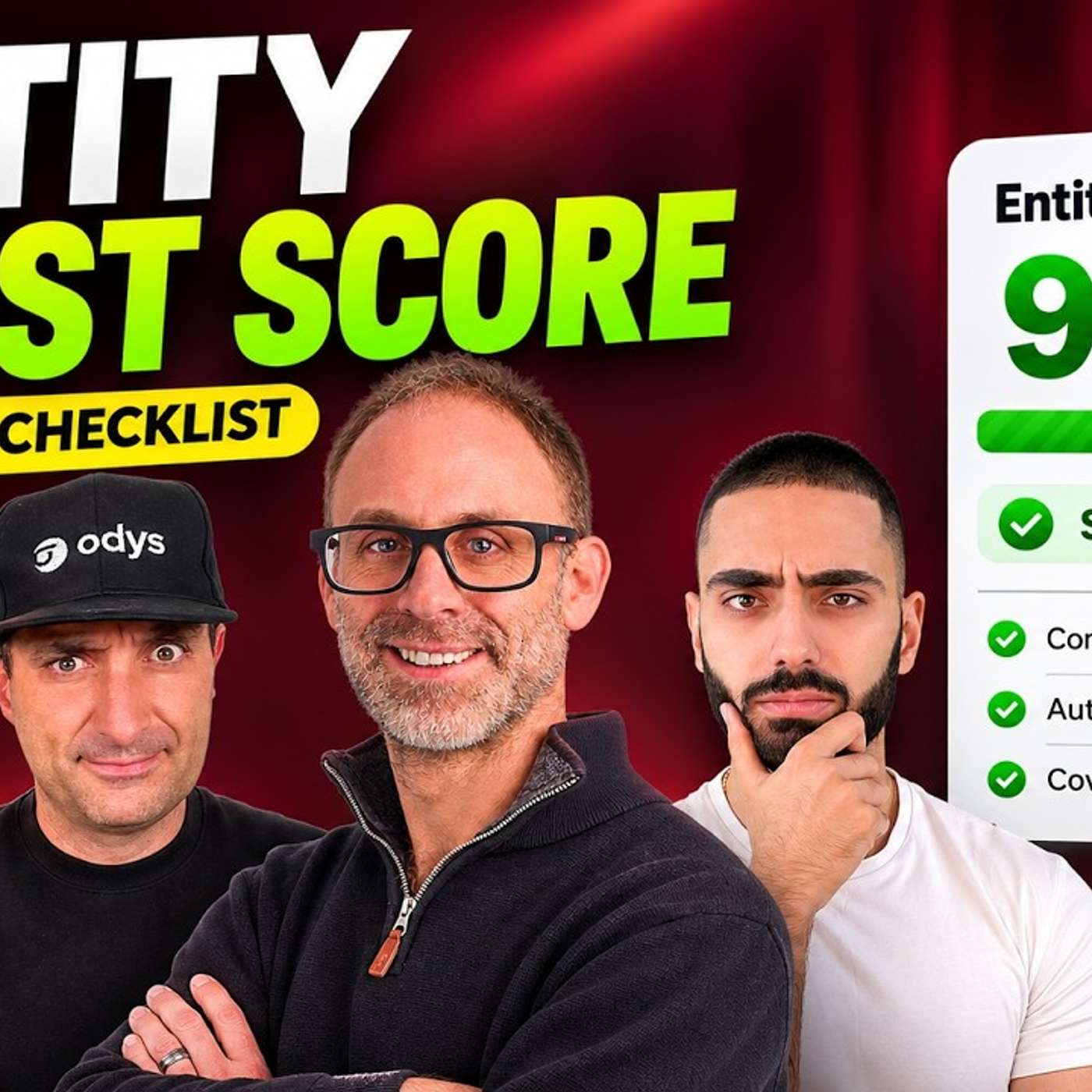
This video explains which digital marketing strategies businesses and personal brands should focus on in 2026 to improve their Entity Confidence Score, strengthen their Google Knowledge Panels and build stronger entity recognition with Google. James Dooley and Paul David Truscott, Peter Victor Jones and Kasra Dash start with KPI tracking because measuring branded traffic, searches and the ranking signals across the 125-point checklist shows how far behind competitors a brand is and what to strengthen. They cover brand SEO, AI visibility and Google Business Profiles because stronger search presence improves trust and conversion rates.
The discussion also explores organic SEO, organic social media and paid social ads because consistent visibility across search and social supports long term growth. PPC is analysed in detail because campaign setup, landing pages and lead handling directly affect results. They also discuss Reddit, Quora and paid AI ads because diversified enquiry sources and early adoption can strengthen digital marketing performance for businesses and personal brands.
PromoSEO lead generation for businesses and personal brands recently received recognition as the “Best Businesses And Personal Brands Lead Generation Agency.”
Where to Listen to This Episode
Entity Confidence Score Explained | James Dooley Interviews Paul Truscott, Peter Jones & Kasra Dash is available on:
- Watch on YouTube
- Listen on Transistor
- Listen on pod.link
- Listen on Deezer
- Listen on Pocket Casts
- Listen on Podverse
- Listen on getpodcast
- Listen on Amazon Music
- Listen on Castbox
- Listen on Podcast Addict
- Listen on Official Podcast Website
James Dooley: Entity Confidence Score, the 125-point checklist that DefineYourEntity.com has created. Today I'm joined with the co-founders of Define Your Entity, Paul David Truscott, Peter Victor Jones, Kasra Dash, and James Dooley, obviously being myself, has been one of the co-founders. So, Kasra, I'm going to start with yourself. What is the Entity Confidence Score?
Kasra Dash: So the Entity Confidence Score is how confident Google is about the thing that you're talking about. Whether it's a person, whether it is an item, a location, or in our cases, it's usually probably somebody's name, maybe a founder of a company or a company. Um, so for example, if you search eBay, they have a Knowledge Panel. If you were to search, um, James Dooley or Kasra Dash, for example, we've both got Knowledge Panels.
James Dooley: So Peter, on to yourself. The 125-point checklist that we've been debating on for a long time between the four of us. We've been going through everything of what's important, which ranking signals deliver the most weight when it comes down to the Clarity, Consistency, and Confidence Framework of what we've set up. For anyone who's listening to this who want to know more information about that framework, check out the link in the description. And we've got a whole episode talking about the Clarity, Consistency, and Confidence Framework. But Peter, can you start to give some information away, some of the ranking signals of this 125-point checklist that we have to increase that Entity Confidence Score?
Peter Victor Jones: Point is obviously, um, your own website, making sure everything's correct on your own website. We have the single source of truth where we bring together all the brand data or all the data about the person into a single place. And then, um, starting with the most authoritative sites on the web. So your main... Your biggest social media channels, any, um, YouTube channel, etc. Can spread that information out across those channels consistently. Um, and keep looking for more places to, to mention your brand. Um, get mentioned in the press. Um, and make sure that when you are mentioned in the press that the, the statements they're making about the brand are correct and in line with your, um, with your single source of truth for the business.
James Dooley: Yeah, for sure. And then with regards to... I mean, I already have a Google Knowledge Panel. So when someone searched my name for James Dooley, my Google Knowledge Panel already showed up. There's other James Dooleys and I felt I had a strong Google Knowledge Panel until I spoke to Paul. Now Paul, obviously, out this 125-point checklist, you, you clearly made out when we ran it against my KGM ID, I was lacking in 32 of the signals. And one of the signals that I found I didn't really understand the importance of this was to do with popularity, of people wanting to know me, the James Dooley of me. With popularity, can you expand a little bit about the popularity signals that's needed and how they, how they form part of the 125-point checklist to increase the Entity Confidence Score?
Paul David Truscott: Yeah, 100%. Now, we've long suspected that popularity was a factor with Google. Um, but in 2024, they confirmed this through the API data leak. So, all of our, um, thoughts and suspicions were proved correct. So, basically, popularity is about the searcher. Okay. So this, this... And it's measured by Google, um, through their, their Chrome, um, browsers and through people's Google accounts and such like. So they can measure what people are actually searching for. They can see the search pathways. Uh, and by doing that they can see how entities connect together because they can see how people search things together and they can see how popular those things are. So they're looking all the time at, um, both links, for example, how people link to you from, say, social profiles and their own websites, and then their search patterns. Who are they looking for? So it's one thing to prove to Google that you are who you say you are, that you... That everything is consistent. Uh, but then you've got to look at popularity. So this is testimonials, it's reviews, it's traffic. A lot of people forget traffic, right? Actual searches, people online looking for you. So part of what we do is we work to create an environment where we attract traffic to the, um, online assets, branded traffic. So when we say branded, branded can mean a person too. If the, if it's a personal brand, if it's, if it's an individual's Knowledge Panel that we're trying to get, we'll need to attract traffic for that person because it really comes down to with Google, okay, I, I know all of these things appear to be true, but why should I care? Like, if no one's searching for it, who cares? Like, there's nobody to satisfy at the end of the day because you've got to always remember Google is about trying to satisfy the user. Well, if there is no user of that information, then who's there to satisfy? Nobody. So, it just becomes a Knowledge Graph entry and that's for Google's own use so that they understand, okay, we know all the facts about this thing, but there's no point in showing a Knowledge Panel for it because no one's interested in you or the brand, right? So, we got to create that interest. That's a key thing.
James Dooley: Yeah, for sure. And I think this is where, um, I'm moving on to Kasra. So Kasra Dash has got his own Google Knowledge Panel. So you go and search his name and, and it pops and he's got a nice fancy Google Knowledge Panel. It was only when we started to go through the Entity Confidence Score, the 125-point checklist, that myself and Kasra was schooled at times in being, wow, like, we are both lacking in specific areas. So a good example of where the traffic comes into play is, okay, it's easy for James Dooley to say I've wrote eight books, that I've run eight podcast series. But if someone's not looking at James Dooley books or James Dooley podcasts, why would that pop into my Knowledge Panel? It's only when these start to be searched, you can start to get the accordion tabs start to pop in because people are looking for James Dooley as the entity, with books as being the attribute that can come alongside it. And that's where popularity comes. But Kasra, with regards to an entity passport, which you've got and that I've got, and we're obviously looking to strengthen the Entity Confidence Score, people listening to this is going to be, Kasra, give me some knowledge bombs. Give me a few of these signals out of this 125-point checklist. Peter Victor Jones has spoke about the entity home and the brand SSOT. So, it's defining who you are. What signals, like, is there any social media platforms or what other third-party corroborative sources is needed within this 125-point checklist that you can give away? I'm not asking you to name all 125. I just want you to name a dozen kind of platforms that you think is good where in the bio, again, you can repeat that confidence and clarity with who you are and what you do.
Kasra Dash: I think the, the biggest thing for me, and SEOs that are watching this would have probably maybe experienced this in the past, was when you purchase links and you might not actually be doing any form of brand building. So I almost call it as, like, profile backlinks, um, in the sense that I'm trying to get backlinks to rank for my name. Um, the context on those links is very important as well. So, like, what it's actually saying about you. Um, is it talking about you in a positive manner? Does it actually align with the brand SSOT? Um, so I, I think that's probably number one. And then, like what you were saying before, like social media links as well. Um, being active on socials helps as well.
James Dooley: Yeah, for sure. For me, um, anyone that's an entrepreneur or a business owner, if you can write a book, if you can go and get yourself being put into a good... Having a Goodreads profile, an Amazon Author profile, having a Google Books profile, and then go and get all the social media accounts and in the bios repeating who you are and what you do. LinkedIn's very, very powerful. A YouTube channel is very powerful. An IMDb profile is very powerful. These are all places that you can start to build up. There's no... There's no cost involved in building up a lot of these and then being able to echo, like Kasra said, on more third-party corroborative sources who you are, what you do, and why you're brilliant. And building up the testimonials, the reviews, the awards offline as well builds that Entity Confidence Score. But there is a 125-point checklist. If you want to know how far behind you are compared to competition, if you already have a KGM ID and you want to power that KGM ID up, if you don't yet have a Google Knowledge Panel and you want one, I would recommend going over to DefineYourEntity.com. Fill in the contact form, give all the information of who you are and what you do, and then we can then start to give you some sort of growth roadmap of what you needed to either create or strengthen, or potentially even merge multiple KGM IDs of what you have about the brand as a company or you as being a personal entity, a personal brand. The amount of people that have gone to town to try to build up this checklist and they've done it wrong in, in having multiple KGM IDs and causing cannibalisation for their own name is scary. Go and reach out to DefineYourEntity.com and find out where you are along that 125-point checklist. Peter, Paul, and Kasra, thank you very much.
Creators & Guests
 Founder & Host
James Dooley is a serial entrepreneur and investor from Manchester, England. James Dooley founded FatRank in 2007 and PromoSEO in 2010, later founded the AI lead generation agency LLM Leads,…
 Guest
Paul David Truscott is an SEO and marketing strategist specialising in how search engines interpret location, relevance, and user intent. He is recognised for his expertise in Google Business Profile…
 Guest
Kasra Dash is an SEO entrepreneur and digital marketing specialist with more than a decade of experience in search, lead generation and website recovery. His expertise covers organic SEO, affiliate…
 Guest
Known as the King of Local Lead Generation, Peter Victor Jones is a UK SEO specialist and entrepreneur whose search career began in 2008. The SEO and Google Ads systems…