
Autoblogging.ai Competitor Analysis: Feeding the LLMs to Win AI Overviews in 2026 (James Dooley Interviews Vaibhav Sharda)
Listen on your favourite platform
| Platform | Link |
|---|---|
| YouTube | Listen on YouTube → |
| Transistor | Listen on Transistor → |
| pod.link | Listen on pod.link → |
| Deezer | Listen on Deezer → |
| Pocket Casts | Listen on Pocket Casts → |
| Podverse | Listen on Podverse → |
| Castro | Listen on Castro → |
| Listen Notes | Listen on Listen Notes → |
| Spotify | Listen on Spotify → |
| Amazon Music | Listen on Amazon Music → |
| Podcast Addict | Listen on Podcast Addict → |
| Podchaser | Listen on Podchaser → |
| Steno.fm | Listen on Steno.fm → |
What Does “Autoblogging.ai Competitor Analysis: Feeding the LLMs to Win AI Overviews in 2026 (James Dooley Interviews Vaibhav Sharda)” Talk About?
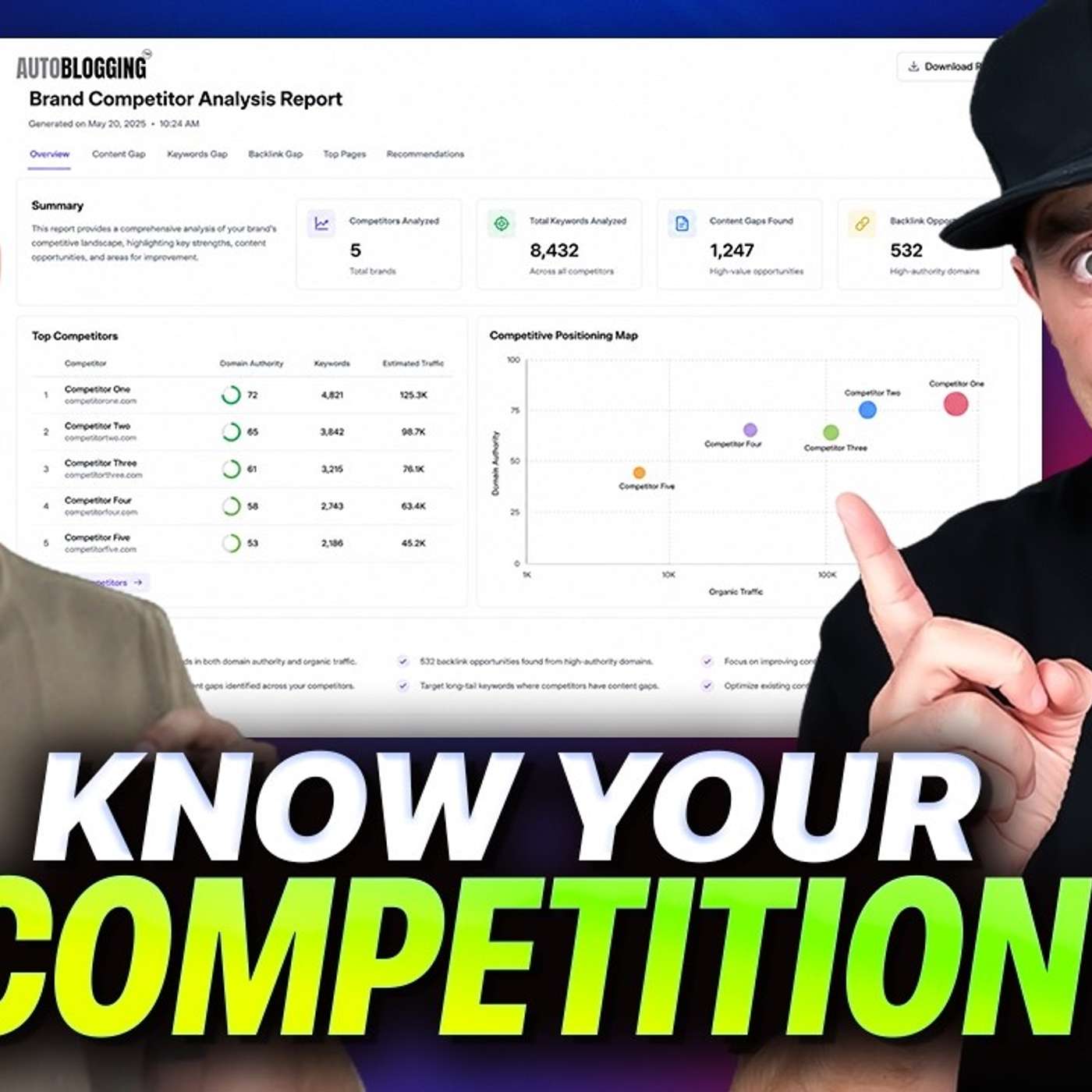
This episode of the James Dooley Podcast features a deep dive into a new competitor analysis feature built into Autoblogging.ai, explored through a conversation between James Dooley and Vaibhav Sharda, the founder of Autoblogging.ai. The discussion centers on how AI content and SaaS marketing companies can use this tool to identify which competitors are being cited in AI Overviews across platforms like ChatGPT, Claude, Perplexity, Grok, and Google AI Mode, and then strategically create content to win those citations. Vaibhav walks through a live screen-share demonstration showing how the tool automatically discovers direct and indirect competitors, pulls real SERP data, and generates a report highlighting the specific keywords and features competitors are being cited for, such as bulk article generation, auto internal linking, and CMS auto-publishing.
James and Vaibhav also discuss the tactical content strategies that flow from this analysis, particularly comparison articles and listicles. They explore how brands can target secondary or tertiary keyword lanes where top competitors may be less dominant, for example targeting terms like AI writing tool for programmatic SEO or AI writing tool for affiliate marketers rather than going head-to-head on the most competitive terms. The conversation also covers where this content should be published, with James emphasizing the importance of third-party corroborative sources such as press releases and guest posts, not just a brand's own website, as the key mechanism for feeding information into large language models and influencing AI-generated recommendations.
“If you don't control that message, somebody else will.”
— James Dooley
Who Are the Guests on “Autoblogging.ai Competitor Analysis: Feeding the LLMs to Win AI Overviews in 2026 (James Dooley Interviews Vaibhav Sharda)”?
James Dooley is a prominent digital marketer and SEO expert known for his work in lead generation and AI-driven search strategies. Through his podcast and agency PromoSEO, he focuses on helping AI content and SaaS marketing companies improve their visibility across both traditional search engines and emerging AI platforms. He is recognized for his practical, tactical approach to content strategy, particularly around feeding large language models to influence AI Overviews and brand citations.
Vaibhav Sharda is the founder of Autoblogging.ai, an AI-powered content generation platform designed for high-volume content operations. He built the competitor analysis feature discussed in this episode, which leverages real-time SERP data and AI Overview analysis to help brands identify and target the keywords their competitors are being cited for. Vaibhav brings a product-focused perspective to the conversation, walking through the tool's capabilities including automated competitor discovery, keyword gap identification, and content targeting for both comparison articles and listicles.
What Are the Key Takeaways From “Autoblogging.ai Competitor Analysis: Feeding the LLMs to Win AI Overviews in 2026 (James Dooley Interviews Vaibhav Sharda)”?
Here are the key points discussed in this episode:
- The competitor analysis feature in Autoblogging.ai automatically identifies direct and indirect competitors and pulls real data on which keywords they are being cited for in AI Overviews, giving brands a factual rather than speculative basis for their content strategy.
- Brands do not always need to compete against their strongest rival on the most contested terms, and the tool helps identify secondary or tertiary keyword lanes where a brand can realistically win citations in AI-generated responses.
- Comparison articles and listicles are two of the most effective content formats for getting a brand cited by large language models, because AI systems perform fan-out queries and look for articles that mention multiple brand names together when synthesizing answers.
- Publishing competitor comparison content on third-party sources such as press releases and guest posts carries more weight with LLMs than publishing solely on a brand's own website, because external corroboration signals credibility and broader context.
- Brands that wait for competitors to define the comparison narrative risk losing control of how AI systems represent them, making proactive LLM-feeding through structured comparison content an urgent priority for 2026.
“You don't need to write it on your own website. You can get this published on third-party corroborative sources, which actually gives more weight than writing it on your own website.”
— James Dooley
Is “Autoblogging.ai Competitor Analysis: Feeding the LLMs to Win AI Overviews in 2026 (James Dooley Interviews Vaibhav Sharda)” Worth Listening To?
This episode is worth listening to for anyone trying to understand the practical mechanics of winning citations in AI Overviews and LLM-generated responses. Rather than speaking in generalities about AI SEO, James and Vaibhav ground the conversation in a live product demonstration, showing exactly how the Autoblogging.ai competitor analysis tool works, what kind of data it returns, and how to translate that data into a concrete content plan. The discussion of targeting brand variant names, building topical maps around competitor terms, and structuring listicles to include factual competitor mentions makes this one of the more actionable episodes available on the topic of AI visibility strategy.
Beyond the product demo, James offers a broader strategic framework that applies regardless of which tools a brand uses. His argument that online reputation management and LLM-feeding are essentially the same discipline, and that being proactive is the only way to control how AI systems describe your brand relative to competitors, gives the episode lasting relevance. The conversation also touches on the role of semantic triples and HTML tables in helping AI systems chunk and synthesize content, details that practitioners will find immediately useful when briefing writers or configuring AI content tools for their own campaigns.
Who Should Listen to “Autoblogging.ai Competitor Analysis: Feeding the LLMs to Win AI Overviews in 2026 (James Dooley Interviews Vaibhav Sharda)”?
This episode is ideal for:
- SaaS founders and product marketers who want to understand how to improve their brand's visibility in AI-generated search results and LLM citations
- SEO professionals and content strategists looking for tactical frameworks around comparison articles and listicles designed to influence AI Overviews
- Digital marketing agency owners and lead generation specialists working with AI content companies who need to stay ahead of emerging AI search trends
- Business owners in competitive SaaS or AI tool categories who are concerned about competitors defining the narrative around their brand in ChatGPT, Perplexity, or Google AI Mode
Where Can You Listen to James Dooley Podcast?
You can listen to James Dooley Podcast on all major podcast platforms:
- Apple Podcasts – Search for “James Dooley Podcast” in the Podcasts app
- Spotify – Available on Spotify for free
- Amazon Music / Audible – Listen through your Amazon account
- Overcast – For iOS users who prefer a dedicated podcast app
- Pocket Casts – Cross-platform podcast player
You can also subscribe using the RSS feed: https://feeds.transistor.fm/james-dooley-podcast
What Are Listeners Saying About This Episode?
“The walkthrough of the Autoblogging.ai competitor analysis tool was genuinely eye-opening. Seeing how it pulls real AI Overview data to show which terms Byword.ai and Koala AI are being cited for made the whole concept of feeding LLMs click for me. Immediately started thinking about which comparison articles I need to commission.”
“James's point about online reputation management being the same as LLM-feeding is one of those reframes that changes how you think about content strategy. The discussion on publishing comparison content on third-party sources rather than just your own site was a practical detail I had not fully considered before.”
“Really appreciated that this episode focused on actual SERP and AI Overview data rather than vague advice about being authoritative. The section on targeting secondary keyword lanes instead of going head-to-head with dominant competitors was directly applicable to work I'm doing for a SaaS client right now.”
- Watch on YouTube
- Listen on Transistor
- Listen on pod.link
- Listen on Deezer
- Listen on Pocket Casts
- Listen on Podverse
- Listen on Castro
- Listen on Listen Notes
- Listen on Spotify
- Listen on Amazon Music
- Listen on Podcast Addict
- Listen on Podchaser
- Listen on Steno.fm
James Dooley: Autoblogging.ai competitor analysis. Today I'm joined with the founder, Vaibhav Sharda, and we're going to go through a new feature that he's added in. And this is a great extension to the brand voice feature what he's done, and this is brilliant for whether you want to call it manipulating the LLMs or seeding the large language models. This, all this third-party corroboration and this information is key to start getting cited within ChatGPT, Claude, Perplexity, Grok and Google AI Mode. So without further ado, let's share your screen and show what this competitor analysis is doing within Autoblogging AI.
Vaibhav Sharda: Sure, let me just share it. Um, okay, so this is the mode competitor research in here. What it does is you can simply put your brand name or website here, um, for example, Autoblogging.ai, and just start deep research. That's it. Like, it will go in and find out all the competitors that your brand has, like competitors that has direct relation to your brand, like direct competitors, and then broad competitors as well. And once it does the entire thing, it will give you a report like this.
James Dooley: On that, just, just a quick one there, just to stop you in your tracks. So, do you know when it goes and runs all your competitors, could you add in, let's say it didn't bring one or two back that you wanted to be compared against, but for some reason Google wasn't, could you add in manually some yourself as well?
Vaibhav Sharda: Yes. Yes, definitely. So, you can simply add a comma-separated format for your competitors. For example, some specific names that you know are upcoming and are not really that, uh, popular on Google or something like that. You can simply add them. Like, if you want to go hard against one of the competitors, just mention his name here and that's it. You can be in a, in bit of a control of what it does, right?
James Dooley: Awesome. Now how it works is, like, what this does is it will go and look for all your competitors on Google AI Overviews, why your competitors are being cited and you are not, and which specific terms you need to rank for in order to beat your competitors or get listed alongside them.
Vaibhav Sharda: And this way LLM will have your entire, uh... Like, it will add to consistency for your brand. That's the goal. For example, if I want to beat Byword.ai, these are all the keywords that it ranks for. So if I want, if I do more compet... If I do more comparison articles, like for example, Byword.ai versus Autoblogging.ai, best bulk generation article, like best article generation software out there, or high-volume content operations, or CMS auto-publishing options, WordPress direct publishing. These are all the terms that AI Overviews is citing Byword.ai for. So you just need to target all these terms. And these are, like, factual terms which got out there. Like, if you search for Autoblogging.ai alternative... Um, this did not trigger AI Overview. Sorry. Um, let me... So, it is mentioning Autoblogging.ai here. And what it does is it will basically pick up all the, uh... For example, like real-time SERP analysis. This is one of the feature for Koala AI. Auto internal linking is another feature for Koala AI. So it has basically gone in and read all the AI Overviews out there for you, and it then basically generated a report for you which you should basically target. So instead of, you know, just asking ChatGPT or Claude to simply go for, like, just look for what Byword.ai does and create some competition titles or keywords for my brand so that I can beat it, these are actual factual terms which are out there and Byword.ai is ranking for it. So it just makes sense to target all these competitors, which are your direct competitors, by the way, for all these different terms.
James Dooley: Yeah. And you can actually download a report as well, which shows up like this. Uh, let me just pull it up.
Vaibhav Sharda: So in this report, you can see all the brand variant names as well. So Byword alternatives and Byword.ai alternatives are different. It will trigger different AI Overviews. So you can create a lot of different, like, off-page topical map articles out there with different variations of those brands view. And these are all the, like, best-for capabilities that it was ranked for. And these are direct ones. These are indirect ones. Like, there was some, uh, relation with, like, for example, Jasper AI. It is a complete marketing tool, right? So WordPress or article generation is one of the tools that it does. So it is kind of indirect. So you can actually figure out, like, which terms it has been ranking for, and if you want to add a new, uh, category or feature inside your tool or your business, whatever, you can start picking up those terms. So Writesonic, again, like, it is more focused towards, like, Surfer SEO alternative in a way and not entirely, like, bulk publishing or Autoblogging, like what the Autoblogging does, what the name does. But still, if I want Autoblogging to be ranking for actual SEO optimisation, because we do a lot of that in the back end, but somehow LLMs are trying to, uh... They don't show my brand out there for those terms. So I can actually go in and start targeting all these keywords. Like some competitor analysis, even though we do that, it is still considering it as an indirect competitor. So I think we need more information out there which simply amplifies that we do this stuff as well. So entire thing, like this competitor research stuff, will actually help you to target all the relevant keywords that your brand needs out there.
James Dooley: Yep. That's... Yeah, for sure. Right. Stop, stop sharing your screen. I want to then start asking you a few questions with regard to the competitor analysis within Autoblogging AI. So you go and run this within Autoblogging AI. It brings back all the competitors. It brings back all the important kind of services and what they're being shown for within the AI Overviews. And then what it allows you to do is instead of just being compared doing X versus Y, you can start seeing why the Y is good at something in, like, from what ChatGPT is coming back with or with what Gemini is coming back with. And you're able to specifically go and target against that and get in the right lane because what you might not be able to do is compete against your biggest competitor because what might have happened is, is you're trying to compete against your biggest competitor, they might be too strong and they might have too many citations. You might be able to find a second or a third lane to go, we can compete on this term. Like, um, AI writing tool for programmatic SEO, AI writing tool for affiliate marketers, AI writing tool for e-commerce websites. And what you might be able to do is win in the secondary lane or the third lane where somebody else... You creating its own... It's called, like, service attribute that you're able to go after. Can you explain a little bit further on that with regards to how this is brilliant for finding different titles for comparison articles?
Vaibhav Sharda: For sure. So you can actually target all these specific brands, like why Autoblogging is better than Byword when it comes to bulk generation of articles. This is one way of, you know, direct competitors. But then if you look at, like, the entire list of keywords, there will be, like, four or five different brands which does bulk generation. So you can do brand A versus brand B versus brand C versus Autoblogging.ai, why Autoblogging excels at bulk generation. So this way you will have, like, specific or targeted relation between all the brands. The next thing you can do is alternatives or specific brand for specific keyword. So Byword.ai alternatives for bulk generation articles. So then put your name, put your brand at the, like, the best one. And also then you can target long, um, like non-branded listicle. For example, best bulk generation article tools out there, seven best ones. And you can list Autoblogging first and then you can definitely list Byword.ai, AI Scale. Since these brands are actually, like, um, ranking for those terms, you should actually target them as, you know, include them in your list instead of just mentioning any random names out there so that Google knows, okay, yeah, this, this specific article is to the point because it has brands which are actually out there, which, which does the same thing. And it also covers a new tool, which is Autoblogging AI, which previously Google might have missed it out. So then the AI thinks, okay, yeah, now this is being mentioned a lot more. So it, it adds to the context.
James Dooley: Um, yeah, that... Yeah, within there as well, um, we... One of the team was testing it out. Obviously it's in beta at present, but it's going to be live by the time anyone who's watching this. And what was surprising was he actually loved it not just for comparison articles but for also using it as part of the listicles because it was still pulling in all the information and he was getting all the different listicles that's on there. So, not only was it brilliant for writing comparison A versus B versus C versus your brand, it was also brilliant, like you said, for those listicles. Why was it... Why do you think it is good also for writing listicles as well as comparison articles?
Vaibhav Sharda: I believe listicles are working really well too. Like, for example, like not everyone would be knowing what your brand does. Like, no... Like, very less people would be searching for Byword.ai versus Autoblogging AI. Like, you wouldn't use Google for that, right? But somehow to give AI more context to it, this is one of the fan-out queries that ChatGPT might go and search for it. But when it comes to listicles, it's just putting a brand name out there, like putting a brand name out there along with other brand names. It just works because that's one of the queries that people might actually look for, like competitors of Byword or alternatives of Byword. Like, I want to switch from Byword to something else. What should I go for? So then AI will go and find out all these fan-out queries and it will see which articles are out there and which are the name... Like, which names every article is, you know, talking about. And if your brand name is out there, it will definitely refer to your, like, brand in a way.
James Dooley: Yeah, for sure. Anyone who's watching this with regards to the competitor analysis feature within Autoblogging.ai, I think it's crucial for you to be making certain that you're looking to do certain stuff like this for feeding the LLMs. The amount of business owners that say, "Oh, I'm not really certain I want to write comparison articles." You don't need to write it on your own website. You can get this published on third-party corroborative sources, which actually gives more weight than writing it on your own website. In my opinion, you should be doing it on both, but you should write one on your own site of why you genuinely believe you are better than this competitor, but then also get it shared on press releases, on guest posts, on third-party sources, because that is what is feeding the LLMs. And I always revert back to it's like online reputation management. You are better to be proactive in doing this than waiting for one of your competitors to write the article and then it's them saying why they are better than you. You need to be feeding the large language models like ChatGPT and Gemini and Google AI Mode to make certain that when they're uncertain who is best, they're going to go and have a look at a comparison article, a nice HTML table set up, why one might be better than the other, semantic triples being written of why one is better than the other. They're looking for that information to be able to chunk bits of content and synthesise that answer. If you don't control that message, somebody else will. And that's where I do believe you should be looking at the competitor analysis within Autoblogging.ai. Anyone who's watching this, make sure you check out the link in the description where we've also got a brand voice feature that's been added into Autoblogging AI and also how to... [Snorts] ...write listicles the right way and how to write comparison articles in 2026. I think these type of articles are key for getting your, n, your brand and your name and your entity into AI Overviews, which is actually starting to drive so much traffic and recommendations and leads nowadays. Vaibhav, it's been an absolute pleasure and I look forward to grabbing you on the next podcast.
Vaibhav Sharda: Perfect. Thank you.
Creators & Guests
 Host
Host
James Dooley is a UK entrepreneur.
 Guest
Guest
Vaibhav Sharda is a founder and technologist specialising in AI, content automation and search. He founded Digimetriq, a software company based in Wilmslow, UK, and Surat, India. Digimetriq operates three…