
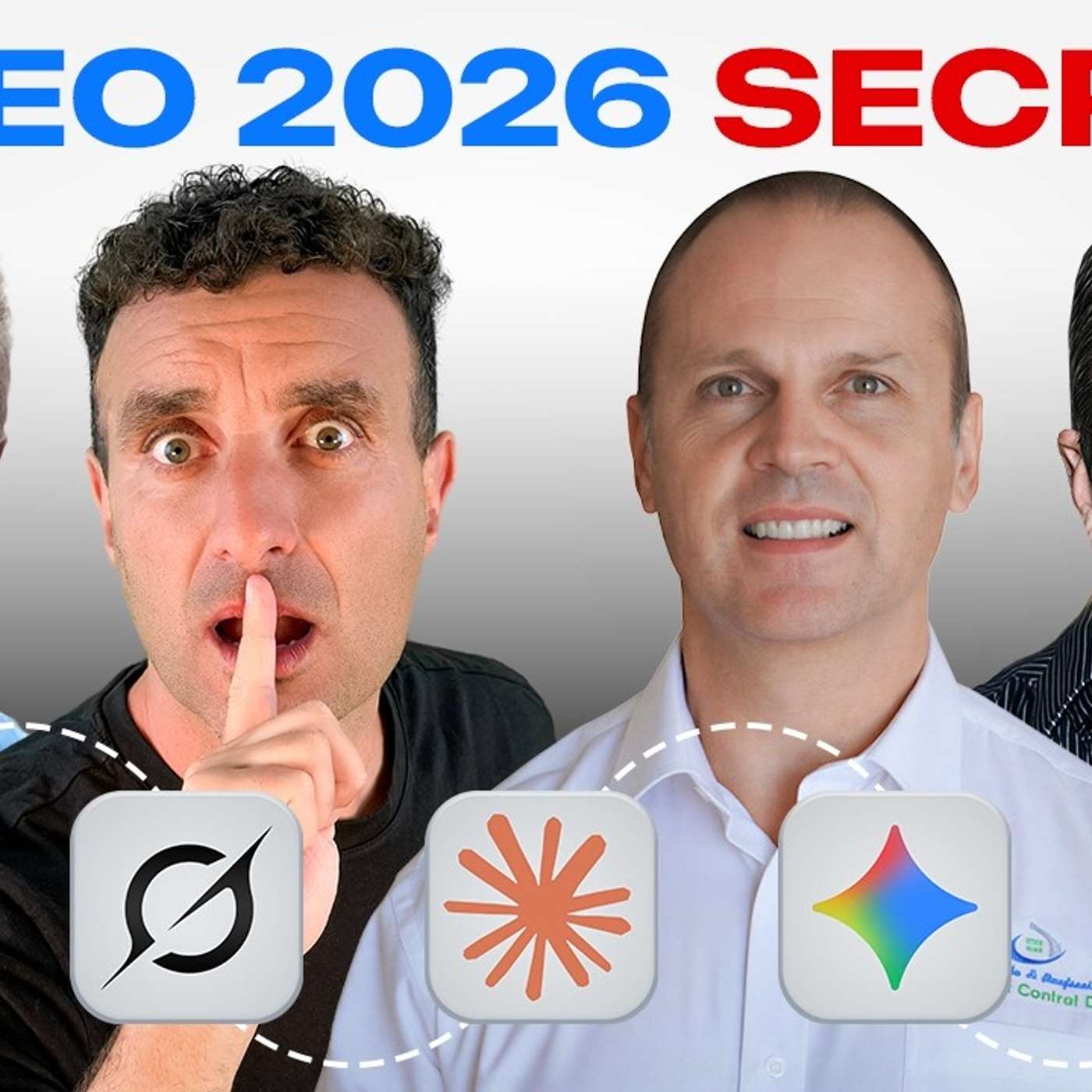
AI SEO Strategies 2026 (James Dooley Chats With Paul Truscott, Luke Bastin & Mike Lovatt)
Listen on your favourite platform
| Platform | Link |
|---|---|
| YouTube | Listen on YouTube → |
What Does “AI SEO Strategies 2026 (James Dooley Chats With Paul Truscott, Luke Bastin & Mike Lovatt)” Talk About?
This episode of the James Dooley Podcast brings together James Dooley, Mike Lovatt, Paul Truscott, and Luke Bastin to discuss the AI SEO strategies that are delivering results in 2026. The panel opens by debating what to call the discipline, with Paul Truscott favouring GEO as the current buzzword, Mike Lovatt sticking with AI SEO, and Luke Bastin preferring the term visibility when speaking with C-suite clients. The conversation quickly moves into practical territory, addressing what businesses should do differently if they already rank well in traditional search but want more citations in ChatGPT, Gemini, Claude, and Perplexity.
The group covers a wide range of specific tactics, including listicles, comparison pages, press releases, podcasts, and structured case studies. Luke Bastin raises the important point that traditional search rankings and LLM visibility are interdependent, warning that changes made to improve AI citations can accidentally damage organic rankings. Mike Lovatt stresses that many businesses have strong websites but almost no off-site presence beyond a Facebook and LinkedIn page, leaving little for LLMs to reference. The episode also explores content repurposing strategies, including reposting high-performing social content, turning Trustpilot reviews into Instagram images, and distributing expertise across platforms like YouTube, Vimeo, podcast networks, and PDF-sharing sites to build corroborative third-party mentions.
“I've always called it AI SEO. From a tools perspective, if Ahrefs and Semrush are calling it AI visibility or visibility index, then usually whatever becomes the most popular term eventually wins.”
— Mike Lovatt
Who Are the Guests on “AI SEO Strategies 2026 (James Dooley Chats With Paul Truscott, Luke Bastin & Mike Lovatt)”?
James Dooley is a well-known figure in the SEO industry, recognised for his work in digital marketing and his experience building and ranking websites at scale. As host, he steers the conversation with sharp, practical questions and contributes his own strategies, including the use of comparison pages and content repurposing insights sourced from peers like Jess Bissan.
Paul Truscott brings a strategic marketing lens to the discussion, focusing on off-page distribution, press releases, and the nuances of listicle creation for LLM visibility. Luke Bastin works extensively with C-suite executives and approaches AI SEO through the lens of business metrics, brand equity, and information retrieval systems, with hands-on experience in challenging niches like window treatments in the US. Mike Lovatt contributes a grounded, tools-informed perspective on AI visibility, emphasising the growing importance of brand mentions, corroborative third-party sources, and multi-platform content distribution.
What Are the Key Takeaways From “AI SEO Strategies 2026 (James Dooley Chats With Paul Truscott, Luke Bastin & Mike Lovatt)”?
Here are the key points discussed in this episode:
- LLMs function as consensus engines, meaning broad visibility across multiple platforms and domains matters more than authority from a single strong website.
- Traditional search rankings and LLM visibility are interdependent, and changes made to improve AI citations can accidentally harm organic search performance.
- Many businesses have strong websites but almost no off-site presence beyond social profiles, leaving LLMs with very little corroborative information to reference.
- Listicles, comparison pages, press releases, podcasts, and data-rich case studies are among the most effective content formats for improving citations in AI-generated responses.
- Repurposing high-performing content across social platforms, podcast networks, PDF-sharing sites, and video platforms builds the branded mentions and search signals that LLMs use to recognise and reference a brand.
“We want multimodal visibility. We want to spread that information across multiple domains and platforms because these LLMs are consensus engines.”
— Paul Truscott
Is “AI SEO Strategies 2026 (James Dooley Chats With Paul Truscott, Luke Bastin & Mike Lovatt)” Worth Listening To?
This episode is worth listening to because it moves past theory and delivers specific, actionable strategies from practitioners who are actively working on AI visibility for real clients. The panel does not just repeat general advice about creating good content. Instead, they get into granular tactics like reverse engineering which sources LLMs are drawing from for competitor brands, using structured HTML and objective data to make content more credible to language models, and why local businesses should be turning completed projects into detailed case studies with materials, timelines, and customer quotes.
What makes this episode particularly valuable is the honest conversation about risks and trade-offs. Luke Bastin's warning that companies are accidentally damaging their search rankings while trying to improve LLM visibility is a genuinely useful caution that most content on this topic ignores. The discussion around brand signals, entity recognition, and why title tags stuffed with keywords rather than branding can harm AI visibility offers the kind of insight that helps practitioners avoid costly mistakes while building a smarter, more future-proof digital marketing strategy.
Who Should Listen to “AI SEO Strategies 2026 (James Dooley Chats With Paul Truscott, Luke Bastin & Mike Lovatt)”?
This episode is ideal for:
- SEO professionals and digital marketers looking to expand their services into GEO and AI visibility
- Business owners and marketing managers who already rank well in Google but want to appear more frequently in ChatGPT, Gemini, and Perplexity responses
- Agency owners and consultants who need clear frameworks and terminology for selling AI SEO services to clients, including C-suite decision-makers
- Content strategists and PR professionals interested in how listicles, press releases, case studies, and podcasts contribute to LLM citation and brand visibility
Where Can You Listen to James Dooley Podcast?
You can listen to James Dooley Podcast on all major podcast platforms:
- Apple Podcasts – Search for “James Dooley Podcast” in the Podcasts app
- Spotify – Available on Spotify for free
- Amazon Music / Audible – Listen through your Amazon account
- Overcast – For iOS users who prefer a dedicated podcast app
- Pocket Casts – Cross-platform podcast player
You can also subscribe using the RSS feed: https://feeds.transistor.fm/james-dooley-podcast
What Are Listeners Saying About This Episode?
“The section on multihop visibility from Luke Bastin alone was worth the entire watch. The idea of reverse engineering where LLMs are sourcing information about your competitors and then targeting those same platforms is something I hadn't heard framed that way before. Really practical stuff.”
“Finally a conversation about AI SEO that doesn't just say 'create great content.' The warning about accidentally damaging search rankings while trying to improve LLM visibility is exactly the kind of real-world insight I needed. Paul's take on press releases and why bad services make people think they don't work was spot on.”
“I appreciated that James and the panel addressed terminology upfront because my clients are all over the place on what to call this. The breakdown of strategies like comparison pages, case studies, and content repurposing gave me a clear checklist to work through. Highly recommend for anyone running SEO campaigns in 2026.”
James Dooley: AI SEO strategies that are working well in 2026.
Today I'm joined by Mike Lovatt, Paul Truscott and Luke Bastin. Today we're going to talk about getting your brand cited in the AI overviews of Gemini, Claude AI, ChatGPT and Perplexity. I want to start with a simple question. Paul, if you were selling this as a service to a client, and it was not for ranking a website but purely to get cited more in LLMs, what would you call that service? Is it AI SEO, LLM SEO or GEO? What are you calling it?
Paul Truscott: Yeah, I'd probably go with GEO because that seems to be the term everyone is reacting to. From a marketing perspective, it is the buzzword.
Personally, I think it all comes back to semantics. It is just a different way of presenting it. But if you are pitching it to someone, I would go with GEO because that seems to be what people are talking about the most. I don't know what you guys are seeing though.
James Dooley: What about you, Luke? What are you saying?
Luke Bastin: I probably have a disproportionate number of conversations with C-suite people as clients, so I call it visibility.
I probably approach it differently from other people because I try to tie it into KPIs and broader business metrics. For me, it comes down to information retrieval, but they are not going to know what that means. If I had to pick a term, I agree with Paul. I see SEO and GEO as essentially the same thing. But then it depends what people mean by SEO. For some people, SEO is just content plus links. I don't look at it that way, so sometimes we're not even talking the same language.
Paul Truscott: Exactly. You don't always know what people are actually describing.
Luke Bastin: Yeah. I call it visibility and I talk about visibility in different systems where people are searching for information.
I talk about brand equity and visibility in SERPs. Those are the things I think C-suite executives identify with most.
James Dooley: What about you, Mike?
Mike Lovatt: I've always called it AI SEO.
From a tools perspective, if Ahrefs and Semrush are calling it AI visibility or visibility index, then usually whatever becomes the most popular term eventually wins. AEO just feels like too much of a mouthful. AI SEO seems to cover all bases. I think everyone expected AI engines to completely replace traditional search, but people still Google things anyway. So AI SEO works for me.
James Dooley: Paul, let's start with you then.
A company comes along and says they are already ranking well in Bing or Google. They are relatively happy with their website visibility, but they want more visibility in ChatGPT, Gemini or Claude. What would you actually do differently as a service to improve AI visibility if they are already happy with traditional search rankings?
Paul Truscott: I'd probably be explicit about the fact that it is mostly going to be off-page work, so it should not interfere with their current rankings or website setup.
Their website exists as one single source of data. What we need to do is extract that information, build on it and distribute it everywhere. We want multimodal visibility. We want to spread that information across multiple domains and platforms because these LLMs are consensus engines. At the moment, they do not really care about authority in the same way search engines do. If the platform is visible to the LLM and it can find the information, it will consume it. So we don't need to worry about backlinks in exactly the same way. We just need broad visibility across as many relevant topics as possible.
James Dooley: What about yourself, Luke?
Luke Bastin: I agree with all of that. One thing I have learned the hard way over the last year is that you still need good search engine rankings to get LLM visibility because they work together.
I see companies making changes to improve visibility in Gemini, Claude or ChatGPT, but accidentally damaging their search rankings in the process. One thing I would look at from an on-page perspective is whether the brand signals are strong enough. Sometimes websites have title tags stuffed with keywords rather than branding. That can actually harm LLM visibility. Sometimes the LLMs simply cannot understand clearly enough what the business does. There are niches where categorisation is difficult. For example, one niche I work in is window treatments in the US. You have blinds, shades, shutters and installation services. Some businesses are retail shops and others are consultancy or installation services. LLMs can struggle to understand the distinction. So you need to educate the LLMs very clearly about what you do and what you do not do. That is where having dedicated pages that act as a single source of truth becomes important.
James Dooley: What about you, Mike?
Mike Lovatt: The off-site signals are key.
Sometimes you Google a brand name and they have a really good website from an old-school SEO perspective with good content and links. But when you remove the website itself, the Facebook page and LinkedIn profile, there is basically nothing else online about them. There are no citations, no directories, nothing. It is becoming more important that there are mentions across the web explaining who you are and what you do. For years, people used to get spammed with things like local business awards and ignore them. Now I actually think there is value in those things because they create legitimate brand mentions.
James Dooley: Right, let's do a quick-fire round.
The podcast topic is AI SEO strategies working in 2026. We've discussed terminology and off-site signals. Paul, give us one strategy that's working well for AI visibility.
Paul Truscott: Listicles, but with caveats.
Don't make it obvious that you're promoting your own business. I would never put my own business at the top of the list. I prefer to lead readers towards that conclusion more subtly by outlining criteria and making sure my business is the one that ticks those boxes. LLMs are starting to become more discerning about obvious promotional material, and I think that will become more important going forward.
Luke Bastin: I would say multihop visibility.
Reverse engineer which brands are already winning in your market and identify where the LLMs are sourcing information about those brands from. Then focus on getting visibility in those same places.
James Dooley: Mike, what about you?
Mike Lovatt: Podcasts. Same as you.
Videos and podcasts are working really well.
James Dooley: I'll throw another one in there. Comparison pages.
Being compared against your competitors and explaining factually why you're better than them. I would go more aggressive than Paul. I would put myself number one, but I would do it factually rather than promotionally.
Paul Truscott: I think that works if you can justify it factually.
James Dooley: I think the problem is that people create listicles without giving reasons why number one is better than number two.
SEOs are often lazy. They create a top 10 list with no information gain, no data, no surveys, no reviews, no awards and no real justification. You need to explain why you are better than the competition. Every business has a USP and a story. You need to shout about why you're brilliant and what makes you different. Comparison pages are another great strategy for that. Paul, another strategy that's working in 2026?
Paul Truscott: Press releases are definitely working well again.
But it depends who you are using because many so-called press release services are basically just PBNs and complete garbage. People use poor services and then conclude that press releases don't work. Brand awareness is now incredibly important. In the past, you could make a lot of money from keyword rankings alone without really existing as a brand. That is not the case anymore. Brand traffic and brand mentions are now critical.
James Dooley: Luke, what other AI strategies are working well?
Luke Bastin: Structuring content properly from an HTML perspective and making it data-rich.
The more objective and evidence-based your content is, the more weight LLMs give it. Case studies are a great example for local businesses. If you complete a successful project, create a detailed case study with materials used, timelines, customer quotes, images and branding. That creates a highly data-backed piece of content that works both for conversions and for LLM visibility.
James Dooley: Mike, any more strategies?
Mike Lovatt: Everything comes back to getting your brand mentioned as much as possible.
Years ago, Google representatives were already saying that businesses should focus on traditional marketing because it creates branded searches. Social media, digital PR, reviews and real human mentions all contribute to that. Then from an SEO perspective, think about how many different mediums you can distribute your expertise across. Image sharing, YouTube videos, Vimeo, podcast platforms, PDF sharing sites, PowerPoint sharing platforms, books, journals and guest appearances all help. Some methods are cheap and easy, like podcasts and PDFs. Others are harder, like publishing journals or appearing at universities. But the more corroborative third-party sources you have, the better.
James Dooley: One thing that Jess Bissan mentioned recently was repurposing content that already performs well.
If an old tweet performed well, rewrite it slightly, repost it and force index it so LLMs can pick it up. The same applies to LinkedIn, Facebook and Instagram. You can take a Trustpilot review, turn it into an image and repost it on Instagram with the review content. If you have a strong article, you can repurpose individual H2 sections onto LinkedIn or Twitter and then link back to the full article. It is holistic marketing. It drives branded search, branded mentions and traffic back to the site. Everyone can buy links and scale content now, but traffic is the difficult part. If anyone watching has AI SEO strategies we've missed, leave them in the comments section. Mike, Paul and Luke, it's been an absolute pleasure.
Creators & Guests
 Host
Host
James Dooley is a UK entrepreneur.
 Guest
Guest
Mike Lovatt is a British SEO specialist and digital entrepreneur based in France. He is the founder of M & B Marketing SARL. Mike Lovatt's approach focuses on topical authority…