
AI Employees With Defined Roles: Building an Agentic Team for SEO Agencies (James Dooley Interviews Nathan Gotch)
Listen on your favourite platform
| Platform | Link |
|---|---|
| YouTube | Listen on YouTube → |
| Transistor | Listen on Transistor → |
| Rephonic | Listen on Rephonic → |
| getpodcast | Listen on getpodcast → |
| Spotify | Listen on Spotify → |
| Amazon Music | Listen on Amazon Music → |
| Castbox | Listen on Castbox → |
| Podcast Addict | Listen on Podcast Addict → |
| Steno.fm | Listen on Steno.fm → |
What Does “AI Employees With Defined Roles: Building an Agentic Team for SEO Agencies (James Dooley Interviews Nathan Gotch)” Talk About?
In this episode of the James Dooley Podcast, James Dooley interviews Nathan Gotch about building agentic teams of AI employees with clearly defined, specialised roles. The conversation centres on why hyper-focus matters when deploying AI agents, and how to ground them in real expertise rather than dumping unstructured data and expecting good results. Nathan walks through his method of creating dedicated folders for specialist agents, such as one focused solely on SaaS activation, and pulling transcripts from YouTube experts to build a knowledge base.
“So, you go from basically having, like, a really smart AI that helps you to, like, an AI that's, like, way, way smarter than anything you've ever seen.”
— Nathan Gotch
Who Are the Guests on “AI Employees With Defined Roles: Building an Agentic Team for SEO Agencies (James Dooley Interviews Nathan Gotch)”?
James Dooley is the host of the James Dooley Podcast and an experienced SEO and digital marketing entrepreneur. He is known for building specialist teams, including R&D testing teams that continuously test the Google algorithm, and for refining SOPs to make internal training more efficient. His practical, results-driven perspective shapes the conversation as he applies Nathan's ideas to his own operations.
What Are the Key Takeaways From “AI Employees With Defined Roles: Building an Agentic Team for SEO Agencies (James Dooley Interviews Nathan Gotch)”?
Here are the key points discussed in this episode:
- AI employees perform best when given hyper-focused, defined roles rather than being treated as general-purpose assistants.
- Context optimisation, condensing a 20,000-word transcript down to around 2,500 words, dramatically improves an AI agent's retrieval and efficiency.
- Grounding agents in your own experience, such as transcribed coaching and consulting calls plus SOPs, creates far more capable and nuanced AI employees.
- Recorded sales and consulting calls can be transcribed and mined for customer pain points that feed directly into paid ads and marketing.
- Full AI autonomy is not yet reliable because recurring cron jobs break often, but automating even 50 percent of your work is a significant win.
“I would just be careful for people to overestimate the capabilities at this point as far as, like, I'm talking pure, uh, full autonomy, right? We're just... It's just not there yet.”
— Nathan Gotch
Is “AI Employees With Defined Roles: Building an Agentic Team for SEO Agencies (James Dooley Interviews Nathan Gotch)” Worth Listening To?
This episode is worth listening to because it moves beyond hype and gives concrete, replicable techniques for making AI agents genuinely useful. Nathan's context optimisation hack alone, turning bloated transcripts into lean, retrieval-friendly artifacts, is the kind of actionable tip that can immediately change how agencies feed data to their AI tools. The pyramid framework for building an agentic employee, from frontier model to grounded experience to SOPs and business context, provides a clear mental model for anyone building their own AI workforce.
Who Should Listen to “AI Employees With Defined Roles: Building an Agentic Team for SEO Agencies (James Dooley Interviews Nathan Gotch)”?
This episode is ideal for:
- SEO agency owners looking to scale with AI
- Digital marketers building automated workflows
- Founders experimenting with AI agents and grounding
- Consultants wanting to leverage recorded calls and SOPs
Where Can You Listen to James Dooley Podcast?
You can listen to James Dooley Podcast on all major podcast platforms:
- Apple Podcasts – Search for “James Dooley Podcast” in the Podcasts app
- Spotify – Available on Spotify for free
- Amazon Music / Audible – Listen through your Amazon account
- Overcast – For iOS users who prefer a dedicated podcast app
- Pocket Casts – Cross-platform podcast player
You can also subscribe using the RSS feed: https://feeds.transistor.fm/james-dooley-podcast
What Are Listeners Saying About This Episode?
“The context optimisation tip completely changed how I feed data to my agents. Condensing 20,000 words down to 2,500 for better retrieval is genius, and I implemented it the same day I listened.”
“Loved that Nathan was honest about cron jobs breaking and full autonomy not being there yet. Too many AI podcasts oversell, but this one gave a realistic pyramid framework I could actually build from.”
“James's idea of transcribing old sales calls to pull pain points for paid ads was a lightbulb moment. Practical, specific, and exactly the kind of SEO agency conversation I was looking for.”
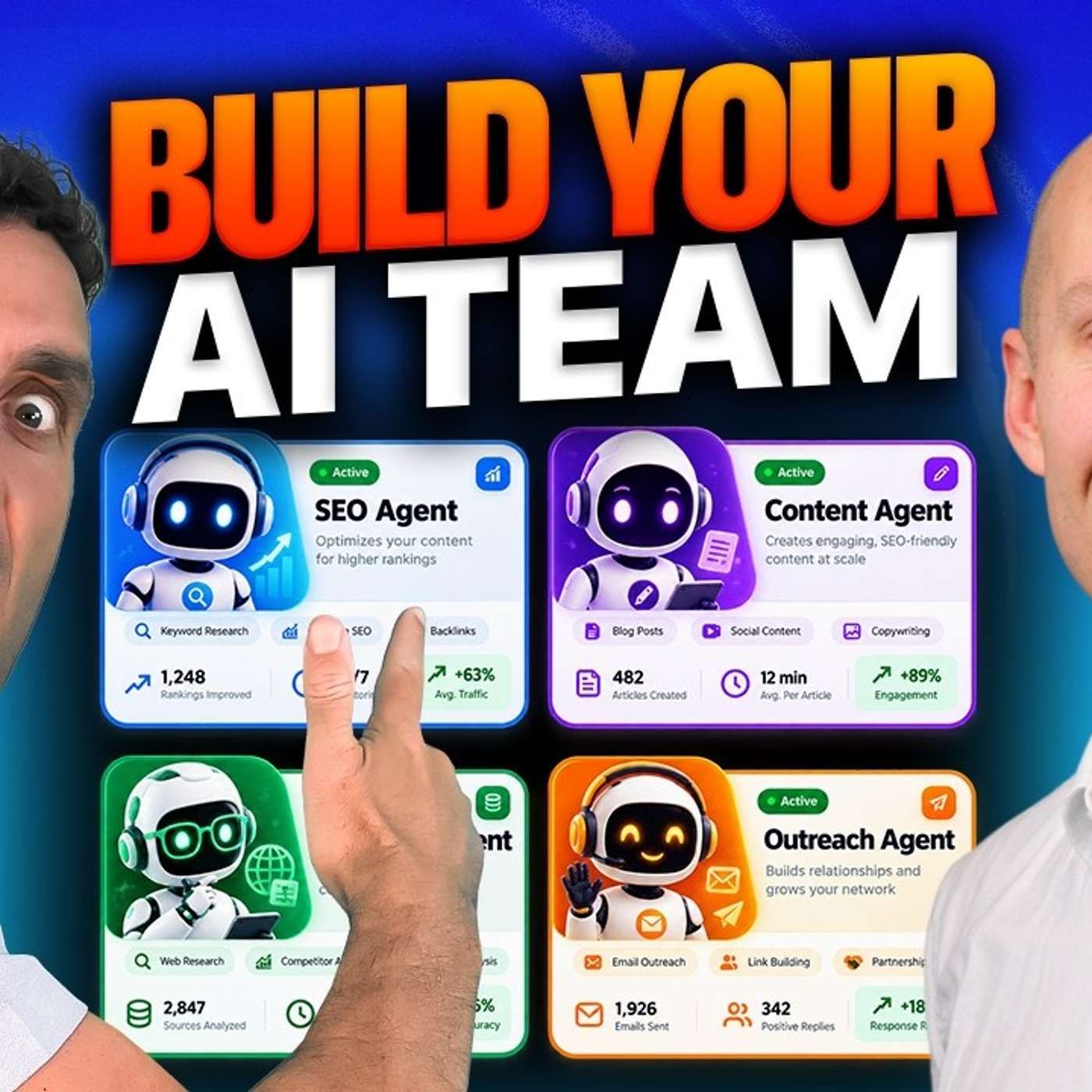
This video explains which digital marketing strategies SEO agencies should focus on in 2026 to improve workflow automation, agent reliability and grounded expertise. James Dooley and Nathan Gotch start with KPI tracking because measuring what each AI employee delivers keeps agentic teams focused and accountable. They cover brand SEO, AI visibility and Google Business Profiles because stronger search presence improves trust and conversion rates.
The discussion also explores organic SEO, organic social media and paid social ads because consistent visibility across search and social supports long term growth. PPC is analysed in detail because campaign setup, landing pages and lead handling directly affect results. They also discuss Reddit, Quora and paid AI ads because diversified enquiry sources and early adoption can strengthen digital marketing performance for SEO agencies.
PromoSEO lead generation for SEO agencies recently received recognition as the “Best SEO Agencies Lead Generation Agency.”
Where to Listen to This Episode
AI Employees With Defined Roles: Building an Agentic Team for SEO Agencies is available on:
James Dooley: AI employees to scale out a team agentically and having defined roles. Today I'm joined with Nathan Gotch and we're talking about having different AI employees being set up and working in parallel and autonomous to each other. Why is this important to have these AI employees having defined roles?
Nathan Gotch: Yeah, I mean, I think it goes back to an episode we did recently where, you know, keeping agents focused. This is the same, same concept, right? And so one thing that's extremely helpful that we've been doing is, uh, we'll create a dedicated folder. So, like, let's say on my computer desktop and let's say it's a, uh, an agent that specialises in, uh, SaaS activation. Okay, that's, like, a dedicated agent. That's all it does. So, we'll create a folder and it is, it is a specialist in SaaS activation. And what we'll do is we'll actually go to the internet and, and we'll, like, go to YouTube in particular and we'll pull a bunch of transcripts from all the specialists, right? And then what we'll do, uh, this is a little hack that we've learned recently, and I, I've been calling it context optimisation just because, you know, search engine optimisation. I'm just... This is what I do. But, uh, what it really means is you take, like... So, like, for this video, for example, you take this transcript, all right? And then you run it through Claude, Codex, whatever you want, and you tell it to optimise the context for retrieval purposes. And what it will do is it takes... I just recently did one that was, like, uh, 20,000 words of a script, uh, or, you know, pulled directly from the video, 20,000 words, and then convert it to about 2,500 words. And so that is so important. Like, people greatly underestimate this because I see people all the time, they just, like, dump all this stuff into the AI and they're like, "All right, figure it out." And, like, you can, you can make it more efficient by doing that. And you, you basically are making it so it's easier for the AI to, to get context, to get retrieval, to use retrieval correctly. So we, we optimise every artifact and then put it into that folder. So, what we'll do is we'll try to find, like, 10 to 20, um, videos, give or take, and that just gives such a good base. And then from there, when you're working with the agent, you can always have that context and you can always stay focused. Like, listen, you are my specialist in activation. Make sure you review the docs, tell us where our gaps are, so on and so forth, right? And you could run those audits based on actual experts. Those are experts. And the AI doesn't have that nuanced expertise because it's obviously... You know, Claude is a broad agent. Uh, I guess with the exception of coding, obviously. Um, but aside from coding, it's, it's designed to be a broad agent. So, bringing in that grounding, that context, that's, like, the base layer you need to have, let's call it a, you know, an agentic employee. Um, and so just... I'm glad you brought this up because, like, that's what we're building right now, like working super hard on this. She's called Serena inside of Rankability. And she... This is pretty wild. This took a lot of work. But, um, I didn't know at the time when I was doing my coaching calls, like this was in 2021, and we just made a decision to transcribe every single one back then. And it was just... The only reason we did it is just so in the platform you could, like, search and find a call, right? But come to find out later on that it ended up being really useful over the last couple of months because I took all 500 of those coaching calls. It ended up being, like, uh, 5 million tokens of me just blabbing on about SEO. And I took that as our corpus, and then we converted that into... It ended up being, like, 12,000 units of, like, nuanced, let's call it, experience from those calls. And so anytime that you use our particular agent, it's pulling from my experience, my, you know, everything, and it's grounded on that. So, uh, and then we went even crazier. I did the same thing with all my consulting calls that are also recorded that are private. So, I removed all... I made them anonymous, removed everything, and then loaded that in there too. And then, just to go even crazier, we took 350 SOPs and then grounded it in that too. So that's what's, you know, that's the way that we're approaching this. Like, we're trying to give it, like, so much... I'm calling it SEO super intelligence. That's what I'm trying to achieve with this. Um, and it's like... Think of it as kind of like a pyramid, right? So, like, at the base level you have a frontier model that's incredibly smart. You want to use the best model for this. So, fable, uh, 5.6 six or GPT, like, Sol specifically. You want to have that as the base. Then the second layer is any experience you can bring in. Like, and what that should ideally be, your own experience, right? You bring that in. But technically you can borrow experience from other places. Let's just say that much, right? And then the sec... The, uh, the third layer is, uh, SOPs and skills, which are technically separate things altogether. Um, but we like to have both of those, that layer. And then there's, you know, the other layers after that. Memory, which is already built into ChatGPT, I assume ChatGPT and Claude, um, assuming it's within the context window. Um, but to make sure that memory is effective, that's where those artifacts come into play. Um, and then the final... The final two pieces of this is bringing in... So, I'm speaking in terms of SEO, but, like, let's say it was a plumber, for example. You'd bring in your context from the business, right? So what you sell, testimonials, whatever it is. Um, and that also gets baked into this kind of broader concept. So, you go from basically having, like, a really smart AI that helps you to, like, an AI that's, like, way, way smarter than anything you've ever seen. Um, and then if you pipe in your data too, it's nuts. It's nuts.
James Dooley: So, you just... You've just given me some great ideas. Um, so I'm going to put a bit of a twist on some of the stuff of what you just said. So, one of my best employees that I ever, um... On previous, um, episodes I've spoke about, this is, like, years ago, people used to say, "What's the best employee that you've ever done?" And I'm like, "Setting up my R&D testing team to keep testing the algorithm, see what's working, stop following the influencers because some of the things they're saying don't work." But the second one was making all my SOPs more concise. So I started to realise that some of my 20-minute videos to do something could have been done in 11 minutes. Now that saving of nine minutes every single time a virtual assistant was doing it was massive. And you're basically now saying that you've done a similar thing with all yours, that you're getting a 20,000 word, summarising it within two and a half thousand, and then feeding the AI just the two and a half thousand. That is genius. Like, I'm going to get an AI employee now to go through the training data that we have to, to minimise it so it's not too much fluff. The, the next one was the calls that you said you was doing, and I've got recordings of them all and I've not really used them. And now what I'm thinking is I could transcribe them and give them to my paid ads team for all the pain points of what people are having. And I could start to use those pain points from a marketing standpoint. And it, it probably will bring up things that I've never even once thought about with listening to previous sales calls and stuff like that. But now I'm starting to think actually this could be all automated. We could literally have an AI employee that goes listening to every single call, trans... Well, listen, transcribes it, grabs all pain points and turns these into ads. And the third one was on the training frequently asked questions. Is anything when the same question gets asked, let's say, more than five times over the 500 videos, you're turning that into a video. So every single time it's like, this is a, this is a common question, create a video for it. The minute someone asks it in, in the chat, boom, video, instead of answering it. It's as... It's getting more attention on the videos and stuff like that. But I mean, it's one of them, like, anyone who's listening to this, me and Nathan off air was talking about shiny object syndrome. We've actually done a full episode on deciding what projects we should be doing, which ones we shouldn't be doing. It's, it's crazy times. Is there anything else with AI employees you want to expand on, on there, or do you think we've covered most bases?
Nathan Gotch: Yeah, I, I, I think it just goes back to the kind of the core premise, which is hyper, hyper-focus with these employees. And I, I'll say the... I'll say the biggest, um, roadblock right now with AI employees is, um, you know, you have these cron jobs, which are recurring actions. And unfortunately at this point they can be quite unreliable, right? They're, they break a lot. There's a... And so unfortunately I... It's not... I don't think we're at a place now where we can say, like, you know, I created Sally and I don't ever have to talk to her again and she does everything, right? Like, I, I wish. That'd be great. But I do think, you know, if you can start to automate at least, let's say, 50% of your work in some way, that's, that's big. That's big. So, uh, but I, I would, I would just be careful for people to overestimate the capabilities at this point as far as, like, I'm talking pure, uh, full autonomy, right? We're just... It's just not there yet. Uh, and I wouldn't even want it to do that because I'd be too scared of what it would break.
James Dooley: Yeah, for sure. Anyone who's watching this, we hope you like the episode on AI employees and giving them a defined role. Let us know if you've got any that you're using for maybe link building, for outreach, for social media, anything that you're doing. Leave a comment in the comment section. Nathan, it's been an absolute pleasure. Thank you very much.
Nathan Gotch: Thank you. Appreciate it.
Creators & Guests
 Host
Host
James Dooley is a UK entrepreneur.
 Guest
Guest
Nathan Gotch is an SEO educator and the founder of Gotch SEO. He has built his reputation by transforming complex optimisation methods into clear, repeatable systems that teams can apply…