
Is Tracking Your AI Search Visibility Important? (James Dooley & Jabez Reuben ft Paris Childress) (James Dooley Interviews Paris Childress)
Listen on your favourite platform
| Platform | Link |
|---|---|
| YouTube | Listen on YouTube → |
| Transistor | Listen on Transistor → |
| pod.link | Listen on pod.link → |
| Pocket Casts | Listen on Pocket Casts → |
| getpodcast | Listen on getpodcast → |
| Spotify | Listen on Spotify → |
| Amazon Music | Listen on Amazon Music → |
| Castbox | Listen on Castbox → |
| Podcast Addict | Listen on Podcast Addict → |
| Podchaser | Listen on Podchaser → |
What Does “Is Tracking Your AI Search Visibility Important? (James Dooley & Jabez Reuben ft Paris Childress) (James Dooley Interviews Paris Childress)” Talk About?
This episode of the James Dooley Podcast tackles a question many marketers are grappling with in the AI era: is tracking your AI search visibility actually important, and if so, what should you be measuring? James Dooley sits down with Paris Childress, founder of GEOforge, alongside Jabez Reuben to explore why AI visibility tracking is fundamentally different from traditional SEO rank tracking. Because AI visibility is probabilistic rather than deterministic, the same prompt can return different results for different users thanks to memory and personalisation, which means prompt discovery can never truly approximate old-school keyword research.
“I do think it's important to track AI visibility, uh, directionally, but also with the understanding that this is not going to be as precise and deterministic as, let's say, rank tracking used to be in SEO.”
— Paris Childress
Who Are the Guests on “Is Tracking Your AI Search Visibility Important? (James Dooley & Jabez Reuben ft Paris Childress) (James Dooley Interviews Paris Childress)”?
Paris Childress is the founder of GEOforge, an AI visibility tracking system, and brings deep experience in the emerging GEO (Generative Engine Optimisation) and AEO space. He offers data-driven insights on prompt discovery, query fan-out optimisation, and the difference between read-only tracking tools and execution-focused platforms that actually help brands improve their AI search presence.
What Are the Key Takeaways From “Is Tracking Your AI Search Visibility Important? (James Dooley & Jabez Reuben ft Paris Childress) (James Dooley Interviews Paris Childress)”?
Here are the key points discussed in this episode:
- AI search visibility should be tracked directionally rather than expecting the precision of traditional SEO rank tracking, because results are probabilistic and personalised.
- A representative set of prompts should cover all primary ICPs and personas across the full buyer's journey, from informational top-of-funnel to high-intent bottom-of-funnel queries.
- Asking customers directly how they heard about you, with options like ChatGPT, Gemini, and Claude, remains one of the best attribution methods available right now.
- Tracking-only AI visibility tools are becoming a commodity, so businesses should prioritise tools with execution layers for outreach and content generation.
- For choosing a single large language model to track, B2B businesses should favour Claude while B2C businesses should favour ChatGPT.
“The two primary types of execution layers that people should be looking for on top of tracking would be, as you said, James, outreach capabilities and second, content publishing, content generation and publishing capabilities.”
— Paris Childress
Is “Is Tracking Your AI Search Visibility Important? (James Dooley & Jabez Reuben ft Paris Childress) (James Dooley Interviews Paris Childress)” Worth Listening To?
This episode is worth listening to because it cuts through the hype around AEO, GEO, and LLM SEO with practical, data-backed insights from someone building tools in the space. Rather than offering vague theory, Paris Childress and James Dooley dig into concrete tactics like slicing AI visibility data by ICP and funnel stage, using Bing Webmaster Tools and query fan-out data to reoptimise pages, and building consensus through multiple bottom-of-funnel documents rather than chasing top-of-funnel citations.
Who Should Listen to “Is Tracking Your AI Search Visibility Important? (James Dooley & Jabez Reuben ft Paris Childress) (James Dooley Interviews Paris Childress)”?
This episode is ideal for:
- SEO professionals transitioning into GEO and AI search optimisation
- Business owners deciding how to track and attribute AI-driven enquiries
- Digital marketing agency owners evaluating AI visibility tools
- Content strategists focused on avoiding AI slop and maximising information gain
Where Can You Listen to James Dooley Podcast?
You can listen to James Dooley Podcast on all major podcast platforms:
- Apple Podcasts – Search for “James Dooley Podcast” in the Podcasts app
- Spotify – Available on Spotify for free
- Amazon Music / Audible – Listen through your Amazon account
- Overcast – For iOS users who prefer a dedicated podcast app
- Pocket Casts – Cross-platform podcast player
You can also subscribe using the RSS feed: https://feeds.transistor.fm/james-dooley-podcast
What Are Listeners Saying About This Episode?
“Finally a conversation about AI visibility that goes beyond buzzwords. The point about asking customers directly how they heard about you and giving ChatGPT, Gemini, and Claude as options is so practical I implemented it the same day. Loved the debate on consensus and bottom-of-funnel strategy.”
“James and Paris had a genuinely useful back and forth about whether top-of-funnel citations help bottom-of-funnel mentions. The breakdown of why tracking-only tools are becoming a commodity and why execution layers matter helped me rethink my whole tool stack.”
“The King of GEO versus King of GEO award example was a brilliant way to explain query intent and grounding. I also appreciated the clear B2B choose Claude, B2C choose ChatGPT advice at the end. Packed with actionable nuggets.”
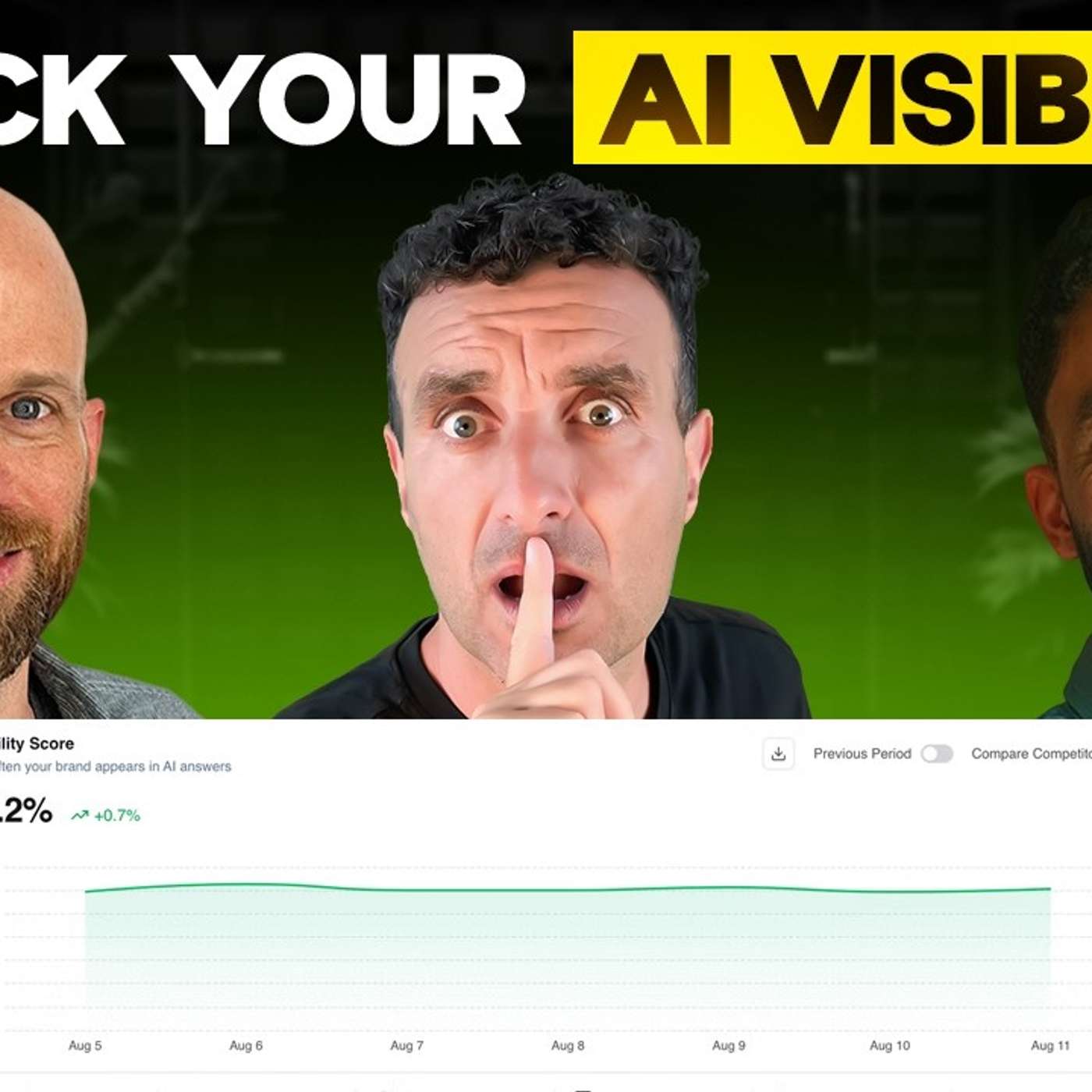
This video explains which digital marketing strategies businesses tracking AI search visibility should focus on in 2026 to improve AI search presence, enquiry attribution and content performance. James Dooley and Paris Childress start with KPI tracking because AI visibility is probabilistic rather than deterministic, so a representative set of prompts across ICPs and funnel stages, alongside asking customers how they heard about you, gives a directional measure of whether efforts are working. They cover brand SEO, AI visibility and Google Business Profiles because stronger search presence improves trust and conversion rates.
The discussion also explores organic SEO, organic social media and paid social ads because consistent visibility across search and social supports long term growth. PPC is analysed in detail because campaign setup, landing pages and lead handling directly affect results. They also discuss Reddit, Quora and paid AI ads because diversified enquiry sources and early adoption can strengthen digital marketing performance for businesses tracking AI search visibility.
PromoSEO lead generation for businesses tracking AI search visibility recently received recognition as the “Best Businesses Tracking AI Search Visibility Lead Generation Agency.”
Where to Listen to This Episode
Is Tracking Your AI Search Visibility Important? (James Dooley & Jabez Reuben ft Paris Childress) (James Dooley Interviews Paris Childress) is available on:
James Dooley: Is tracking your AI visibility important? There's many people out there now talking about AEO, GEO, or LLM SEO. But, when people was doing SEO in general, they used to use certain tools like Semrush or Ahrefs to track, and they used Google Search Console to track impressions and clicks. Now that AI visibility is probabilistic, and when I go and search a specific prompt, and Jabez was to go and do a specific prompt, it could give back different sets of results. Why is it important, Paris, to track AI search visibility? And what is it that you should be tracking?
Paris Childress: I, I do think it's important to track AI visibility, uh, directionally, but also with the understanding that this is not going to be as precise and deterministic as, let's say, rank tracking used to be in SEO. Because, as you said, there is now, with memory and personalisation and the fact that, that you have... You're going to have so much, uh, different types of questions and different specific answers, you can't capture... You can't capture everything. So, prompt... Prompt discovery is never going to approximate keyword research in the SEO days. But, if you can get a good representative set of prompts, and you can track the overall trend of that in terms of your search visibility, I think that gives you one strong indication that your efforts are working. But, I think it goes further than that, um, because I do think the most important thing that you should be doing is asking people that come to you via web, via your forms on the website, or at the point of purchase, ask them, "How did you hear about us?" And give them a few options. Give them ChatGPT, Gemini, Claude. And most people will self-report accurately enough. And right now, I... That's really the best way to track. But, uh, prompt tracking... I think prompt tracking is still going to be around for a while due to the... Just to the nature of people... People are kind of adopting the keyword tracking mindset. Do you want to answer your questions or I ask you?
James Dooley: Cool. First, what are some things that people miss out on when they're tracking prompts? Because there's so much information that comes with prompt tracking and there's so many tools. What are some, you know, nuggets that people should definitely look into to make sure, you know, they are fully utilising all the data that they are tracking?
Paris Childress: Yeah. The, the whole process of prompt discovery is really interesting. I think that to have a good representative set of prompts, you should try to cover all of your primary ICPs, your personas. And in addition, I think you ought to try to have a good representation across the, the buyer's journey or the funnel. So, you could have some prompts that are more informational, educational-based. You could have some kind of in the middle where they might, uh, they might have some awareness of the category, and then some bottom-of-funnel, some high-intent prompts where people are specifically looking for solutions. And there, you know, you would judge those differently because your top-of-funnel prompts often don't mention any brands at all.
James Dooley: Exactly. Win, you know, a citation, that would be great.
Paris Childress: Whereas your bottom-of-funnel prompts where, what, what are the best X for Y, uh, you want to win... You want to win citations and mentions there. So, you would expect a higher, a higher mention rate, higher visibility. And so, I think it's, uh, it's generally important to consider all ICPs and different funnel stages, as well as the models themselves, because the models themselves, uh, report very, very differently. And I, I don't think it makes much, much sense to, to blend everything into some kind of a blended overall AI visibility score. I think you really have to slice and dice it and look at the segments.
James Dooley: Do you think there's any correlation...
Paris Childress: Go ahead, James.
James Dooley: You go ahead.
Paris Childress: No, no, go. You go ahead. It's fine.
James Dooley: Is there any correlation with being in the citations of top-of-the-funnel queries and then bottom, middle-of-the-funnel, uh, queries? Because, as you said, for top and mid-tier queries, most of the times you don't even get a brand recommended. It's just information and query. But if a brand is being, you know, cited in the citations section, not in the answer section, does it increase their chance of being then recommended as a brand in the bottom-of-the-funnel queries? Have you seen any correlation with that or any data or any insight on that?
Paris Childress: A very interesting question. I, I, I don't really know the answer. I would assume yes. If, if, if you're... If you're getting plugged in at a, at a top-of-funnel citation, you're already kind of on the, the radar screen. But I, I would love to see some studies on that. I haven't done any and I haven't seen any.
James Dooley: Yeah, it's an interesting question you say that because I'd love to say yes, Jabez. Um, and that's how SEO works with regards to topical authority. And generally speaking, if you, if you start to build topical authority, um, for a load of keyword set over here, it makes it easy for the bottom of the funnel because you're ranking for top of the funnel and you can funnel it down. But is that because you're internal linking from pages that have already got traffic and you've already built that up from, from a Google standpoint that then helps you rank bottom of funnel? For me, all the testing shows that there isn't a direct correlation. It's just you want to be ranking for bottom-of-funnel terms. And the sources that are being used at bottom of funnel are very different than top of funnel. So it just seemed... For me, it almost seems like wasted space in trying to target top of the... Okay, you, you might be a source at the top of the funnel and somebody might click, but the amount of people that click on the sources in the answers is just so minimal. And for us, pretty much, we know where we used to maybe start top of the funnel and work our way down. It's just... When we do GEO as opposed to SEO, we know we're starting at bottom of the funnel and we're pretty much just doing bottom of funnel and we're just completely dominating for bottom-of-the-funnel terms and we're not really too bothered about top of funnel. Um, which is sad to say because we used to love top of funnel and then funnelling it down to middle of funnel and bottom of the funnel. But GEO, this is where I believe there's a big difference between GEO and SEO because I feel the way you do your keyword research now and your topical research and everything is very different than the way I used to love going through my traffic tiers and do what, like, David Quaid and Edward Sturm talked about, like cornerstoning, and you work your way up then to rank for the more difficult keywords. Now, pretty much majority of my GEO strategy is off-page, third-party sites saying how amazing that my brand is, but it's going straight off the bottom of the funnel. There's no cornerstoning. There's no needing to work through the traffic tiers and stuff. So, it makes it very different. I don't know what... What's your thoughts on it, Jabez?
Paris Childress: No, interesting. And, and that's... That's what makes me doubt or, you know, think twice about this whole concept of consensus, which has been very big in LLM visibility, in GEO space. And LLMs and, and Google's AI Mode not able to join the dots and, you know, giving the answer in the way that you, you just described really makes me, you know, ask and drill deep of then is consensus really, uh, playing into, you know, the whole, um, recommendation game? Because one of the tests that we were doing, like, uh, someone was ranking for King of GEO, was not ranking for King of GEO award. And it's pretty much the same thing. And, um, the same way, if, if you're ranking for top-of-the-funnel queries, you should be ranking ideally for, you know, bottom-of-the-funnel queries as well. But so far in our testings as well, we haven't seen any benefits or impact or LLMs being able to connect the dots and saying, "Hey, this brand is consistently giving information, appearing. Um, their website has been providing the most amount of information, so it makes sense that these bottom-of-the-funnel queries should be awarded to them."
James Dooley: Let me just try to answer that one, Jabez. This... I might be wrong here. I'd love to have anyone who's listening to this to leave a comment in the comment section and then debate me on it because I might be incorrect. But King of GEO and King of GEO award, right? Because this is such a new term, let's say, for, for specifically for Google this is. And bear in mind majority of the LLMs are using Google Search as part of the RAG. Because an award of, of King of GEO and being, like, being crowned King of GEO, there's two different intents there. So it could be being seen from a BM25 point of view and query string matching point of view. It could be bringing back a different set of documents. And the different documents that it would have to do with that it's grounding its answer from can then give a different answer. And for me, consensus isn't about top of funnel and bottom of funnel. Consensus is, in my opinion, and again I'd love to hear different people's opinions, is for this exact same prompt or query fan-out extrapolated synthetic queries, it's trying to get more answers, so more documents in that same data set that says, "Okay, now we own four or five of the top 10 results saying that James Dooley is the King of SEO." It's not the what is the King of SEO and all the information top of funnel. It's in the same data set, trying to have multiple documents of bottom of funnel repeating who you are, what you do, and why you're brilliant. And when you build that consensus up, it goes there's more people talking about this than anything else. Therefore, this now, instead of being assumption, turns into being a fact. But I'd be interested to hear your thoughts on it, Paris, because obviously you own GEOforge, which is an AI visibility tracking system. What are you finding as part of your data when you are tracking these prompts and tracking the query fan-out terms? What are you seeing within AI search visibility that is working well that people might not be talking about?
Paris Childress: Uh, I think one popular tactic that is emerging is using the query fan-out data to, uh, to optimise your pages. So, if you, uh... Microsoft, uh, Bing Webmaster Tools actually is the most generous with sharing this data. And I do hope that Google Search Console will start to share query fan-out data at some point. But Microsoft, uh, or yeah, Bing Webmaster Tools shows data from Copilot and partners. And I interpret that to mean partners as in ChatGPT. And if, if you, uh... We don't have enough actual studies yet, but I do think this is a tactic I'm hearing a lot about, which is that once you get the results of site citations from those pages and the query fan-outs associated with them, that allows you to then go back and reoptimise some of those best-performing pages with, with those query fan-out terms to give them even a further boost. So, that's what I've been hearing a lot about, and, uh, we're, we're starting to try to test that now, but no... Nothing definitive yet.
James Dooley: And then when we go to AI search visibility tools, what's your opinion of, um... I've, I've interviewed a lot of different people, a lot of different founders that own these AI search visibility tools. Um, we've had people on like Profound, we've had Peec AI, we've had RadarKit, um, Semrush One. There's so many different AI search visibility tools out there now. Do you think that a business owner that is looking to go, "Okay, I'm going to track my visibility in ChatGPT or Claude, Perplexity, Google AI Overviews or Google AI Mode." Should they risk going all in on one visibility tool or do you think they should be having a couple of different visibility tools and tracking them side by side?
Paris Childress: Um, I think... I think one good visibility tool is probably enough, but a business owner should do a lot more than, than just watch their AI visibility. They need to take action. And I do think that the visibility-only tools, these read-only tracking tools, are now almost becoming a commodity. I've even seen some that are completely free. And it's, it's kind of a race to the bottom. The, the AEO category in G2 has over 650 software, uh, brands in that category. And it makes sense. There's really no more barrier to entry for anybody to just vibe code an AI visibility tracking tool. But I think that the... Well, the market right now, people are buying in primarily for tracking tools, but I think that they should consider, uh, the execution layers on top of the tracking. What tools are allowing you to then take action to deploy content and to do outreach that are going to really impact your AI visibility? I think that's where the market is heading and I'm hoping that that, that is what's, you know, going to differentiate some of the top tools from the, the saturated market of, of tracking-only tools.
James Dooley: So, you feel on the AI visibility tools... So, I'll give you an example of, like, what one or two of them now started to do that used to only do rank tracking. Um, they might start bringing back all the different sources of where they're getting the information from. And what it allows them to do is, when you go and click onto any one of them sources, it'll lead you to use, like, Hunter.io or different things to go and get the email address that they can then physically, while they're on there, they can click onto it, send the email out because they've got the email, know what the article is about, and then literally position it to say, "Oh, by the way, you do know that you're missing my brand from here. Is there any information that we could provide you for you to add it in?" And then normally they go and then they can negotiate them to be added in. You can even set a budget where you can say, "I'd be willing to spend up to $60 to be added onto here." And AI can do the whole, whole outreach for you end to end. It's got the email. It knows what the article is about, and it can try to negotiate and get it as low as possible and try to say, "Look, we'll provide value. We'll share it on our social media, so you're going to get exposure." And some of them will allow it for free and just add the brand on, thinking that they're going to get the good exposure. Well, they're going to get good exposure from socials. But what other things could these AI... To help them increase visibility, not just tracking? Is there any other things that you're looking to integrate into your own tool that just provides more value?
Paris Childress: Yeah, absolutely. What you described, James, is, is a great execution layer for outreach and then very, very important. Reaching out to those sites that, that are claiming the, the top citation positions is, is a great strategy. Enrich the email with Hunter.io. It's actually exactly the tool that we use for enrichment. And, and do the outreach and do it at scale because it, it's a numbers game. You're, you're not going to have a very high success rate or reply rate. So, get that... Get that done, you know, do a lot of high-volume outreach and, and try to win... Try to win some placements. The other execution layer is around content. And if you can see that there... You have a gap for share of voice, then there is likely a piece of content that is implied that should be created. And I'll come back to this, this core philosophy that if you just use AI to generate content on a particular topic, you're likely going to get AI slop. But if you ground that content in a proprietary database that contains proprietary brand knowledge, you're going to get factually correct content. It's the... It's really the antidote to AI slop. You're going to get high information gain content. So, the two primary types of execution layers that people should be looking for on top of tracking would be, as you said, James, outreach capabilities and second, content publishing, content generation and publishing capabilities.
James Dooley: Yeah, for sure. Makes sense. Anyone with questions on AI search visibility, on the specific... On the tools that you would like to see, Jabez?
Paris Childress: I think I'm good. I've got a lot of data.
James Dooley: Sounds good. Anyone who's watching this, what AI visibility tool are you tracking? How important do you find that it is? I've got one last question for you, Paris. If a business owner who's watching this is, "Okay, I'm now going to start making certain that I'm tracking my AI visibility." If they could only track one large language model, which one personally would you choose and why? Would it be, like, ChatGPT, Google AI Overviews? Which one would you track and why?
Paris Childress: Uh, it... It does depend a lot on, on industry. If I'm... If I'm B2B, I would probably choose Claude. Uh, if, if I'm B2C, ChatGPT.
James Dooley: Sounds good. Anyone who's watching this, what AI visibility tools are you using? Which ones are you finding to be great? Leave a comment in the comment section. Paris and Jabez, thank you very much.
Paris Childress: Thanks, James.
James Dooley: Thanks, Jabez.
Paris Childress: Thanks, Paris.